By the late nineteenth century, travel itself was transforming. What had once been an activity reserved for diplomats, pilgrims, scholars with sponsors, and the independently wealthy was becoming increasingly systematized. Advances in imperial infrastructure reshaped movement into a managed system. Tourism, in its modern sense, was emerging, not simply as leisure, but as an industry that organized repeatable experiences and mitigated risks.
Gertrude Bell came of age within this revolutionary transition. Her travels unfolded at a moment when older forms of individual, skill-based travel coexisted uneasily with mass tourism. Whether climbing Alpine peaks or traversing the biblical landscapes of the eastern Mediterranean, Bell consistently positioned herself against travel as mere consumption. Her writing, climbing, and linguistic study reflect an effort to remain an active participant rather than a passive observer—someone shaped by place, rather than merely passing through it.
This section situates Bell within the changing culture of travel, tracing how mountaineering, biblical tourism, and organized transport networks formed the backdrop against which her own movements took on meaning.
Die Bergsteigende Miss
Gertrude was passionate about mountain climbing. Mountains were fast becoming objects of conquest for people of means, who claimed one ascent at a time. Those who couldn’t afford the thrill of the climb also crowded the slopes as far as roads or rail could transport them.
From her early climbs in the Massif des Écrins beginning in 1897 to her final ascent of the Matterhorn in 1904, Gertrude Bell was an enthusiastic and increasingly accomplished mountaineer. She wrote about climbing not as novelty or thrill-seeking, but as a disciplined pursuit of clarity—one that could be achieved above ten thousand feet.
In her Alpine Journal article, “Concerning Mountains: Die Engelhörner,” Bell wrote with particular admiration for the Bernese Oberland, home to many of Switzerland’s most formidable peaks. One summit in the region—Gertrudspitze—was later named in her honor, a rare acknowledgment of her standing within a field still dominated by male climbers.
Following her ascent of the Engelhörner, the German-language Bund Journal referred to Gertrude Bell as “die bergsteigende Miss“—literally, “the mountain-climbing Miss”—a designation that acknowledged her technical competence while still marking her as both foreign and female.[1]
However, Bell increasingly expressed frustration with the crowds of tourists who filled trains and hotels. By the early twentieth century, the kind of travel Gertrude Bell practiced, demanding, time-intensive, and grounded in individual competence, was beginning to give way to something far larger. Advances in transportation, guide services, publishing, and imperial infrastructure transformed travel from an elite undertaking into a reproducible experience. What had once required judgment and intensive preparation increasingly became something that could be purchased, scheduled, and consumed. Adventure was no longer confined to a small class of travelers willing to master terrain and uncertainty; it was becoming an aspiration for the masses, scaled to meet demand.
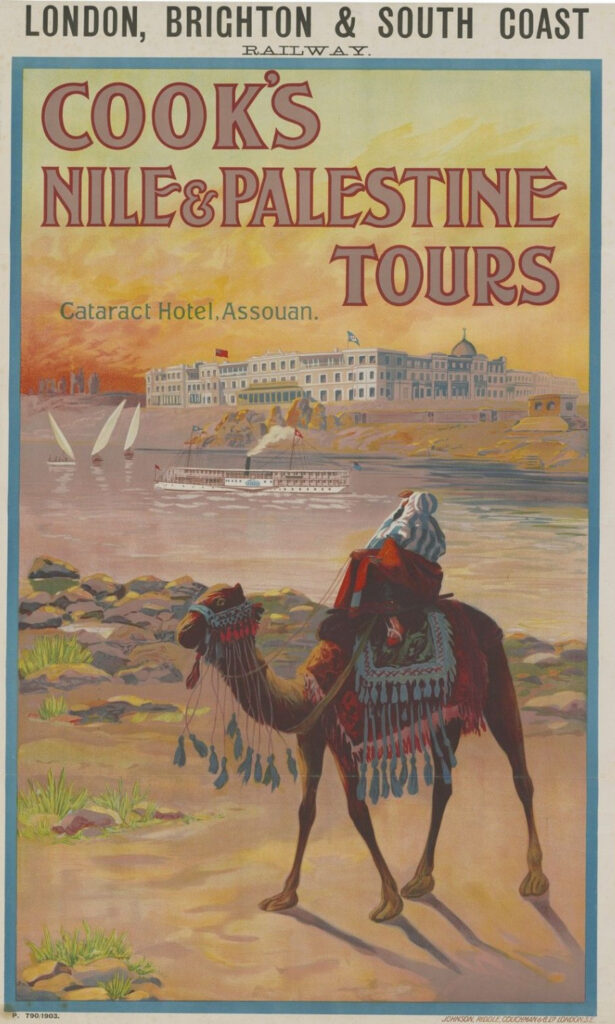
Biblical Tourism: Steamships and Railways
During the Victorian period, international travel entered a new phase as distant regions were drawn into expanding networks of movement, study, and presentation. Sites associated with the biblical world proved especially compelling. Over centuries, Christianity had spread far beyond its places of origin, until the majority of its adherents were born and raised at distances that would once have been insurmountable for all but the most privileged travelers. Biblical places were familiar to Western readers long before they were reachable. For centuries, they existed as named landscapes in scripture rather than destinations one could actually visit.
By the 1860s, the biblical world was no longer distant, but it remained uncertain. Steamships and railways brought unprecedented numbers of European travelers into Palestine. Yet, the landscapes they encountered did not always neatly conform to the image Western society had formulated from scripture, inherited tradition, or existing maps. This dissonance generated a growing demand for authoritative knowledge capable of stabilizing sacred geography through measurement, survey, and classification.
In 1865, financial backers came together to form the Palestine Exploration Fund (PEF) to meet that demand. The organization’s early efforts focused on archaeological expeditions in Jerusalem. By 1872, the PEF had financed C. R. Conder and Horatio Kitchener’s surveys of the region, producing a systematic cartographic and archaeological framework that rendered Palestine legible to Western scholarship, pilgrimage, and travel alike.
Thomas Cook & Sons
In the early nineteenth century, the Holy Land was not a tourist destination in any modern sense. Under Ottoman rule, it remained a peripheral interior region, lacking the infrastructure, security, and accessibility required for large-scale travel. Pilgrimage persisted, but it was sporadic, difficult, and largely confined to the devout and determined.
That reality began to change within a single generation. An English carpenter and Baptist preacher named Thomas Cook discovered, by happenstance, that he had the logistical prowess to organize mass movement while arranging transportation for hundreds to attend a temperance rally. He would soon turn this practical skill into an international enterprise. Cook began by booking group travel at discounted rates within his local region. As the model proved successful, he expanded outward: first across continental Europe, then to the United States, and by the early 1870s into global itineraries that reached as far as Japan.
Yet long before the circuits of international travel took shape, Cook had been drawn to the great river civilizations of the biblical world. In 1869, he escorted his first organized group of travelers to Egypt. He envisioned a future in which middle-class travelers from across Britain and beyond would soon follow, moving through the Nile Valley and onward into Palestine, where sites such as the Jordan River, traditionally associated with the baptism of John the Baptist, would become destinations not only of devotion, but of repeated, organized visits.
This expansion was made possible by a convergence of infrastructure. The completion of the Mount Cenis Tunnel in 1868 allowed travelers to reach Brindisi, on Italy’s southern Adriatic coast, by rail. In 1869, a modern European-style road connecting Jaffa to Jerusalem reduced the final leg of the journey by carriage to a single day. Distance, uncertainty, and dependence were sharply reduced. Jerusalem was no longer approached as a remote interior destination, but as a site directly connected to the Mediterranean transport network—a transformation that quietly redefined pilgrimage and tourism alike.
Cook & Son did not operate alone. While the firm targeted the expanding middle class, the Belgian luxury company Compagnie Internationale des Wagon-Lits et des Grands Express Européens offered elite travelers a parallel experience, complete with sleeping cars, dining services, and tightly controlled routes. Together, these firms converted movement itself into a managed service, segmented by class but standardized in form.
By the 1890s, Thos. Cook & Son’s system was mature. A 1897 guidebook published by the firm advertised a “Tour to the Great Desert and Palestine,” encompassing the Sinai, Petra, Mount Hor, and Palestine itself. Meanwhile, a separate company, Thos. Cook & Son (Egypt) Ltd operated Nile tours from the Delta to the Second Cataract, further subdividing sacred geography into purchasable itineraries.
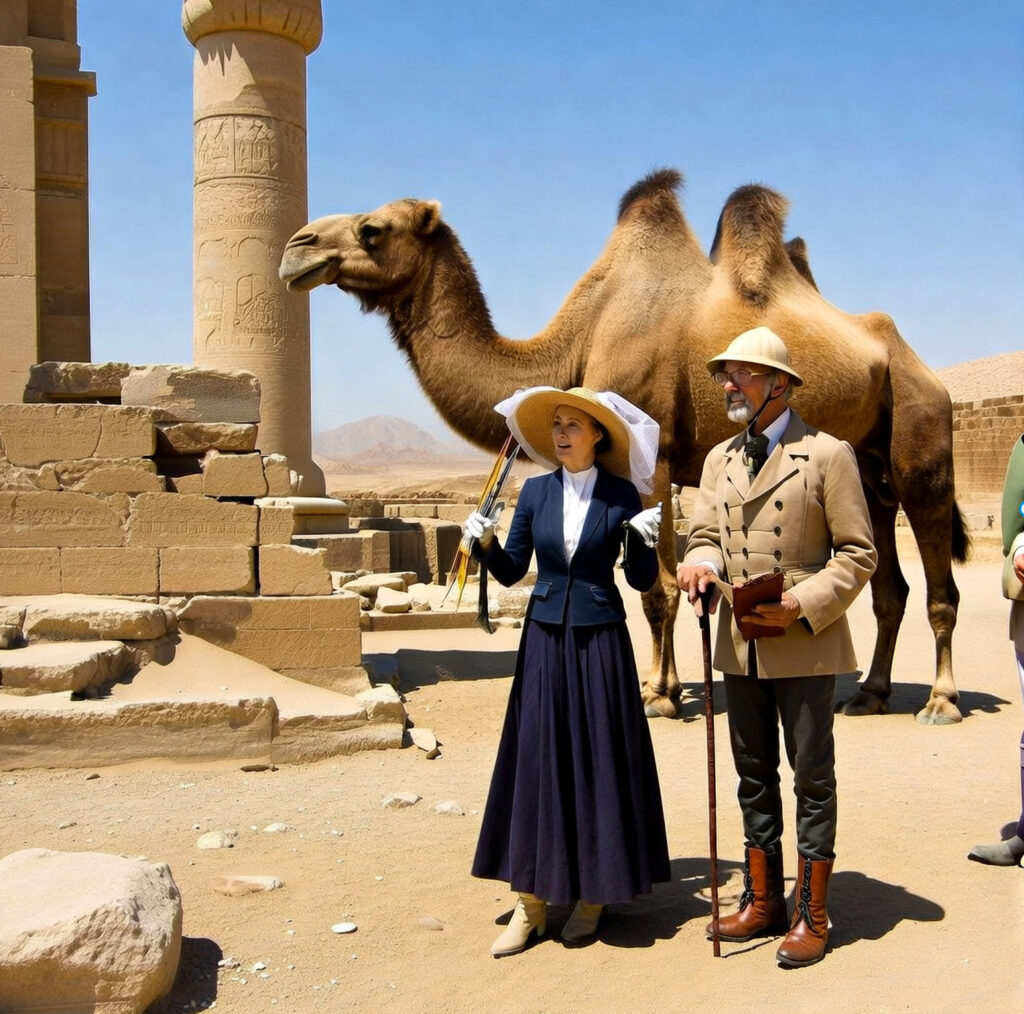
Contemporary observers recognized the shift. In 1869, American author Mark Twain published The Innocents Abroad, a satirical account of a pleasure voyage aboard the Quaker City—an early antecedent of the modern cruise. The itinerary included Tangier, Paris, Milan, Venice, Rome, Athens, Constantinople, Smyrna, Ephesus, Beirut, Palestine, and Cairo. Twain captured the emotional intensity of organized pilgrimage, writing of fellow travelers who, upon reaching the Holy Land, “could scarcely eat, so anxious were they to ‘take shipping’ and sail in very person upon the waters that had borne the vessels of the Apostles.” Elsewhere, sacred landscapes such as the plain of Esdraelon were absorbed into a rolling catalogue of historical reverie, collapsing millennia of conflict into a single consumable vista.
What Thomas Cook ultimately sold was not experience, but predictability. His firm’s power lay in logistics rather than romance: synchronized rail and steamship schedules, standardized hotels, vouchers that replaced cash, and itineraries that absorbed risk on behalf of travelers. In an era when long-distance movement still carried an aura of danger, the Cooks transformed travel itself into a reliable commodity. This operational system aligned seamlessly with empire.
That alignment extended beyond tourism. The same transport networks Cook helped normalize were later used to move troops toward Sudan during the unsuccessful Gordon Relief Expedition. Khartoum fell in 1885, just days before relief forces could arrive. Major-General Charles George Gordon, “Chinese Gordon,” famed for his earlier command of a Qing military force during the Taiping Rebellion, was killed when the city fell.
By the time of Cook’s death in 1899, the company had become indispensable. Originating with the 1896 Olympic Games in Athens, Cook & Son secured exclusive contracts to organize and manage passenger transport for the Games, a role it retained for at least a decade. Travel had become not an adventure, but a system.
A Contemporary Witness to Tourism’s Transformation
“In Alexandria, a certain Thompson, of Sunderland, has inscribed his name in letters six feet high on Pompey’s Pillar. You can read it from a quarter of a mile away. You can’t see the pillar without seeing Thompson’s name and consequently thinking of Thompson. This cretin has thus become part of the monument and has perpetuated himself along with it” [7]
A new phenomenon was descending upon Egypt and Ottoman Palestine. Depending on who the source is, the influx of visitors was framed either as an invasive swarm or as economic fertilization; compared in equal measure to a plague of locusts and to the life-giving flood of the Nile. Tourism, even in its earliest mass form, arrived as a contradiction—both burden and benefit, extraction and investment.
Egyptologist and founding member of the Egypt Exploration Fund, Amelia B. Edwards, described the modern Nile as a place where distinctions formed quickly. Within days, she observed, one learned to tell “a Cook’s tourist” from an independent traveler, and to recognize that most tourists were English or American. The river hosted an assortment of motives: “invalids in search of health; artists in search of subjects; sportsmen keen on crocodiles; statesmen out for a holiday; collectors on the scent of papyri and mummies,” alongside journalists, men of science, and a surplus of travelers drawn simply by curiosity itself. [8]
One category of traveler went unmentioned in Edwards’ respectable taxonomy, yet was no less present. European men also arrived in Egypt and Ottoman Palestine, driven by erotic curiosity, seeking intimate encounters with women they perceived as “exotic,” accessible, or outside the constraints of European social order. Gustave Flaubert’s Egyptian letters make clear that sexual access formed part of the imaginative geography of the East for many male travelers.
A new phase of human travel was now bearing down upon the relics of the ancient world. As with all emerging phenomena, there were few norms and little supervision to guard against human behavior. Tourists encountering graffiti carved into ancient columns, brick walls, and statues readily added their own “autographs,” as Edwards termed them. Not one to mince words about human nature, Flaubert sharply noted the imbecility of travelers who, unable to process the experience before them, embedded themselves in the landscape through defacement.[9]
For Flaubert, the vandalism of antiquity was not an act of appreciation, but of refusal—the refusal to be altered by a place that demanded humility rather than possession.
Learning to Look
“I rode down to Jerusalem alone–the road was full of tourists, caravans of donkeys carrying tents for cook and Bedouin escorts. I made friends as I went along and rode with first one Bedouin and then another, all of them exaggerating the dangers I was about to run with the hope of being taken with me into Moab.” Gertrude Bell enroute to Jordan. [11]
In December 1899, Gertrude Bell arrived in Ottoman Syria, i.e., Palestine. She was comfortably settled at the Jerusalem Hotel near the German consulate. The Bells were family friends with the consul’s wife. Gertrude did join the crowds to visit popular sites with western tourists, but her primary aim for this trip was to become more proficient in Arabic. As she anxiously yearned for news of British fortunes abroad concerning the Boer War, where her brother Maurice was, Gertrude set about exploring the culture and landscape of Jerusalem. She was assigned a teacher named Khalil Dughan, a Christian who told her that his ancestors had arrived in the Holy Land as Western crusaders. Additionally, a local girl, Ferideh Yamseh, frequently accompanied Gertrude, helping her learn the local Arabic dialect.
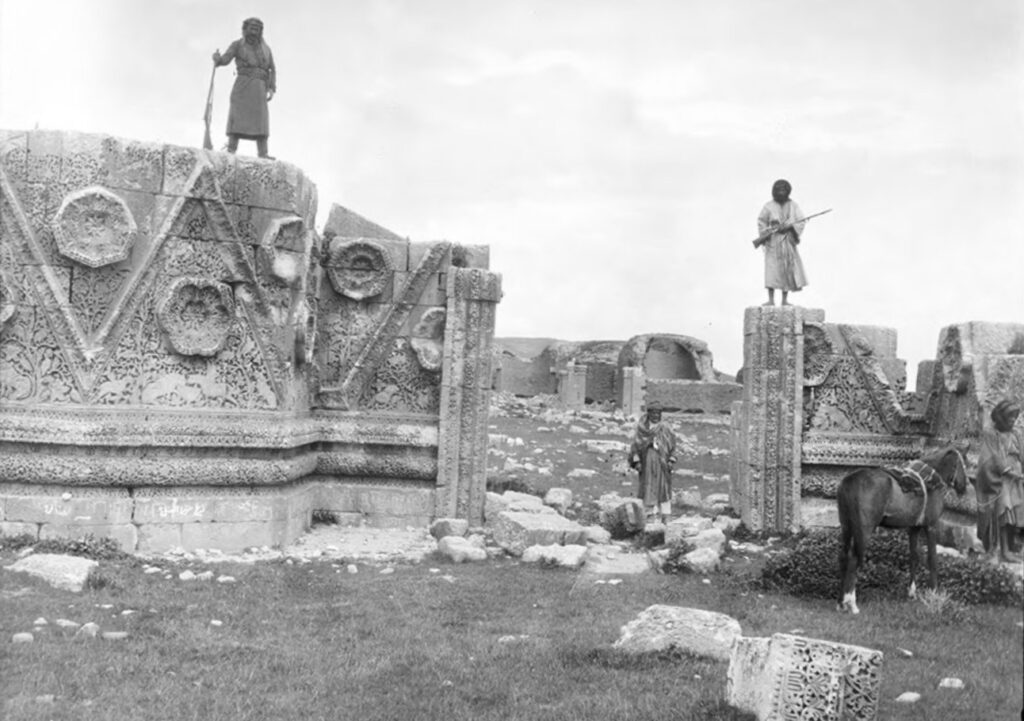
In early 1900, Gertrude set out for Jordan with guides, a cook, a missionary couple called the Hardings, and others. Due to imperial geopolitics, she went under the guise of a visiting German, rather than an English tourist. During this journey, Bell’s penchant for constantly testing boundaries was evident when a fellow westerner told her that she would never receive local permission to enter the ruins of a Crusader fort that was currently used as barracks for Turkish troops. Rather than ask and be refused, she simply went in.[12] The episode illustrates how access within empire often depended less on formal authorization than on confidence, timing, and social position. Upon politely greeting the soldiers inside, she was provided a tour.
“I was also invited by an Arab into his mud and thorn dwelling and eat leben and bread with him while he questioned me about the journey. The hotel is full of German waiters from Cairo – I prefer the company of the Arab.”
Gertrude displayed remarkable ease with everyone she met on the journey. Her ability to connect with people was not accidental; it reflected a habit of attention, an understanding of social networks, and a willingness to meet others on their own terms. Bell appeared drawn to Arab people not as objects of curiosity, but as participants in conversation and exchange, preferring their company to the enclosed social world of westernized infrastructure.
Conclusion
By the turn of the century, travel was becoming predictable. Gertrude Bell moved within that system without fully accepting it, relying on the structures of mass movement while resisting its routines. Her preference for language, conversation, and direct encounter over spectacle reveals a traveler still learning how to look, rather than one already certain of what she would find.

Notes & Citations
[1] Bell, Gertrude. “Concerning Mountains: Die Engelhörner.” The Alpine Journal 41 (1929): 21–34. Accessed January 10, 2026. https://www.alpinejournal.org.uk/Contents/Contents_1929_files/AJ%201929%20Vol%2041%2021-34%20bell%20Engelhorner.pdf.
[2] Mark Twain, The Innocents Abroad; or, The New Pilgrims’ Progress, Project Gutenberg, accessed January 14, 2026, https://www.gutenberg.org/files/3176/3176-h/3176-h.htm#ch46.
[3] Friedrich-Ebert-Stiftung (FES), Tourism in East Jerusalem: Current Situation and Future Prospects(Jerusalem: FES Palestine, 2020), 10, https://palestine.fes.de/fileadmin/user_upload/Publication_1/IPCC/IPCC_2020/Tourism_in_East_Jerusalem_2020s.pdf.
[4] Cook’s Tourists’ Handbook for Egypt, the Nile, and the Desert (London: T. Cook & Son, 1897), https://digitalcollections.rice.edu/documents/detail/cooks-tourists-handbook-for-egypt-the-nile-and-the-desert/284328
[5] Twain, Innocents Abroad.
[6] I used Shutterstock AI to create this image in January 2026.
[7] Alain de Botton, The Art of Travel (New York: Vintage International, 2004), 87.
[8] Amelia B. Edwards, A Thousand Miles up the Nile (London: Longmans, Green, and Co., 1877), accessed January 14, 2026, 1-2. https://archive.org/details/thousandmilesupn00amel/page/n27/mode/2up.
[9] de Botton, The Art of Travel, 88.
[10] Gertrude Bell, Photograph: Mashetta, the gateway (remains of gateway with detailed carving to the palace; men standing on gateway, horses in foreground), 22 March 1900, GB/3/1/1/1/233, Gertrude Bell Archive, Special Collections, Newcastle University, near Amman, Jordan. https://gertrudebell.ncl.ac.uk/p/gb-3-1-1-1-233.
[11] Gertrude Bell, The Letters of Gertrude Bell, vol. 1 (London: Ernest Benn, 1927), Project Gutenberg Australia, https://gutenberg.net.au/ebooks04/0400341h.html.
[12] Gertrude Bell to Sir Hugh Bell, 20 March–8 April 1900, GB/1/1/2/1/5/7, Gertrude Bell Archive, Special Collections, Newcastle University, https://gertrudebell.ncl.ac.uk/l/gb-1-1-2-1-5-7.
For readers who wish to follow ongoing research, subscription is available in the footer.