Captain Bull, son of the Lenape leader Teedyuscung, lived a life shaped by shifting alliances. At times, he fought alongside Anglo-British forces; at others, he struck at their settlements. This dual role, ally and adversary, neighbor and threat, was not unique to Bull but was emblematic of Native leaders navigating the turmoil of empire and war. His trajectory, from childhood in Moravian mission towns to the burning of Big Island to imprisonment by the British, and finally to the founding and contested legacy of Bulltown, captures the uneasy blend of cooperation and resistance that defined the eighteenth-century frontier.
Teedyuscung
Teedyuscung, “King of the Delawares,” the Native leader who famously gave George Croghan a black eye (see Part I), was a larger-than-life figure. He had to be, to navigate the tense world of tribal factionalism while confronting land-hungry provincial governments. Born in what is now New Jersey, he witnessed year after year as more land was stripped away and his people driven further and further west. By the early 1750s, the Lenape were fragmented, wary, and living amid the constant pressure of colonial ambition. Teedyuscung’s rise came out of this fracture.
The title “King of the Delawares” was a invention ofcolonial fiction. Pennsylvania had once applied it to Sassoonan when it suited their needs, and they revived it for Teedyuscung for the same reason: they wanted a single negotiator who could be held responsible for the decisions of many.
In 1755, the year the Lenape went to war with Pennsylvania, a colonial deposition identified Teedyuscung—together with three of his sons, “Amos”, “Jacob”, and an unnamed third—as participants in a raid that killed five settlers, burned buildings and fields, and carried off prisoners.[1] Whether those men were his actual sons or members of his band remains unclear; the record does not care to distinguish. However, after this raid, “the King of the Delawares” emerged not as a war captain but as a voice calling for peace. Within a year, he had shifted from raiding parties to the negotiation tables at Easton, where he pressed Pennsylvania for recognition and restitution for lands taken through corrupt or ambiguous deeds. Peace, to him, was not a surrender but a strategy—one of the few remaining tools for a people caught between colonial governments, Iroquois claims of oversight, and the hard fact of dwindling territory. His life traced that uneasy terrain: neither simply war captain nor simple diplomat, but a leader working within—and against—the forces that defined the eighteenth-century frontier.
Pennsylvania was in crisis. After Braddock’s defeat the previous summer, Lenape and Shawnee war parties swept across the frontier, burning farms, killing settlers, and carrying off captives. The provincial government, long reluctant to engage in military conflict, suddenly found itself pressured to negotiate. In July, the Council in Philadelphia received Teedyuscung, who arrived with a delegation of about thirty Lenape, positioning himself as a spokesman not only for his own people but for a wider Native confederacy. Teedyuscung stood before the Pennsylvania council and declared that the peace belt he carried would bind all ten nations to any agreement. In that council, he styled himself “King of the Ten Nations,” claiming authority not only over the Six Nations (Mohawks, Onondagas, Oneidas, Senecas, Cayugas, and Tuscaroras) but also the Lenape, Shawnee, Mohicans, and Munsees (Munsee are Lenape, though not all Lenape are Munsee).[2]
A few days later, however, Captain New Castle, a western Ohio Valley Lenape leader, appeared at a Philadelphia council session “much in liquor” and accused Teedyuscung of having bewitched the governor, insisting he was cursed to die soon. The governor dismissed it as drunken nonsense, but the charge still entered the official minutes. Teedyuscung could claim to speak for ten nations, but the defiance of his western “kin”—who distrusted the eastern Lenape’s closeness with the Haudenosaunee (Iroquois) and Pennsylvania—exposed the limits of his real authority.
By August, the talks stalled. Teedyuscung departed without concluding a treaty—though not without stocking up on as much rum as he could afford.[3] Colonial clerks recorded the detail with disdain, and later writers often caricatured him as the perpetually drunk “Indian.” But that misses the point. Teedyuscung was a man under relentless pressure: he had known nothing but the loss of homeland since birth, distrusted by his own kin, doubted by the Haudenosaunee, and manipulated by the colony whose frontier wars he was trying to end. Anyone who has ever felt the call of alcohol—or anything that quiets pain and steadies the nerves beyond what reason permits—can understand the impulse. Teedyuscung was not just the “King of the Delawares,” but a man carrying an unbearable weight. Drink did not define him; it surrounded him—used by some colonists as currency, by others as leverage, and by many Native communities as a blunt tool against despair. That he is caricatured for being associated with rum, while Victorian figures who drowned themselves in opium, laudanum, whiskey-soaked excesses are romanticized as tragic geniuses, says more about the prejudice of posterity than than about Teedyuscung himself.
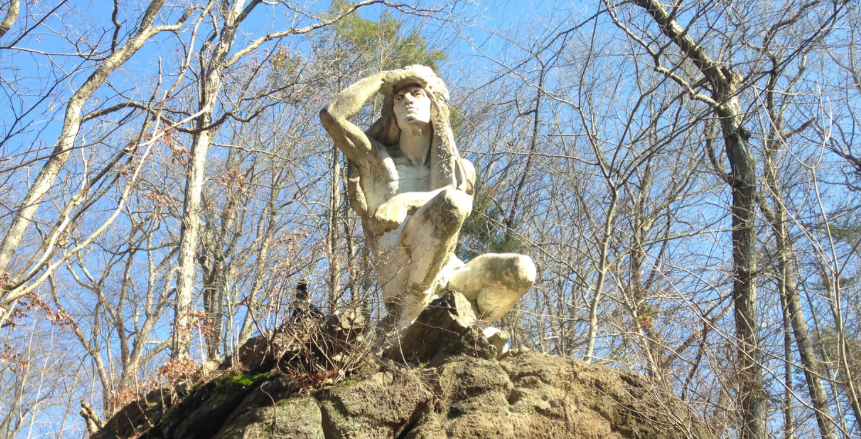
By November 1756, Teedyuscung was at Easton still pressing for peace when reports reached the council that a band of Minisink were gathering near Fort Allen and Trout Creek, a hundred strong, vowing to destroy both the governor’s party and Teedyuscung’s delegation. The warning underscored how fragile peace was in a moment when Native factions themselves were divided over whether survival meant negotiation or continued war. It was this same conference when Teedyuscung accused the Pennsylvania government of defrauding his people of lands in the colonies northeastern land claims. [5] Benjamin Franklin would later take up Teedyuscung’s cause, using his land fraud complaints as a vehicle to attack the Penn faction. Peace, however, was never simply a matter of speeches or petitions. While colonists debated titles and boundaries, Teedyuscung was risking his life in a divided world shaped by promises broken long before he reached Easton.
At the Mission
In his lifetime, Teedyuscung formed a close relationship with the Moravian missionaries. The Moravians were a Protestant sect that emerged in eighteenth-century Germany, tracing their roots to the followers of Jan Hus, the Czech reformer executed for heresy in 1415. Under the leadership of Count Nikolaus Ludwig von Zinzendorf, the movement took on a distinctly missionary character. Zinzendorf believed it was God’s will that the Moravians carry the gospel to all peoples, and under his guidance, they established missions across Europe, the Americas, Africa, and the Caribbean.
In 1746, the Moravians founded a mission town called Gnadenhütten, some thirty miles from their regional nucleus at Bethlehem, Pennsylvania. Teedyuscung’s openness to Christianity may have built on an earlier line of argument he had made in the wake of the Walking Purchase: that, as someone who had embraced the Presbyterian faith, he and his family should not be forced west. Now, with the Moravians, he again leaned on Christian affiliation.[6] Among the Moravians, he and his family found a degree of mutual respect that was denied to them by other colonial Christians.
At Bethlehem and other Pennsylvania mission towns, Moravian missionaries baptized Native converts and their children, routinely giving them biblical names. Teedyuscung was baptized and given the name Gideon, and members of his household—including his son Bull, whose Lenape name may have been Keomilas—also lived at the mission. How fully Teedyuscung embraced Christianity, or whether any of his children adopted the faith in more than a nominal sense, remains unclear.[7] As mentioned earlier in the post, colonial sources list men called Jacob, Amos, and John as his “sons,” but the nature of these ties is uncertain; such kin terms often reflected Moravian practice rather than literal parentage. Teedyuscung himself accepted baptism but never relinquished his Lenape name; he remained “Teedyuscung” in both Native and colonial usage.
The Moravians’ success in converting some Lenape to Christianity sparked a backlash. Native prophets of the Indian Great Awakening urged their people to reject European teachings and return to ancestral ways. For them, Moravian Christianity threatened not only their religion but also their cultural survival, deepening divisions within Lenape communities. In 1754, Teedyuscung led his followers away from Gnadenhütten to settle in the Wyoming Valley, M’cheu-wami.[8] Quaker leaders hoped to use Christianized Natives there as a buffer between settler society and “heathen” tribes.
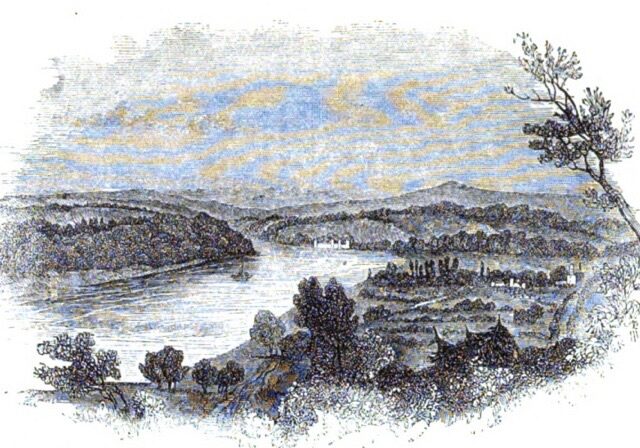
M’cheu-wami: a homeland for the Lenape
In 1754, Teedyuscung led his followers into the Wyoming Valley, a fertile stretch of the Susquehanna. Lenape from the Ohio Valley came east to join him, seeking safety in numbers.
However the valley was also drawing the attention of Connecticut’s Susquehanna Company settlers. The Wyoming would be another instance in the ever continuing pattern of North American colonization. Refuge was never permanent: Anglo authorities displaced Native peoples, offered them new land (always reduced land) elsewhere to contain the crisis, and then seized that land in turn when new settlers pressed forward. It was a cycle—promise, occupation, removal—that did not end in the eighteenth century but shaped American expansion itself. Settlers poured into Wyoming regardless of treaty language, and colonial authorities either could not or would not enforce the promises they had made. Within a year he and his sons joined the frontier war against Pennsylvania, yet he continued to press for a negotiated settlement.
At the Easton Treaty of 1758, Teedyuscung demanded that the Wyoming Valley be formally recognized as a Lenape homeland. His argument was pointed: without a secure place to live, the displaced Lenape would be forced to wander again, and in the process many would be drawn into French alliances. Securing Wyoming, he hoped, would give his people stability, restore some measure of autonomy, and blunt the cycle of displacement that had already broken them apart. To colonial officials, this sounded like a peace condition; to Teedyuscung, it was a survival strategy for a nation whose future was slipping away.
Teedyuscung’s dream of a protected Lenape homeland died with him in 1763, when his Quaker-built cabin in the Wyoming Valley was consumed by fire. After his death Lenape families who had gathered at Wyoming abandoned the settlement, driven off by hostility and uncertainty, and the valley slipped from their hands as the lands to the east had before.
From Ally to Villain
In the late 1750s, Captain Bull worked alongside the British, cooperating with officers such as Fort Pitt’s commandant, Colonel Hugh Mercer, in the Susquehanna and Juniata valleys. This cooperation did not erase the recent past — only a few years earlier, his father Teedyuscung and “brothers” had taken part in raids against frontier settlements. For Bull, as for many Lenape leaders, alliance was less loyalty than expedience. By 1760, angered by colonial mistreatment, he was already voicing thoughts of turning his band against the English once more. According to colonial records, after his father Teedyuscung’s death in 1763, Bull inherited his father’s role as a Lenape chief. What he inherited most of all, however, was the crushing weight of settler encroachment. After retreating out of the Wyoming Valley, Bull and his followers regrouped on the Big Island of the Susquehanna near present-day Lock Haven, but their refuge there was always precarious.
When frontier war flared again in 1763, Pennsylvania authorities moved swiftly against any Native community suspected of raiding. Colonel John Armstrong, already notorious for the 1756 destruction of Kittanning, marched on the village at Big Island. The settlement was burned, its inhabitants killed, captured, or scattered west into the Ohio country. The destruction of Big Island underscored not only the futility of trusting colonial promises, but the harsher truth that settlers and officials alike would never allow the Lenape simply to remain.
His arc from ally to outcast mirrored the larger pattern of Lenape relations with the British: moments of cooperation repeatedly undone by mistrust, abuse, and violent reprisal. In October 1763, Lenape raiders attacked newly arrived Connecticut settlers who had claimed land in the Wyoming Valley under the Susquehanna Company charter.[10]
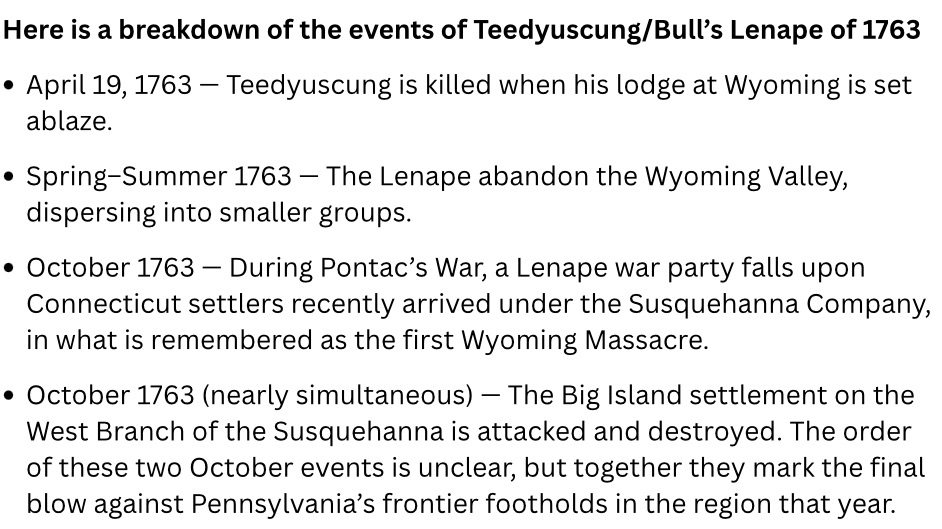
Captain Bull’s reputation on the western Pennsylvania frontier was shaped as much by rumor as by raids. After Teedyuscung’s death, settlers blamed Bull for leading Lenape war parties that destroyed the Susquehanna Company’s Wyoming settlement, killing settlers and carrying off captives. Some even claimed the Company had arranged the fire that killed his father, giving him a clear motive, recognizable to all, to strike back, though this rests on little more than hearsay. One dreadful account alleged that Bull’s band roasted a female captive alive, but no reliable first-hand evidence supports the charge; it bears the hallmarks of frontier atrocity lore that magnified genuine violence into sensational tales.
The details of such stories vary in reliability, yet the broader point holds: Bull was actively engaged in hostile operations against Anglo-European settlements during Pontiac’s War. On this, contemporary documentation is clear. In March 1764, Sir William Johnson reported that Andrew Montour’s party had intercepted Lenape “on their way to attack the settlements,” and among the captives was “Capt Bull, the famous Head Warrior … son of Teedyuscung,” whom he called “a great villain.”[11] While Bull and other leaders were confined, many of the women and children taken with them were delivered to the Mohawks, to be adopted into their towns in keeping with Haudenosaunee custom.
The same year Henry Bouquet forced the return of Anglo captives who had been adopted into Shawnee, Lenape, and other Ohio Country towns, Sir William Johnson received Lenape captives taken by Andrew Montour’s party and allowed the women and children among them to be given to Haudenosaunee families for adoption. It was an asymmetry baked into the frontier: British officials demanded the restoration of their own people from Native adoption, yet treated the adoption of Native captives into Haudenosaunee towns as both acceptable and politically convenient. The moral logic shifted with the identity of the child.
Bulltown
Bulltown, on the Little Kanawha River, was established as early as 1765, the year of Captain Bull’s release from imprisonment. Local memory long maintained that the settlement took its name from him, and nineteenth-century county histories explicitly tied its origins to Bull and his band of Lenape followers. That spring, Lenape leader Killbuck had traveled to Johnson Hall in New York to witness the release of Lenape prisoners, including Bull.
From there, the group moved west into the Ohio River Valley, where Bull remained. No longer the youthful “villain” William Johnson had once condemned, he became part of the mixed settler–Native community radiating out from Fort Pitt and down the Ohio. A March 1791 receipt records his purchase of a calico shirt, three quarts of rum, a plain shirt, and leggins — routine goods that show not an outsider raiding the frontier, but a participant in the same trading networks that bound Native leaders, settlers, and backcountry families into a single regional community.[12]
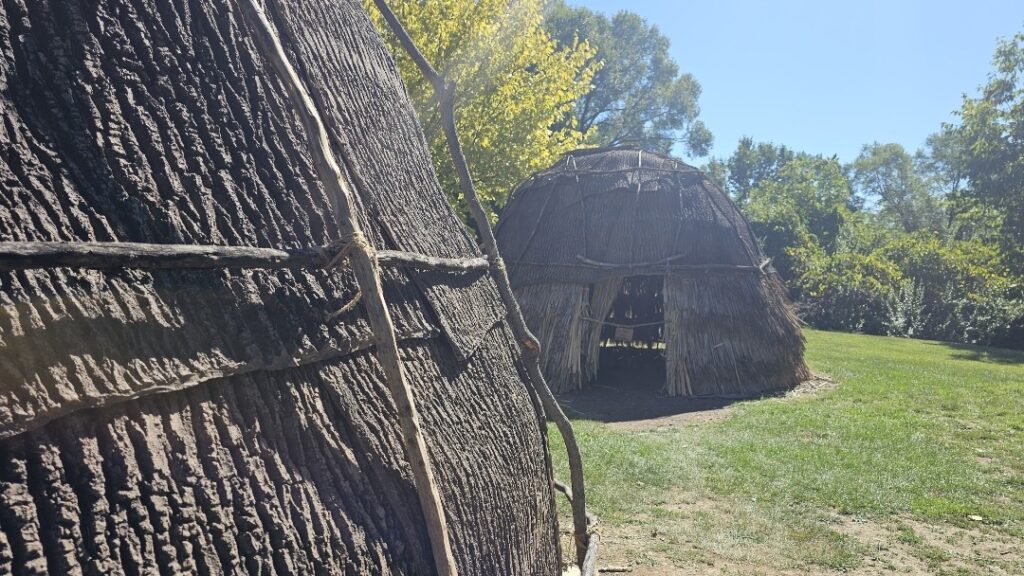
Bulltown consisted of about twenty cabins and a council house. The site chosen for Bulltown offered clear advantages: it lay beside fresh water, provided access to game for hunting, and stood near a salt lick that attracted animals and supported subsistence needs. Yet its security was short lived. After the Treaty of Fort Stanwix in 1768, Anglo-European colonists claimed vast tracts of the Ohio Valley as their own, including the Little Kanawha country. What had once seemed a promising refuge for Captain Bull and his followers was suddenly cast as available land in the eyes of speculators and surveyors, setting the stage for new rounds of dispossession.
What happened to Bulltown?
For a time, the Lenape of Bulltown coexisted peacefully with their settler neighbors, hunting and trading with Buckhannon and Hacker Creek communities. But frontier tradition holds that in the spring of 1772, after a settler named Stroud returned home to find his family murdered, a vigilante band followed a trail they believed led to Bulltown. Modern historians, however, suggest that if such a trail existed, it may have been deliberately laid to make it appear as though Bull’s people were responsible. According to the story, the men entered the village, killed everyone they found, and threw the bodies into the Little Kanawha—only to later insist they had seen no Native people there at all. This tale, first recorded by Alexander Scott Withers in Chronicleshof Border Warfareimes (1831) and later expanded by Lucullus McWhorter in Border Settlers (1915), portrays Bulltown as the site of a massacre, with men like William White and William Hacker sometimes identified as perpetrators.
However, not everyone accepted that a massacre ever occurred. The earliest printed source to claim Bulltown’s destruction was written decades after the fact and based mainly on oral tradition and local memory. Withers often blurred hearsay with history, and he offered no contemporaneous evidence for the Bulltown episode. Later writers simply elaborated his account. The so-called “deathbed confessions” of two perpetrators belong to this later layer; Lucullus Virgil McWhorter and his successors repeated the story, but there is no surviving sworn or written statement from any Bulltown killer.
A significantly different version is found in documents associated with Simon Kenton and preserved in the Draper Manuscripts. Kenton recalled visiting the Lenape town on the Little Kanawha and noted that Bull and his people were peacefully removed in May 1772 by officials from Indian Affairs. They resettled near the White River, close to the Wabash, and later moved on to the Mississippi; by 1779, when General Henry Hamilton was captured at Vincennes, they were reported further west. [14]
“Chief Bull, son of King of the Delawares, Teedyuscung, died in the 1790’s near old Fort Rosalie, on the lower Mississippi, where he lies buried. Relatives of James Lambert, who settled in what is now Jefferson County, Missouri, before 1790, know of their descent from Chief Bull, through two of the chief’s daughters who married men by the name of Lambert.”[15]
This account resurfaced in Awhile Ago Times (later reprinted in the Hacker’s Creek Journal), which argued that the Bulltown massacre story was folklore, not fact. Even Alexander Withers, the source most often cited, admitted uncertainty—speculating that perhaps five white men had murdered Bull and his entire village, “a hundred people in all.” His lurid guesswork stuck in regional memory, but Simon Kenton’s recollections and Lyman Draper’s notes point instead to removal, not slaughter.
Subsequent generations carried the memory in radically different directions. Some swore that Bulltown ended in a bloodbath, with a hundred Lenape corpses thrown into the Little Kanawha. Others traced descent from Captain Bull’s daughters, insisting his people survived, absorbed into kinship networks rather than sunk in a riverbed. Neither version is airtight: a massacre of that scale would have left more than rumor, while the Lambert genealogy is as circumstantial as Withers’s tale. What is clear is that Bulltown became a site where memory fractured.
When the U.S. Army Corps of Engineers built Burnsville Lake in the 1970s, they preserved the name “Bulltown” in a historic park and campground, fixing it on the landscape even as the story behind it remained dubious. The Bulltown Historic Area today highlights the 1863 Civil War battle, with interpretive signs and reconstructed log structures—but nothing about a massacre. That legend endures only in oral tradition and nineteenth-century county histories, a ghost story anchored to a name.
Conclusion
The Bulltown story stands out because, unlike most frontier legends, it does not cast settlers as desperate defenders but as aggressors. Why, then, did such a tale endure? Part of the answer lies in how it was framed: as vengeance for the Stroud murders. That context provided Anglo-European readers with a moral justification, recasting atrocity as justice. Dehumanizing a community into a single guilty “village” made it easier to accept women and children as collateral in a righteous reprisal.
Yet the record is divided. Alexander Scott Withers, writing in 1831, repeated oral traditions of massacre, while Simon Kenton’s recollections and the Draper Manuscripts suggest that Bull and his people were removed peacefully in 1772, resettling west along the White River and later the Mississippi. If Kenton’s account is correct, the memory of Bulltown’s destruction is less a record of fact than a reflection of how settlers imagined the frontier: erasure by extermination, even when displacement had already done the work.[16]
Maybe we want to believe the story of removal west, because it would mean Teedyuscung, Captain Bull’s, and those whom they led’s long, hard struggle finally ended in peace. History, though, is rarely about peace—that is a reason why so many prefer fiction. When the sources thin out, certainty goes with them. All that remains is the possibility that, this time, Bull’s small faction of the Lenape briefly slipped the cycle of betrayal and reprisal and found a place of rest — if not for their descendants, then at least for the final years of their own lives.
Epilogue
Dispossession of Native peoples was not solely a factor of the eighteenth to early twentieth centuries. In 1953 H.R. 108 explicitly targeted dozens of tribes for the termination of federal recognition and the liquidation of tribal lands. It persisted into the modern era, ongoing, evolving, and repeatedly renewed through legal, political, and economic mechanisms. Following H.R. 108, Congress spent a decade implementing the termination agenda, passing more than one hundred acts that dissolved tribal governments and privatized reservation lands, including the Menominee Termination Act (1954), the Klamath Termination Act (1954), the Paiute Termination Act (1954–1957), the Wyandotte Termination (1956), and many others.
Notes and Citations
[1] Pennsylvania Archives, Series 1, vol. 3 Philadelphia: Joseph Severns & Co., 1852), 46.
James Kenny also mentions another son of Teedyuscung whose anglicized name was John whom he encountered in the company of Killbuck.
James Kenny and John W. Jordan, ed. “Journal to Ye West-Ward, 1758-59.” The Pennsylvania Magazine of History and Biography 37, no. 4 (1913): 421, https://www.jstor.org/stable/20086139.
[2] Pennsylvania Archives, Series 1, vol. 2 (Philadelphia: Joseph Severns & Co., 1852), 735.
[3] Pennsylvania Archives, Series 1, vol. 2 (Philadelphia: Joseph Severns & Co., 1852), 747.
[4] “Teedyuscung Statue in Wissahickon Park”, photograph by Natecation, 2 January 2016, licensed under Creative Commons Attribution-ShareAlike 4.
[5] Pennsylvania Archives, Series 1, vol. 3 Philadelphia: Joseph Severns & Co., 1852), 32. “Petition to the King in Council, [2 February 1759],” Founders Online, National Archives, https://founders.archives.gov/documents/Franklin/01-08-02-0070. [Original source: The Papers of Benjamin Franklin, vol. 8, April 1, 1758, through December 31, 1759, ed. Leonard W. Labaree. New Haven and London: Yale University Press, 1965, pp. 264–276.]
[6] Merritt, Jane T. “Dreaming of the Savior’s Blood: Moravians and the Indian Great Awakening in Pennsylvania.” The William and Mary Quarterly 54, no. 4 (1997): 729. https://doi.org/10.2307/2953880.
[7] Keomilas was very likely was his Lenape name, remembered in later tradition, but it isn’t documented in the 1760s sources. That’s why historians usually hedge and just call him “Captain Bull, son of Teedyuscung.”
[8] Smith, Andrea Lynn. “Savagism, Silencing, and American Settlerism: Commemorating the Wyoming Battle of the American Revolutionary War.” Settler Colonial Studies 10, no. 3 (2020): 358. https://doi.org/10.1080/2201473X.2020.1761005.
[9] Vale of Wyoming. In Valley Views of Northeastern Pennsylvania: Reproductions of Early Prints and Paintings of the Wyoming and Other Valleys of the Susquehanna, Lehigh, Delaware, and Lackawanna Rivers Together with a Descriptive List of the Plates, ed. Gilbert S. McClintock. Pennsylvania: Wyoming Historical and Geological Society, 1948, [45]. Public domain. Digitized by Google, available via HathiTrust
[10] Frederick C. Johnson, Moravian and Indian Occupancy of the Wyoming Valley (Pa.), 1742–1763 (Wilkes-Barre, PA: [Wyoming Historical and Geological Society.], 1895), [21].
[11] Sir William Johnson to Thomas Gage, March 2, 1764, in The Papers of Sir William Johnson, vol. 11, ed. James Sullivan (Albany: University of the State of New York, 1921), 86, https://archive.org/details/papersofsirwilli0011john/page/86/mode/2up.
[12] Baynton, Wharton & Morgan Papers, Roll 2234, Pennsylvania State Archives (Harrisburg).
[13] Reconstructed bark houses in the style of Lenape wigwams, Frontier Culture Museum, Staunton, Virginia. Author’s photo, 2024.
[14]: Lyman C. Draper, “James’ Notes,” Simon Kenton Materials, Draper Manuscripts, microfilm, West Virginia University, Morgantown.
[15] “Chief Bull King of the Delawares. Many Descendants Living in the Monongahela Valley.” Hacker’s Creek Journal 3, no. 4 (1985): 51. Hacker’s Creek Pioneer Descendants, Horner, WV. Available online at Internet Archive: Hacker’s Creek Journal Volume 3 Issue 4, page 218-219.
[16]: Alexander Scott Withers, Chronicles of Border Warfare (Clarksburg, Va.: Joseph Israel, 1831), 136–37.
For readers who wish to follow ongoing research, subscription is available in the footer.