By the 1760s, the frontier was a ledger of overlapping claims—chartered, surveyed, and improvised. Where law thinned, paper multiplied. Few men exploited that vacuum more deftly than George Croghan—Indian agent, land speculator, diplomat, and self styled power broker in and beyond the Ohio River Valley. Like George Washington, Croghan had marched with Braddock’s doomed expedition in 1755, though his role was not martial but diplomatic: interpreter and intermediary between British officers and Native scouts.
Over the following decade, Croghan’s ambitions narrowed to a single pursuit: land—and as much of it as he could amass. In 1772, his sprawling paper empire collided with Washington’s own. Their rivalry revealed the contradictions at the heart of Britain’s western ambitions, where imperial order blurred into private speculation. Both men staked their fortunes on a frontier that existed more on paper than on the ground. From the stillborn colony of Vandalia to schemes of predatory lending and armed intimidation, their contest exposes how the pursuit of improvement turned violent—and imperial—in its own right.
Crawford’s Letter from the Edge
“there are such numbers of people out now looking for land, and one taking another’s land from him. As soon as a man’s back is turned another is on his land. The man that is strong and able to make others afraid of him seems to have the best chance as times go now.” William Crawford to George Washington, March 1772. [1]
William Crawford, Washington’s man on the ground, kept his ear to the dirt—tracking rumors, surveys, and every opportunity to extend his patron’s reach west. In the spring of 1772, writing from Stewart’s Crossing, he informed Washington that he was awaiting the return of a surveyor to complete the mapping of Washington’s claim at Great Meadows. On the same site, Washington had won his first military victory nearly two decades earlier.
Crawford’s letter carried more than logistical updates. He warned that George Croghan was selling land to anyone willing to buy, even tracts outside his legally claimed area near Fort Pitt. Croghan, he explained, “claims and is selling any land that any person will buy of him inside or outside of his line, and offers his bond to make a title for it… at ten pounds sterling per hundred acres.”[2] These “bonds” were little more than speculative IOUs. His private surveyors, operating well beyond their authority, had already run lines as far as ten miles past his legal boundary. Crawford reported seeing Croghan’s written order instructing them “to run out thirty thousand acres of land, one thousand in a tract.” In effect, Croghan had created his own illegal land office, peddling promises he had no power to fulfill. It was a long way from Isaac Stewart trading his army jacket for a patch of ground.[3]
Times had changed since land could be had for the price of a musket or an army coat. By May, Crawford noted that as far south as Grave Creek, fifteen miles below Wheeling Creek, the frontier was growing crowded.[4] Fellow claimants on the ground were powerless to stop Croghan, who had gone full blown rogue speculator. Settlers paid him six pounds per tract for surveys on land they already claimed—to avoid trouble. It was, in effect, an intimidation racket: pay Croghan’s men or lose your land.
Credit and Conquest
Croghan’s empire had begun long before his speculation drew the notice of Crawford and local settlers—built not just on ambition, but on debt. In the 1750s, as a frontier trader, he was backed by the Philadelphia firm of Levy & Franks, which supplied him with goods that he extended on credit to Native communities throughout the Ohio Country. The firm encouraged liberal use of credit, trusting Croghan’s influence to secure repayment. When those debts went unpaid—a frequent result of disrupted trade and wartime losses—Croghan pressed his Native partners to sign over land as collateral. What began as commerce soon became coercion.
By 1755, the same credit system that had fueled his rise collapsed. That year, the Pennsylvania Assembly passed a special debt-relief act, protecting Croghan and his partner, William Trent, from their creditors, including Levy & Franks, for a period of ten years. The moratorium was repealed in 1758, restoring creditors’ right to sue, but there was little left to seize. Sure, he would see the inside of a jail cell if he ventured too far east, but Croghan kept to the frontier. Cut off from formal credit, he abandoned trade and turned to land, converting unpaid Native debts into speculative claims that would define the rest of his career. By the 1760s, he was utilizing the same instruments that had nearly ruined him—credit, obligation, and default—to construct a new kind of empire. The goods he had once advanced on borrowed capital became leverage; when those debts went unpaid, he demanded repayment in the form of land.[5] The irony was that Native-to-colonist land transfers were illegal, as only the Crown could sanction cessions of Indigenous territory.
Vandalia: The Colony That Never Was
Everyone Crawford spoke to confirmed the same thing: the only authority behind the land seizures was Croghan himself—yet he carried on undeterred.
What appeared to be chaos on the ground was, in fact, part of a larger design. Croghan’s unauthorized surveys and land sales were not random acts of greed (although he was deeply in debt); they were groundwork for another kind of scheme entirely—Vandalia, a fourteenth colony he ambitiously hoped to midwife into existence. Backed by the Walpole Company’s London investors, Vandalia promised to transform Croghan’s paper empire into a royally sanctioned province stretching from the Monongahela deep into the Ohio country. Every acre he claimed, cleared, or sold on speculation helped make the case that settlement was already underway. Once the Crown approved the charter, his fraud would become law.
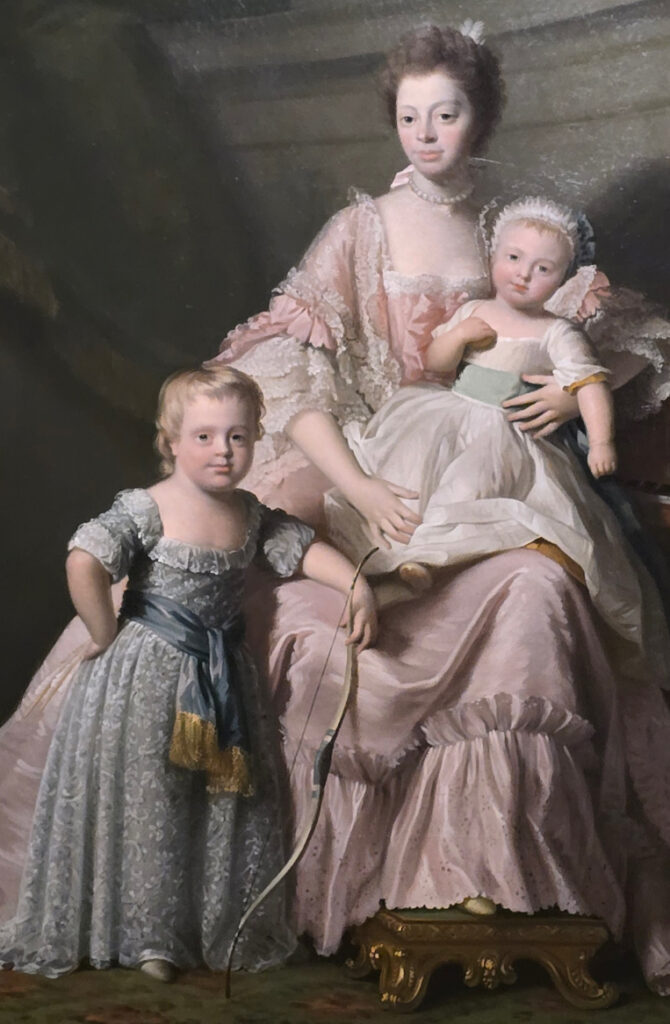
Why Vandalia? The name was chosen to honor Queen Charlotte of Mecklenburg-Strelitz, George III’s German consort and the mother of their many children. The connection was indirect—derived from the ancient Germanic tribe of the Vandals, fancifully believed to be among her and the future king’s ancestors. Colonies were seldom named after women by name. Virginia had memorialized Elizabeth I as the Virgin Queen, and Maryland honored Queen Henrietta Maria’s saintly namesake rather than the queen herself. Vandalia would have done the same for Charlotte: a symbolic nod to royal lineage and the veneer of imperial civility projected onto the frontier.
Vandalia’s origins lay with the so-called “suffering traders”—a group of merchants, including Croghan, William Trent, Samuel Wharton, and the partners Baynton, Wharton & Morgan —who sought compensation for goods lost during Native American attacks in the French and Indian War. Their losses were real, but the solution they pursued was anything but modest. Joined by London investors under the Walpole Company, they proposed converting their unpaid debts into land, millions of acres stretching from the Monongahela River to the Ohio River. What began as a plea for reimbursement evolved into one of the largest speculative land schemes in the British Empire.
Even Benjamin Franklin was involved. The future founding father saw Vandalia as more than a private land grab—he imagined it as a model colony, one that could relieve population pressure in the seaboard provinces, extend British settlement westward in an orderly way, and bring “civilized” governance to the frontier. Franklin had long envisioned such an expansion; as early as the 1754 Albany Congress, when he proposed the establishment of new colonies in the interior as a means of strengthening imperial unity and securing the frontier.[7]
In 1764, George Croghan traveled to London to lobby the Board of Trade for the creation of new western colonies. But one of Franklin’s London associates, Richard Jackson, cautioned that ministers feared such a move would reignite Native conflict and drive military costs beyond what Parliament was willing to bear.[8] London had no objection to pushing the empire westward—it objected to paying for it. Defending and governing the new frontier was expected to cost £20,000 a year, so officials proposed that the Western frontier should fund it’s own expansion through a tax on the fur trade—the empire’s most profitable frontier enterprise.[9]
In that same year, Croghan was serving William Johnson’s ambitions as much as his own. Both men sought to strengthen the Indian Department through Crown control and to fund it by taxing the fur trade while encouraging regulated settlement in the West. Johnson envisioned the former French territory in the Illinois Country as a new English colony. The plan faltered out of fear of reigniting war—but the idea lived on in Vandalia, the speculative colony that Croghan and his associates would later champion: a privatized revival of Johnson’s failed imperial design.
But before Vandalia’s charter could leave London, the frontier had already slipped beyond control. Croghan’s dream of a royally sanctioned colony was collapsing into the same lawless world it was meant to contain.
A Contest of Colonels
In October 1770, while traveling west on a land fact finding mission, Washington stopped at the home of Colonel Thomas Cresap—the notorious “Rattlesnake Colonel”—near present day Oldtown, Maryland. Cresap had just returned from England and carried the latest news of the proposed Vandalia colony. If the scheme succeeded, its grant would swallow up much of the territory Washington hoped to claim for himself. Long entangled in the networks of George Croghan and the so called “suffering traders,” Cresap had become an unlikely courier of imperial rumor, ferrying word of the colony-in-waiting across the Atlantic frontier.
By 1773, both Washington and Croghan also carried the honorifics of “Colonel.” Washington’s military commission was dormant; Croghan’s title was merely honorary. In the anarchy of overlapping claims, such distinctions meant little. Each man saw the West as unfinished business—an empire in waiting, and a test of who would rule it.
Washington didn’t begin life as a wealthy planter with vast estates. As a younger son in a Virginia gentry family, he inherited far less than his older half-brothers. In a society where land equaled power, that meant he had to earn his way into prominence. Military service, surveying, and land speculation weren’t just career paths—they were strategic tools. Washington’s ventures west of the Alleghenies were as much about building a legacy as they were about turning a profit. The frontier, in that sense, wasn’t just wilderness; it was his ladder. After all, in the early 1770s, Washington had no idea he would one day become one of the most revered figures in history.
Washington, like other elite speculators, aimed to lease land in parcels and profit, much like the landed gentry of Europe. Surviving leases show his approach to tenant holder was structured: tenants were required to plant orchards, maintain fences, and live on-site to ward off squatters. He wanted order—and profit.
Washington’s ability to gain western lands stemmed from his status as a veteran of the French and Indian War. He first petitioned Governor Robert Dinwiddie, and later Lord Dunmore, to bring the promised veteran land grants to fruition. Under Dinwiddie’s 1754 proclamation, officers and soldiers of the Virginia Regiment were promised 200,000 acres to be divided among them as a bounty for their service. When Dunmore finally reactivated the program in the early 1770s, the distribution was based on rank. As colonel and commander of the regiment, Washington was personally entitled to 15,000 acres. He also acquired additional acreage by purchasing or otherwise obtaining the claims of fellow soldiers. One such transaction involved his neighbor, John Posey, who transferred his 3,000-acre claim to Washington in payment of a debt. [11] Washington then used Posey’s claim to secure land at Millers Run — a tract that would soon draw him into direct conflict with George Croghan and the chaos of overlapping frontier titles.
In the years leading up to the American Revolution, neither Washington nor any other settler on the Forks of the Ohio—or near Wheeling—held a legitimate deed from Virginia, Pennsylvania, or any recognized authority. Legal titles would not begin to be issued from Richmond until the early 1780s, after the Virginia Land Office was established. By then, many of the original claimants—especially those soon to appear in this story—had already moved farther west in search of new opportunities. In 1773, Washington’s empire was every bit as tenuous as Croghan’s: both were built more on paper than on law.
In November 1773, Crawford reported that George Croghan was telling settlers along the Ohio that Washington’s military bounty lands, the tracts promised to officers and soldiers of the Virginia Regiment, were not legally valid. “The officers and soldiers could never hold one foot of the land,” Croghan declared.[13] He was deliberately poisoning Washington’s reputation on the frontier, insisting the regiment’s grants were worthless and their surveys illegitimate. Croghan, it seems, had no intention of letting Washington’s western ambitions stand in the way of his own.
In December, a gang leader encouraged by Croghan’s brother Major Edward Ward led a group of ten to twelve squatters onto Washington’s Miller’s Run property, the acreage Washington had acquired from his neighbor, John Posey’s allotment. The squatters began advertising the same property for sale. Crawford tried to negotiate, offering to buy them off as he had done with the squatters at Great Meadows the year before—an episode of frontier diplomacy I’ll return to in the next post. Croghan’s men had taken payoffs before, but this time they refused to do so. The land had become personal. Croghan believed that Washington, and by extension Crawford, had cheated his family out of land that he claimed was rightfully theirs. Even George Washington was powerless to enforce a backcountry claim without a musket, or a governor, on his side.
Conclusion
“The first and most obvious lesson of this history is that America has always been a nation of real estate speculators.” [14] Economist Edward L. Glaeser (2013)
In the end, Croghan’s collapse and Washington’s rise were not simply the fortunes of two ambitious men—they were the hinge on which the continent turned. Both played the same game. Both carved claims on paper, leaned on patronage, and gambled on a future that did not yet exist. But they bet on different worlds. Croghan wagered everything on the British Empire—on charters, prerogatives, and a fourteenth colony that would legitimize the thousands of acres he had already promised away. When imperial order cracked, his scaffolding collapsed with it. What had once looked like bold vision became debt, lawsuits, and ruin.
Washington gambled on something else: that the collapse of empire would not end speculation, but liberate it. He did not need Vandalia or London investors to validate his claims; he needed only a new political order that treated western land as the nation’s future rather than the empire’s frontier. And when that order arrived, it turned his surveys into substance and his ambitions into assets. Croghan’s empire died with Britain’s in the West. Washington’s expanded beneath a new flag.
The deeper lesson is this: the frontier did not end speculation—it made it national. The vacuum of authority that once swallowed squatters, surveyors, and Native nations would not resolve after independence; it was absorbed into the logic of the republic. What Croghan tried to build through imperial favor, the United States would later pursue through federal land offices, treaties, removals, and surveys. Croghan imagined himself master of a frontier that belonged to no one but the daring. Washington imagined the same—but his version survived because the nation chose it. The republic did not replace the speculative frontier; it inherited it.

Notes & Citations
[1] C. W. Butterfield, Washington-Crawford Letters, being the Correspondence between George Washington and William Crawford, from 1767 to 1781, Concerning Western Lands (Cincinnati: Robert Clarke & Co., 1877). 24-25.
[2] Butterfield, Washington-Crawford Letters, being the Correspondence between George Washington and William Crawford, from 1767 to 1781, Concerning Western Lands. 25.
[3] Howard L. Leckey, The Tenmile Country and Its Pioneer Families (Waynesburg, PA: Greene County Historical Society, 1950). 12.
[4] Butterfield, Washington-Crawford Letters, being the Correspondence between George Washington and William Crawford, from 1767 to 1781, Concerning Western Lands. 26
[5] Statutes at Large of Pennsylvania, “An Act for the Relief of George Croghan and William Trent, for and during the Space of Ten Years,” passed December 3, 1755 (repealed June 16, 1758), in The Statutes at Large of Pennsylvania, 1682–1801, Vol. 5 (Harrisburg: Clarence M. Busch, 1898), 213–216, https://babel.hathitrust.org/cgi/pt?id=hvd.32044017612086&seq=219; Nicholas B. Wainwright, George Croghan: Wilderness Diplomat (Chapel Hill: University of North Carolina Press, 1959), 28, 259–68.
[6] Queen Charlotte with Prince George and Prince Frederick, attrib. Johann Zoffany, ca. 1771–1772, oil on canvas, Walters Art Museum, Baltimore.
[7] The Mississippi Valley in British Politics remains the definitive historical study of the Vandalia petition and Franklin’s lobbying in London.
Clarence W. Alvord, The Mississippi Valley in British Politics, vol. 1 (Cleveland: Arthur H. Clark Company, 1917), 90, https://babel.hathitrust.org/cgi/pt?id=yale.39002004042652&seq=96.
[8] Alvord, The Mississippi Valley in British Politics. 214-215.
[9] Alvord, The Mississippi Valley in British Politics. 224.
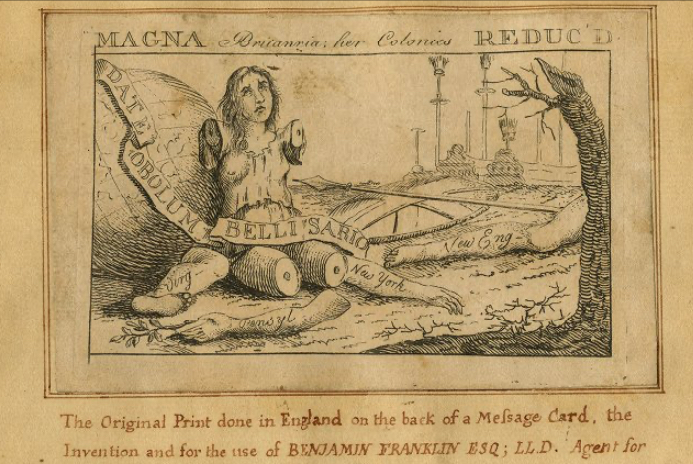
[10] Engraver unknown (traditionally attributed to Benjamin Franklin). The Colonies Reduced. ca. 1766. Library Company of Philadelphia, Print Department. https://www.librarycompany.org.
[11] “General Washington’s Land on Millers Run [Editorial Note],” Founders Online, National Archives, https://founders.archives.gov/documents/Washington/04-02-02-0245-0001. [Original source: The Papers of George Washington, Confederation Series, vol. 2, ed. W. W. Abbot (Charlottesville: University Press of Virginia, 1992), 338–356.]
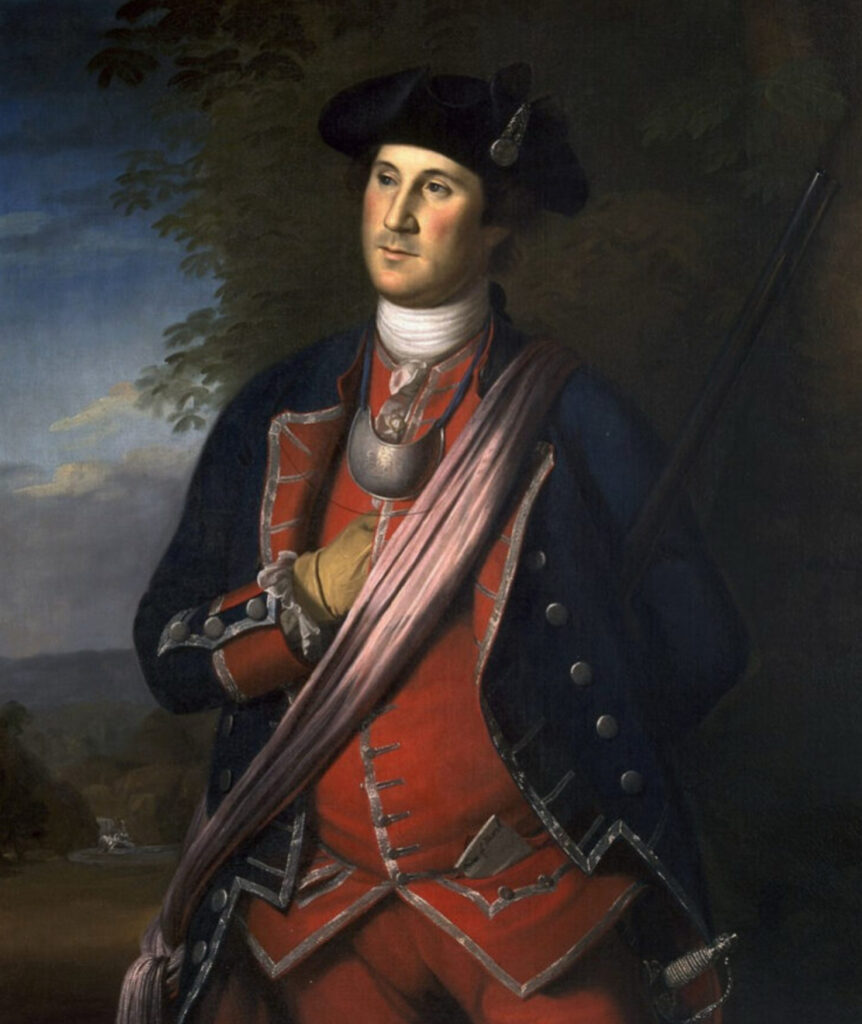
[12] Charles Willson Peale, Colonel George Washington, 1772, oil on canvas, Washington and Lee University, Wikimedia Commons, https://commons.wikimedia.org/wiki/File:George_Washington_by_Charles_Willson_Peale,_1772.jpg.

[13] Butterfield, Washington-Crawford Letters, being the Correspondence between George Washington and William Crawford, from 1767 to 1781, Concerning Western Lands. 35.
[14] Edward L. Glaeser, “A Nation of Gamblers: Real Estate Speculation and American History,” Rappaport Institute for Greater Boston Policy Briefs, Harvard University, 2013, https://www.hks.harvard.edu/sites/default/files/centers/taubman/files/ely.pdf.
For readers who wish to follow ongoing research, subscription is available in the footer.