The land we call North America—home today to the United States among other nations—has no name that predates the imperial possessives imposed by European conquerors. Before they drew their maps and renamed the continent “America,” “New France,” “New Spain,” and later “the United States,” this place was not nameless but known by thousands of names, each local, relational, and ecological. None described a single unified landmass, because no Indigenous worldview required a continental category. What existed instead were webs of homelands—overlapping spheres of kinship, memory, and use.
Its forests, rivers, and mountains carried names that described relationship, not ownership. “America” is not the land’s name; it is ownership staked in language.
Owning the Wilderness: The Dawn of a New Era in Human Thought
By the eighteenth century, a new chapter had begun—the era of ownership. On the frontier, power no longer came from naming places on a map, but from improving them—clearing trees, fencing fields, planting crops. In the 1760s and 1770s, when no government truly ruled the borderlands, improvement became its own kind of law—a foreign logic imposed on a land that had recognized no such need.
The belief that labor created ownership was older than the colonies—and older than Locke, though the Enlightenment ensured he got the credit. It was something distinctly early modern English, rooted in medieval common law. It carried forward through the Protestant work ethic: the improvement of waste ground into farmland was both civic virtue and moral duty.[1] What people later romanticized as the refinements of “Englishness”—teatime, manners, order—had always rested on a deeper creed of labor and enclosure. Locke merely gave philosophical polish to what centuries of English practice had already made law: unworked land was unowned, and whoever improved it deserved to possess it.
When that idea crossed the Atlantic, it took root in harder soil. Deep in the forests of the continent—on the borderlands of empire where no government truly ruled—settlers built fences and cabins as proof of possession. To labor was to own. The wilderness, and the people already living there, did not recognize that claim, but the newcomers believed the rule was self-evident: land worked was land claimed. On paper, it all sounded simple. In practice, things quickly became messy. Improvement brought as much confusion as order. George Washington’s experiences in the Upper Ohio Country—particularly the dispute at Millers Run, discussed in the previous post—would prove the point. He wasn’t alone. Across the frontier, stories like his repeated endlessly—from Pennsylvania’s ridges to Virginia’s river valleys.
A Claim at Great Meadows
In May 1772, George Washington’s land agent, William Crawford, wrote with frustrating news: squatters had built a cabin and fenced off several acres of Washington’s property at Great Meadows—the same site where he had fought his first battle twenty years earlier. Crawford had secured the tract for him two years before, purchasing it from a local settler, William Harrison, for thirty pistoles; a small fortune. A pistole was the common Anglo-French name for a Spanish gold coin worth just over a British pound sterling. Many readers may be more familiar with the “doubloon,” but that was a larger coin—twice the gold of a pistole. It would make a great story to say the first president paid for the site that is now a national park with doubloons, but alas, he paid in pistoles.
In a colonial economy perpetually short on British coinage, Spanish pistoles and Portuguese half-joes were prized for their intrinsic value. They were real gold and silver in a world that often ran on paper promises. By the benchmarks we’ve used in this series, Washington’s thirty pistoles could have bought roughly 42,000 bricks (materials only, at the Williamsburg 1777 rate of 15 shillings per thousand) or about 125 prime beaver pelts (at roughly five shillings apiece).[2] It was no small investment.
In theory, legal title ruled the frontier. In practice, supply and demand did. The early land rush rewarded whoever arrived first, with or without a deed. Harrison had no paper title to the tract, only the improvements—the cabin and cleared ground—that frontier custom treated as proof of ownership. Washington wanted the land and paid Harrison’s price, as was the ordered custom. Having bought the improvements, he now held the legal claim, even though a formal deed still hadn’t been executed.
Two years later, when Crawford found new squatters living on the property, the same logic turned against Washington. By clearing and fencing his land, they too had created improvements, which gave them a limited claim to ownership. It didn’t matter that Washington had paid Harrison fairly; by creating their own improvements to the land, they had, in effect, bought into his investment without asking. It was as if you purchased a car, someone broke in, installed a new stereo, and then demanded to co-own it.
Crawford settled the matter by paying them five pounds for their work and asking them to leave. The only other option would have been to allow them to buy the tract outright.
The Myth of the Poor Settler
Newcomers to the Upper Ohio River Valley after 1773 arrived too late to claim the choicest tracts. The familiar image of penniless dreamers stumbling west in search of liberty is largely a myth. Many immigrants brought cash and were willing to pay extra for fertile or well-situated parcels, whether or not they had a deed.
Fertile and well situated had just been what Washington had been looking for in his 1770 reconnaissance trip down the Ohio. Washington had a preference for “bottom lands,” riverside tracts whose fertile alluvial soils promised both abundant crops and convenient transport. Ground that could feed itself and offered direct river access to export its surplus was the kind of acreage new arrivals would pay any price for. Washington’s eye for prime land would matter little if he couldn’t ward off competition. He may have gotten there first, or in the case of Great Meadows, second, but many would follow and want what he saw as his. William Crawford ensured tenants or other placeholder personnel were situated to the best of his ability.
The Myriad of Rights
Absentee speculators like Washington operated within legal frameworks and surveyed boundaries, but many backcountry settlers, long accustomed to governing themselves, saw little need for official paperwork. Frontier custom, an uneasy blend of European and Indigenous practice, produced a set of informal titles known as cabin rights, corn rights, and sugar-camp rights. These claims, rooted in use and labor rather than in parchment, could be bought and sold like any other improvement. A cabin meant something. A clearing meant something. That was proof enough.
What is all this saying?
On the eighteenth-century frontier, land ownership wasn’t the binary matter it is today. A family could occupy a tract without holding title, clear fields, throw up a cabin, tap a few maple trees, and then sell those improvements while the ground itself still belonged—on paper—to someone else. Washington’s Great Meadows squatters didn’t need to sell their work back to him. In theory, they could have sold those improvements to anyone willing to pay for them—even, for maximum irony, to George Croghan.
It is genuinely unfortunate that no folk tradition ever imagined Washington and Croghan forced to occupy the same acreage like a colonial Grumpy Old Men, glowering at each other from opposite sides of a half-finished cabin. The concept writes itself. Unfortunately, history does not. They were not roommates, they were not allies, and the only thing they shared was competing ambitions.
My attempt to lighten a complex subject aside:
This owning the improvement but not the land scenarios created situations where multiple parties could claim different rights to the same piece of land:
• One person might have “cabin rights” because they built a structure.
• Another might have “corn rights” because they planted and harvested crops.
• A third could have “sugar camp rights” for tapping maple trees in the area.
Meanwhile, none of them, not even the accepted landowner, may have had an actual deed to the land.
It’s similar to how modern landowners might own the surface rights, but a company could own the mineral or oil rights beneath the surface. In both cases, ownership is split into layers of claim and use, based on what people did on the land — not just what paperwork they held.
In 1780, Governor Thomas Jefferson conceded that the confusion was vast. Untangling the mesh of overlapping patents and informal transfers, he warned, would take years.[4] Until then, legality was only a suggestion. The frontier ran on opportunity.
The Right of Common
Imagine claiming a rich tract only to discover that the nearest path to the river ran across another claimant’s field. Today, trespassing would likely result in a lawsuit, or worse. In the 1770s, however, it was far less of a concern. Boundaries were porous, and so long as one respected fences and crops, the right to roam: to fish, forage, and ferry through another’s land was assumed. The frontier was not yet private in the modern sense; it was a shared geography of use and occupation.
The old English “right of common” allowed neighbors to graze livestock, pannage which meant to let pigs forage freely, gather wood, fish from any pond or stream, or forage for wild plants and minerals freely on so-called “waste” or unfenced land. And on the American frontier, almost everything was unfenced. With people claiming up to 400 acres at a time, most of the countryside remained open to shared use. Even if a tract was recognized as yours, it wasn’t truly private unless it was fenced or under crop. Your neighbors’ cattle might graze your meadow so long as they kept clear of your cornfield. Your children could gather wild crabapples from the neighbors, but not apples from their cultivated orchard. On the frontier, that understanding persisted, land was shared until improvement made it exclusive.
This older world of shared use did not collapse all at once. It was fenced away. Industrial expansion, railroad timbering, emerging capitalist property norms, and the rise of conservation laws slowly converted the commons into property. After the Civil War, a booming market for plant-based medicines sent harvesters deep into forests, ripping out ginseng and goldenseal by the ton. Plants that Native communities had gathered sustainably for generations were nearly wiped out within decades. What had once been a communal right became, almost imperceptibly, a regulated privilege, or a crime.
Conclusion
A National Park would have baffled the Founding Fathers. To them, land meant labor: clearing trees, turning soil, fencing fields. Wilderness was not a treasure but a failure—an absence of improvement. Belonging was measured in how much you transformed the earth. That older world feels distant, yet its logic still echoes. The frontier taught Americans to see land as something to seize, carve, and prove. The idea that a field or forest might be kept untouched for its own sake—that its value lay not in possession but in restraint—required a different kind of revolution. You can still see the old instinct today in the manicured acres of open lawn, shaved clean of a single tree, as if emptiness itself were a sign of order.
Only after centuries of extraction, enclosure, and speculation did Americans reach for a new ideal: land held in common trust. Even then, it remained contested, fragile, and easily undone. That is why Great Meadows, once a site of dispute and improvement, now stands as protected ground. The landscape where a young colony faced off against a world power, squatters built cabins, and Washington measured his claims has become a place we preserve precisely because it now stands as protected ground; not privately owned, not for sale, held in trust rather than possessed. It is a reminder that the meaning of land in America has always been argued, constantly shifting; shaped as much by imagination as by law.
Notes & Citations
[1] See Joyce Chaplin, An Anxious Pursuit: Agricultural Innovation and Modernity in the Lower South, 1730–1815(Chapel Hill: UNC Press, 1993), James Tully, A Discourse on Property: John Locke and His Adversaries (Cambridge: Cambridge University Press, 1980), and John Brewer and Roy Porter, eds., Consumption and the World of Goods(Routledge, 1993)
[2] “M3301004 Manuscript,” Colonial Williamsburg Foundation, Rockefeller Library, Williamsburg, Virginia, accessed October 7, 2025, https://research.colonialwilliamsburg.org/DigitalLibrary/view/index.cfm?doc=Manuscripts/M3301004.xml&highlight=Brick and Baynton, Wharton & Morgan Papers, Roll 2238, frame 880, Pennsylvania State Archives (Harrisburg).
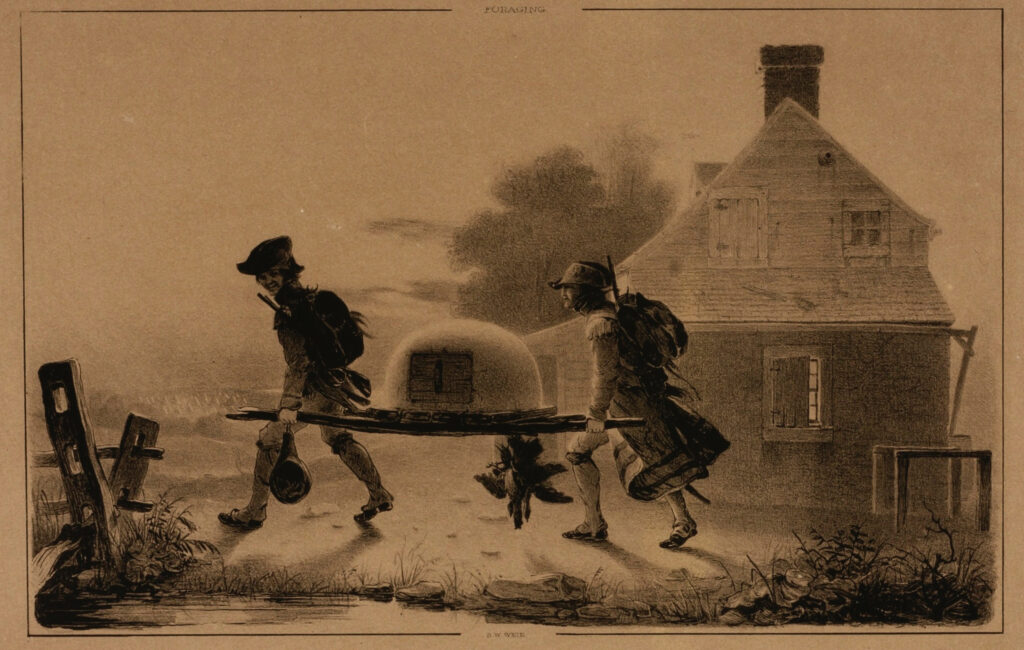
[3] Robert Walter Weir, Foraging, Smithsonian American Art Museum, Gift of the Reverend Dewolf Perry, accession number 1975.54.1.
[4] Amelia Clewley Ford. Colonial precedents of our national land system as it existed in 1800. University of Wisconsin, 1910. 129.
For readers who wish to follow ongoing research, subscription is available in the footer.