By the early 1770s, the frontier that once pulsed with trade and fragile diplomacy had hardened into a marketplace of deceit and dispossession. Part II traced that transformation—how a river world built on exchange, kinship, and Indigenous sovereignty fractured under speculation, imperial neglect, and the relentless logic of improvement.At its opening, traders like John Gibson and the Butler brothers moved easily through the liminal world of Fort Pitt, where Native and European economies overlapped. Commerce and kinship were inseparable; marriages tied traders to Shawnee and Lenape families, and language bridged worlds law could not. But the same networks that once bound these communities together slowly corroded them. Rum replaced reciprocity, debt replaced trust. By the time George Croghan and Teedyuscung quarreled in a drunken fury, the experiment at the Forks of the Ohio was already faltering.
Through Croghan, Part II followed the frontier’s moral and material collapse. Once the Crown’s trusted Indian agent, he transformed his authority into a private engine of speculation as debts mounted. Vandalia, his envisioned fourteenth colony, revealed how British “civilization” in the Ohio Valley had become indistinguishable from organized fraud. Even Benjamin Franklin endorsed the scheme, convinced that a royal colony might restore order. Instead, it accelerated the disorder. He had no way of knowing that Croghan was out falsifing records, bribing interpreters, or illegally selling land.
George Washington emerged not as Croghan’s foil, but as another player in the same high-stakes game. Croghan improvised empire; Washington, America’s future Cincinnatus, worked within the forms of legality—buying soldiers’ land bounties and shaping his holdings into miniature empires of improvement. One traded in promises, the other in permanence; one’s fortunes rose and fell with the British Crown, the other’s with the emerging republic. But both were enthralled by the same creed: land was virtuous only when possessed, cleared, and made to yield.
As that creed spread, every boundary—legal, geographic, and moral—began to dissolve. The British Empire ruled the frontier on paper, but west of the Appalachians, paper no longer mattered. The Proclamation of 1763 existed as rumor. Settlers crossed it daily, staking claims that recognized no king. To keep pace with a land rush already beyond their control, colonies granted “preemption rights,” giving squatters priority to purchase the ground they had already seized. Improvement became law; possession became title; violence became enforcement.
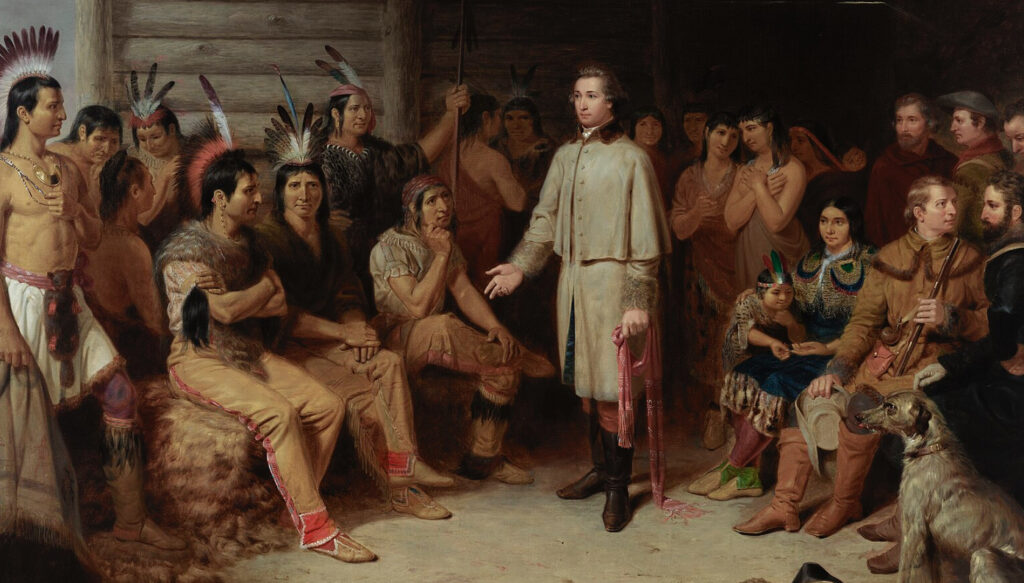
The frontier economy that began in pelts and credit ended in confusion. A single tract could host three claimants at once—one with a cabin, one with a cornfield, one with a survey. Native nations that once dictated the terms of trade now watched treaties negotiated in their absence. The 1768 Treaty of Fort Stanwix, an agreement between the British and the Haudenosaunee, ceded lands they no longer lived on, betraying the Shawnee, Lenape, and Ohio Haudenosaunee ie “Mingo” who actually inhabited the region.
For years Teedyuscung fought to secure a homeland for his people, believing that paper might protect what war could not. Every promise to him was undone before the council smoke cleared. After his death in 1763, his son Captain Bull inherited not a kingdom but a grievance. As surveyors carved and sold the lands his father bargained for, Bull’s disillusion mirrored the collapse of diplomacy itself: where words once carried weight, force now ruled. By the 1860s, no Lenape land remained in the East—only memory, archaeology, and revitalized language carried by descendant nations in Oklahoma and Wisconsin.
By the end of Part II, the Ohio River Valley stood stripped of illusions. The British Empire could draw lines on maps, but it could not command the land or the people upon it. Native alliances lay shattered. Every acre had become a contest of possession. On paper, the West was still imperial. In practice, it was already American—lawless, speculative, and primed for the fires to come.
For readers who wish to follow ongoing research, subscription is available in the footer.