Against a backdrop of fear of attack from Native peoples and fellow settler counterclaimants, settlers would have looked to their colonial government and militia to protect them, but, as already alluded to, in the borderlands around Wheeling and Pittsburgh, the government was in question. In areas where sovereignty itself was contested, such support would never come. Settlers operating outside formal legal structures devised innovative methods to resolve disputes, assert claims, and maintain order.
Claim Clubs
The Fair Play Men exemplify how one frontier region addressed the chaos of overlapping claims, squatter conflicts, and legal ambiguity. Settled west of Fort Augusta, near Pennsylvania’s Pine Creek, these so-called “Fair Play Settlers” established one of the earliest examples of the frontier claim club phenomenon. Typically formed by squatters living far from governmental control, claim clubs served as grassroots judicial bodies that resolved local conflicts—especially those involving land. The Fair Play system operated through cooperation, mutual defense, and collective enforcement. In effect, it created a self-imposed jurisdiction where outside authorities—whether from the colonies, eastern speculators, or rival claimants—could be resisted with unified resolve.
The Fair Play Men met beneath the Tiadaghton Elm, an old hardwood rising over Pine Creek. Trees were landmarks of a different order back then—sentinels, boundary markers, meeting halls. According to frontier lore, George Washington once measured a tree forty feet wide in the Ohio backwoods. No such note survives in his journal, but the scale of the now largely long-gone primordial forests of the Appalachians is not in doubt. Beneath that elm, on July 4th, 1776, the Fair Play settlers signed a declaration of their own. A similar one was signed the same day in Philadelphia, you may have heard of it, though that more famous variant mattered far less in these parts. In the backcountry, law was local, and allegiance grew from the roots of community, not distant decree.
Compliance in these assemblies depended less on abstract consensus than on reputation and consequence. A verdict ignored risked retaliation, exclusion from labor networks, or the loss of mutual defense—penalties that could be as decisive as formal punishment in a landscape without courts.
Church Authority
“Our God, our help in ages past,
Our hope for years to come,
Our shelter from the stormy blast,
And our eternal home.”
O God, Our Help in Ages Past” is a hymn by Isaac Watts, first published in his 1719 book The Psalms of David Imitated in the Language of the New Testament.
In the absence of formal political institutions, kinship ties, shared ethnic origins, and religious association provided cohesion in backcountry settlements. In the early days of frontier settlement, there was no resident minister to sustain regular congregations. Early on, religiosity relied on family prayer, folk beliefs (more on that in part IV), and the occasional visiting preachers.
Communities of diverse origin were bound to develop differing religious practices, and the backcountry was no exception. Traveling the Carolinas in 1767, the Anglican minister Charles Woodmason recorded what he viewed as alarming religious chaos: “among these Quakers and Presbyterians, are many concealed Papists,” he wrote. “We have too a Society of Dunkards.” Surveying what he described as a “medley of religions,” Woodmason concluded that “true genuine Christianity is not to be found.” [4] His harshest criticism, however, was reserved for Presbyterians—whom he regarded as the most dangerous of these ungenuine Christians. That hostility reveals more than sectarian contempt. To religious leaders like Woodmason, Presbyterians represented organized religious dissent to the authority of the Church of England.
The religious diversity Woodmason condemned also explains why Presbyterian institutions gained traction on the frontier. In the Ohio River Valley, Presbyterian ministers, and, in their absence, church elders, frequently assumed leadership roles, serving as moral authorities and informal mediators in land disputes. Unlike Anglican parishes, Presbyterian churches did not depend on fixed hierarchies or civil backing. In areas lacking magistrates, they became the closest thing many communities had to functioning civic institutions.
There is an irony Woodmason himself never fully resolved. Even as he lamented that “true genuine Christianity” was nowhere to be found, his journals record hundreds of settlers converging on his preaching sites, bringing with them what he described as endless numbers of children to baptize. What Woodmason interpreted as religious disorder may instead reflect a population eager for ritual, legitimacy, and communal recognition—practicing Christianity in forms that lay beyond the institutional expectations of an Anglican clergyman.
Across frontier settlements, from the southern Appalachians to the Ohio River Valley, communities like Wheeling, where no formal church structure yet existed, gathered for open-air sermons and itinerant preaching as the primary expression of collective religious life. Worship services in Wheeling began well before the 1787 founding of the Forks of Wheeling Presbyterian Church. Early settlers and informal leaders, such as Rev. John Brice, met under a prominent oak tree. [5]
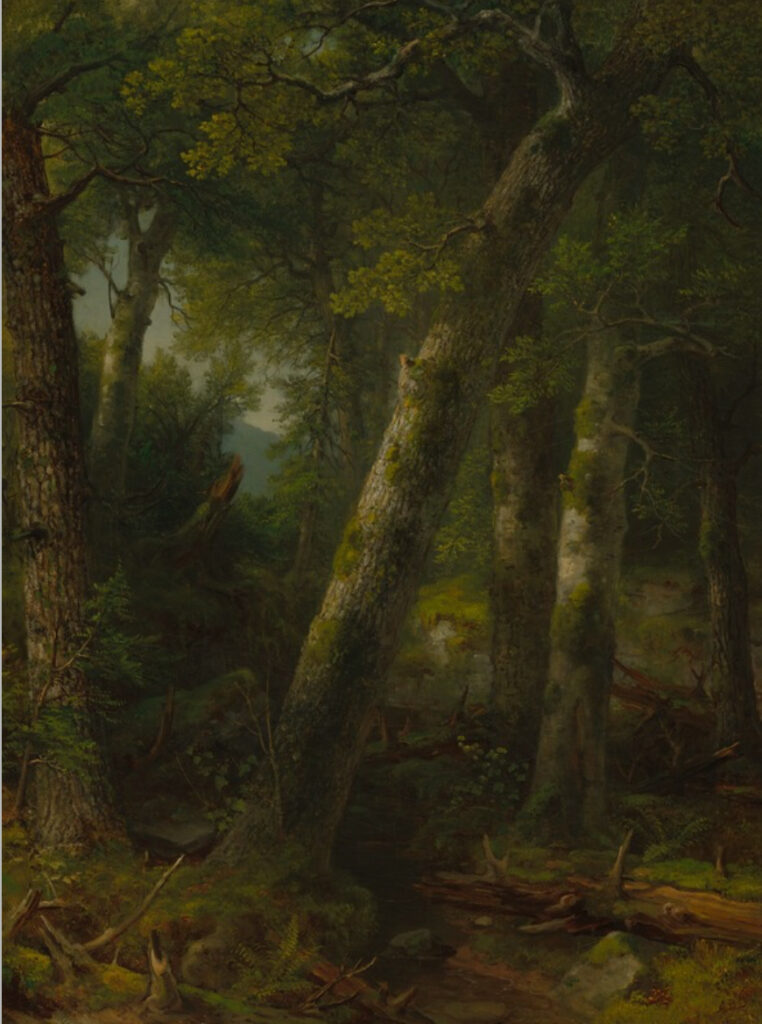
The repeated appearance of large trees as preaching sites and by the Fair Play Men in this post is not accidental. Across the backcountry, in places lacking churches or civic buildings, massive oaks and poplars functioned as informal gathering sites, providing shade, acoustics, and a recognizable center for communal life. Few of these trees survive, and fewer still are named. Their disappearance mirrors the fate of many of the gatherings they hosted—events central to communal life, yet largely absent from the written record.
The importance of these living landmarks did not disappear with the frontier. In 2006, the National Park Service formalized this recognition through its Witness Tree Protection Program, an effort to identify and preserve historic trees that predate or directly observed significant events. Long before monuments or minutes, trees had already served as gathering places, boundaries, and silent record-keepers—roles the frontier depended on, even if the archive did not.
Kinship Ties: Bloodlines and the Architecture of Settlement
Families were deeply ingrained in the fabric of frontier society through marriage, land ownership, and shared ambitions. These family networks were equally critical to religion in shaping governance.
Favor often followed blood, not from corruption, but from necessity. In a landscape where formal institutions were weak or absent, loyalty mattered more than neutrality. What would later be condemned as nepotism was, on the frontier, a system of trust, one that placed authority in the hands of those bound by kinship and mutual survival. Militia commands, magistracies, and surveying appointments frequently circulated within families, producing a local order built as much on obligation as on law.
In my research, the same surnames kept surfacing—not by coincidence, but by design. As settlers moved west, they did so in coordinated kin clusters, laying claims side by side, fortifying cabins together, and voting one another into local authority. Marriages weren’t only personal—they were strategic alliances, binding families into something bigger than the sum of their parts. In regions without a stable government, kinship became law, defense, and legacy. If your surname showed up in multiple townships, it wasn’t chance—it was the quiet work of dynasty-building, unfolding one marriage and one land grant at a time.
Take the Tomlinsons, for example. They didn’t just have large families—they raised entire branches that fanned across the region. Sons became militia captains, daughters married into other influential settler families, and cousins appeared on land petitions, wills, church rosters, and jury lists. In Part III, we will begin exploring the implications of kinship networks for the events of April 1774.
Community was everything beyond the systemized safety of the urban world. The Wetzels and other settler families who had once been the Zanes’ neighbors along the South Branch of the Potomac followed the brothers west. By 1774, members of Ebenezer and Silas Zane’s extended families, the McCollochs through marriage, joined them as well; Silas would later marry his wife, Elizabeth McColloch, in Wheeling. Brothers Jonathan and Andrew Zane each married into the Mills family. It wasn’t just land these families sought, but the continuation of their alliances.
Community
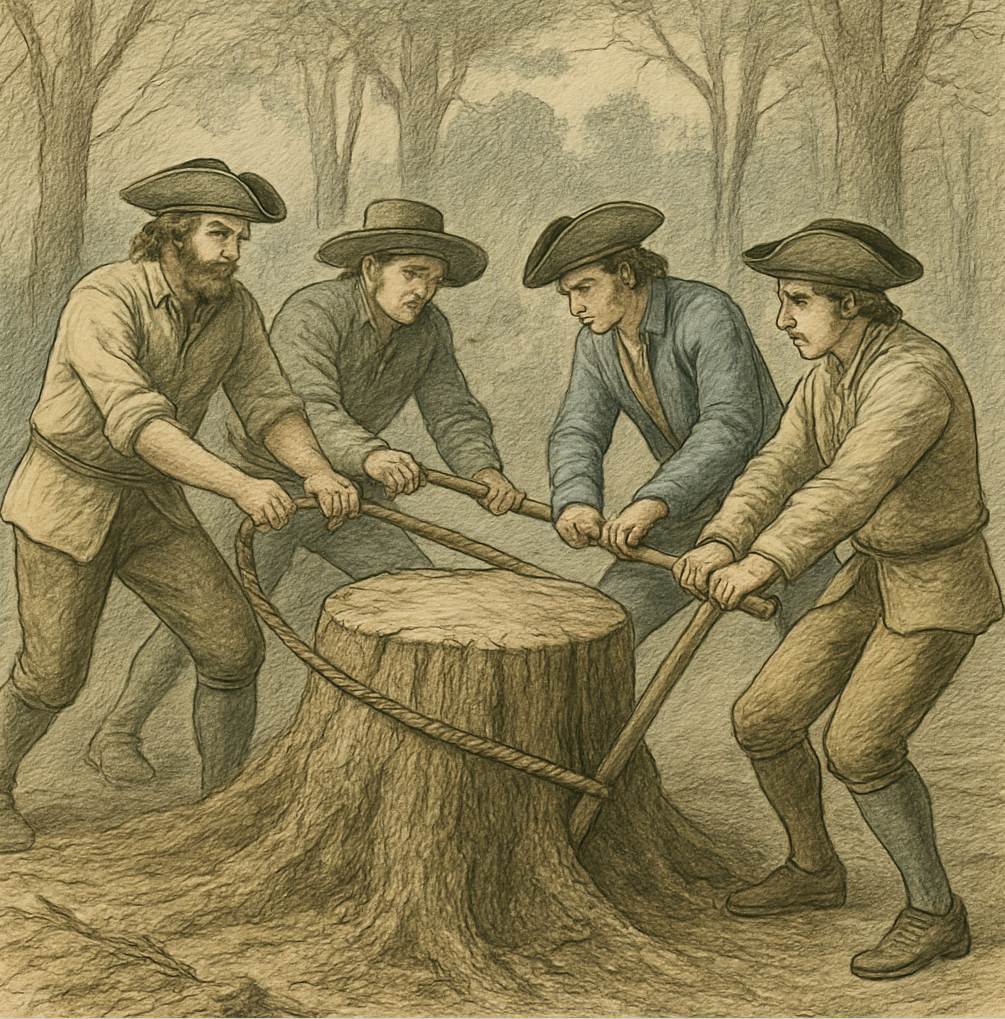
In 1786, a group of surveyors recorded attending a Methodist religious service at William Greathouse’s cabin. The next day, the surveyors then attended a husking bee at Harman Greathouse’s plantation. It was quite the social event, featuring rye whiskey, singing, and dancing. Perhaps someone there played the fiddle, a musical instrument introduced to North America by the Scots-Irish. Around 10 pm, the surveyors noted that those who could walk home did so. Those who didn’t leave stayed up all night “arguing religion.”[6] Moments like this reveal the frontier at its most communal: a society improvising fellowship, belief, and belonging in the absence of formal institutions. The next morning, a Sunday, more people arrived at the plantation to finish the remaining whiskey.
It’s not hard to imagine that, in gatherings like this—where faith, land, and kin intertwined, a new vision for the frontier was already taking shape. However, possibly in a similar meeting to those, just over twenty years prior, a new idea, a new plan came into being. One that would shatter the frontier world’s post Seven Years’ War balance.
Conclusion
This is the first of three posts that deal extensively with the family alliances present in Wheeling before April 1774. The history of the Upper Ohio River Valley isn’t a story of isolated settlers carving homes out of wilderness; it’s the story of families—interconnected, ambitious, and often entangled in one another’s fortunes. The Tomlinsons, Greathouses, Coxs, and Swearingens were not merely neighbors; they were kin, business partners, and sometimes rivals, bound by shared risk and competing claims. Their marriages, alliances, and feuds reveal how settlement was as much a social project as a geographic one.
By continuing to trace family networks in the next two posts, I aim to demonstrate that the frontier wasn’t built by nameless pioneers, but by interlocking dynasties whose private ambitions shaped both public violence and local governance.
Notes & Citations
[1] Ilia Murtazashvili. The Political Economy of the American Frontier. Cambridge: Cambridge University Press, 2016. 63.
[2] Albert H. Tillson Jr. Gentry and Common Folk: Political culture on a Virginia frontier 1740–1789. Lexington: The University Press of Kentucky, 2015. 36 & 65.
[3] “Forest in the Morning Light by Asher Brown Durand.” National Gallery of Art, January 1, 1970. https://www.nga.gov/artworks/56571-forest-morning-light.
[4] Woodmason, Charles. The Carolina Backcountry on the Eve of the Revolution: The Journal and Other Writings of Charles Woodmason, Anglican Itinerant. Edited by Richard J. Hooker. Chapel Hill: Omohundro Institute and University of North Carolina Press, 1953. 42-43.
[5] “History of Old Stone Church, Elm Grove: 1787-1907.” Ohio County Public Library. Accessed June 17, 2025. https://www.ohiocountylibrary.org/history/3534.
[6] William Hocking Hunter, Pathfinders of Jefferson County (Columbus, OH: Jefferson Chapter, Published for the Society by A.H. Smythe, 1898), 199.
For readers who wish to follow ongoing research, subscription is available in the footer.