Wheeling was the first Anglo-American settlement downriver of the Forks of the Ohio. In the spring of 1774, the borderland community was heavy with rumor and fear as settlers gathered on the Ohio River’s edge. The atmosphere seethed with restless ambition and a sense of impending doom. These frontiersmen had come to claim new lands, but whispers of Shawnee raiding parties, tribal councils that called for settler deaths, and reprisal killings churned in every tavern and trading post from Fort Pitt to the mouth of the Little Kanawha. At the first suggestion that war was on the horizon, an anxiety best described as fight or flight set in.
What happened next would not unfold as a neat chain of events but as overlapping eruptions of fear, vengeance, and speculation. And though later generations would weave these acts into a heroic frontier war narrative, the reality was far murkier. The violence that began at Wheeling in 1774 was not yet Dunmore’s War—it was something rawer, more chaotic, and less easily explained
A Shot-Riddled Canoe & No Turning Back
A few days before the 26 April mass gathering of Kentucky-bound settlers at Wheeling, a Pennsylvania trader stood on the banks of the Ohio.[1] According to sources such as The Pennsylvania Journal, he was known as Stephens. He was the lone survivor of a trading convoy ambushed by a Cherokee party on 16 April, a raid that left one trader dead and another mortally wounded.[2] For months, Virginians had feared reprisals for the killing of a Cherokee in North Carolina by Isaac Crabtree, and now that fear seemed fulfilled.
This is one of those moments that feels too improbable to be fiction, and therefore must be true. To historians, the sequence almost defies belief: a survivor of a Cherokee attack arriving at Wheeling just days before Connolly’s circular reached the frontier, his story landing amid a population already braced for retribution. It reads like a coincidence, but history often arranges its accidents with cruel precision.
A man known interchangeably as Cosh and John Bull later revealed that the convoy’s traders had foolishly displayed their silver goods to the very men who killed them.[3] What feels like fate is, in truth, the accumulation of events—misjudgment, rumor, timing—stacked so tightly that chance begins to look like design. Sir William Johnson, Superintendent of Indian Affairs for the Northern Department, would eventually charge George Washington’s old associate, Guyasuta, with reaching out to area tribes to identify the attackers.[4] But for the moment, Stephens was alone; alone except for one man, Benjamin Tomlinson.
Tomlinson had come upon the aftermath and helped Stephens bury his murdered companions. The burial was a grim punctuation mark in a trade world where such risks had long been understood.
Stephens barely had time to register his own survival or mourn his associates. At the behest of his employer, William Butler, he was ordered back into a canoe and sent once again downriver toward Shawnee towns on the Scioto. Butler’s brother Richard was waiting there for the shipment. The new party consisted of Stephens, a Lenape called Compass, one Shawnee, and possibly another white trader.[5]
Not long into their renewed journey, the men spotted canoes ahead. Perhaps Stephens felt his pulse quicken, still raw from the attack he had just survived. The others, accustomed to the artery-like traffic of the Ohio River, likely felt none of his alarm. Stephens moved to paddle toward shore when the gunfire erupted.
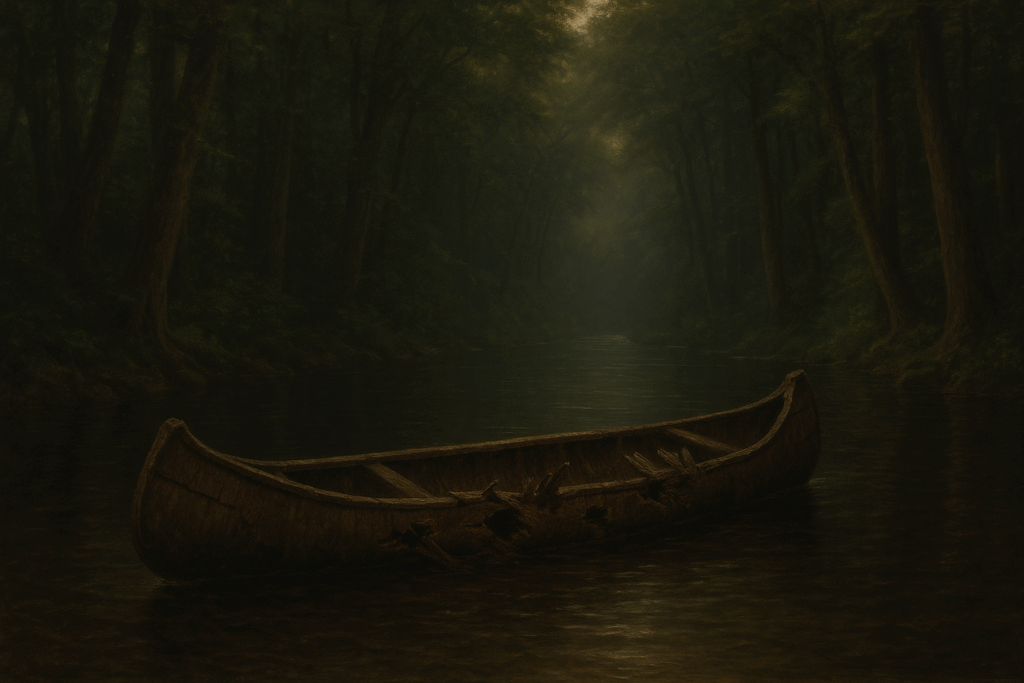
It wasn’t the canoes ahead that posed the danger; it was the men concealed along the riverbank. They fired without warning.[6] The two Native traders were killed instantly. Only the white traders were spared.
Michael Cresap was in the canoes upriver, not among those who pulled the trigger, but he would later cite a circular sent out by Fort Pitt’s Virginia assigned commandant John Connolly to justify the violence. When the attackers returned to Wheeling with the Butler’s now seized cargo in tow, Ebenezer Zane noticed the seized canoe and asked what had happened to its occupants. The men claimed the traders had fallen overboard, but the bullet holes and the blood pooled in the keel gave them away. Devereux Smith would remember the murdered men as “those well known to be good men” in a letter dated 10 June 1774.[7]
Stephens had no other choice but to accompany his party’s attackers back to Wheeling. It was he who provided the most damning evidence against that of Cresap, the only real testimonial evidence that cannot be explained away by disassociation. The Pennsylvania Gazette reported Stephens’ recollection that he, Cresap, threatened to kill every “Indian” he found on the river.[8]
That same day, another settler raiding party set out from Wheeling. When they returned, they did so from Pipe Creek with three fresh Native scalps and stolen Native property. There would be no turning back.
Captina Creek: Attack on the Shawnee Leaders
The next group of Native canoes managed to slip past Wheeling under the combined cover of darkness and the mid-river island. These were not warriors on a raid, as settler rumors would later claim, but a delegation of leaders returning from Fort Pitt. For months, since 25 December, they had stayed as guests at George Croghan’s manor, Croghan Hall. Croghan had requested their presence to negotiate with colonial agents, hoping to maintain the fragile peace. Yet peace was already unraveling.
Across the Ohio frontier, whispers of violence moved faster than couriers. Not only did the settlers feel the palpable unease, but Native leaders ensconced within Croghan’s Hall spoke openly of their fears. The memory of prior community attacks and lives lost haunted them as much as the sight of Connolly’s called for settler militias forming up nearby. Militia near the mouth of Sawmill Run even fired their weapons near the Native camp.[9] The leaders broke for home, returning to Shawnee country.
A settler called McMahon notified those gathered in Wheeling after the Native party of just over a dozen stopped near his cabin. McMahon had notified the Native party of the attack on the Native traders on the river the day previously, of which the leaders had not previously been aware.[10] An alert rang out, and frontiersmen poured into canoes to pursue. Fifteen to twenty miles downriver, five native canoes were observed abandoned.
In the ensuing skirmish, Othawakeesquo, a Shawnee leader known to Anglo-Americans as Ben, was killed, and two more were wounded.[11] One of Cresap’s men also fell in the chaos, a casualty of friendly fire or a last, desperate shot from the riverbank, accounts differ. The remaining Native leaders sought shelter in a Lenape camp west of the Ohio. William ‘Catfish’ Huston of Catfish Camp recorded that the attackers left the skirmish with a Native scalp and an Anglo-American, known as Big Tarrener, so severely wounded he had to be carried in a litter.[12]
A Mingo camp about thirty miles upriver at the mouth of Yellow Creek was soon identified as the next target. However, as the party drew closer to its objective, Cresap opposed the attack. He noted that the camp appeared to be a seasonal hunting encampment, with women and children present, rather than a war party preparing for hostilities. Some historians have even suggested that Cresap’s hesitation stemmed from his awareness that the camp was connected to Logan, the Mingo leader widely regarded as a “friend to the whites” in the region. Whatever his reasoning, Cresap’s counsel prevailed. The group ultimately decided to abandon their plans and return to Wheeling without striking the Mingo camp.[13]
Descent into Madness
John Gibson, soldier, adopted member of the Lenape, Dunmore-appointed Justice of the Peace, Pennsylvania-affiliated trader, and lone resident of the last remaining occupied cabin in the abandoned Native settlement of Logstown, was traveling down the Ohio River with a small party of traders when they encountered members of Clark’s expedition fleeing upriver. We last saw Gibson mentioned in part II of the series as a trader who operated out of Pittsburgh, as he remained affiliated with the area. A group of settlers, once bound for Kentucky but now fleeing the hive-mind-like fervor that had overtaken Wheeling, warned Gibson and his convoy of the rumored, though unverified, attack on a Shawnee encampment. The settlers admitted they were retreating eastward, fearing that war was now inevitable.
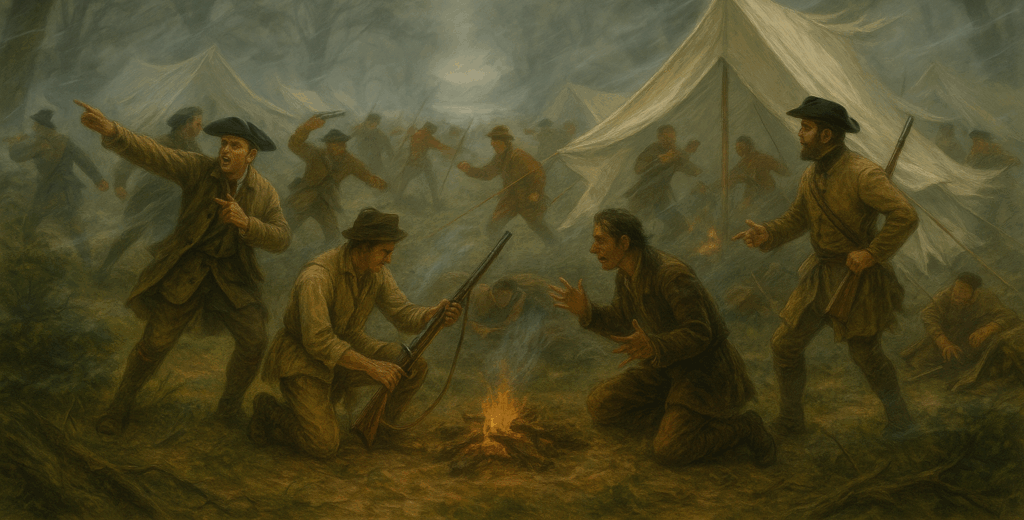
Upon reaching Wheeling and observing the mania that gripped its temporary occupants, Gibson and his fellow traders decided to wait overnight in hopes of meeting with Cresap. Gibson and Cresap almost certainly knew one another professionally from Cresap’s earlier years as a Redstone-based trader. But what Gibson observed disturbed him: a restless crowd of settlers on the brink of violence, their fear and anger boiling over into threats. He recalled later that some men even threatened to kill members of his party, labeling the Pennsylvania traders as “traitors.”
The next morning, Cresap finally arrived. Calm amid the hysteria, he spoke privately with Gibson and explained his own decision to withdraw to Redstone, leaving the panicked settlers to their own devices. The mob was beyond Cresap’s control, and he was retreating east. It should be noted that, although Cresap’s name is attached to every attack in later accounts, the traumatized trader Stephen’s offers the only contemporary testimony that even tenuously directly links Cresap to the violence along the Ohio that fevered spring. If Cresap truly said he would kill any Native found on the river, as Stephens revealed to Devereux Smith, that alone betrays a bloodlust born of hatred. Yet one must ask: would the longtime friend of Nemacolin and his kin have ever uttered such words?
Nevertheless, Cresap’s apparent friendly relationship with John Sappington and the latter’s macabre “gift” to him following the massacre of Logan’s kin suggest that by then, Cresap may have come to believe that friendship or kinship offered no exemption and that Natives were better off dead, regardless of past ties. The scalps taken at Pipe Creek, Captina, and those to come became trophies, reminders to settlers that they had struck first. But what did Cresap see in them? Perhaps the act, so celebrated in the moment, pressed heavier on his conscience than his companions ever realized.
In the end, the reign of terror unleashed by the frenzied settlers, denied their march into Kentucky, burned itself out. Their violence ebbed as quickly as it had flared, leaving behind bloodied memories and a smoldering frontier. Cresap departed east, and Gibson, wary of the fervor consuming his fellow Anglo-Americans on the frontier yet resolute in his purpose, pressed on downriver toward the Scioto, unaware that the rising tide of violence would shape the fate of his family more than any other soul in Wheeling that day.
Conclusion
Wheeling did not ignite the Ohio so much as prove it was already burning. No one can say how many lives were lost when the Anglo-American settlers crowding the frontier chose vengeance, not for attacks endured, but for those they believed inevitable. It was vengeance for the long hindrance of their ambitions, for the presence that lingered beyond the treeline, always there even when miles away. In 1774, the settlers waged war against their own fears and took Native scalps as tangible proof of what they claimed was their God-given right to the land.
Cresap left, the crowd thinned, and the river slid past the blood in its eddies. In the days that followed, the settlers drifted back to their cabins, leaving Wheeling quiet but not at peace. Word of the killings spread up and downriver, carried in fragments of rumor and fear. The Ohio seemed to hold its breath, its calm surface masking the violence still gathering beneath. Yet though the settlers at Wheeling withdrew, the Ohio Valley was anything but at peace. In the tangled web of family ties, land hunger, and competing colonial ambitions, other hands continued to fan the embers of war.
Notes & Citations
[1] This is as good a time as any to put out a disclaimer about dates. The dates vary by the source. I have settled on a timeline centered on the last days of April 1774, while others may accept the early days of May.
[2] John J. Jacob. A Biographical Sketch of the Life of the Late Captain Michael Cresap. Cumberland, MD: Thomas Holden, 1826. Accessed October 30, 2025. https://babel.hathitrust.org/cgi/pt?id=uc2.ark:/13960/t8ff3sn2n&seq=61. 55.
[3] Peter Force, ed. American Archives: Consisting of a Collection of Authentick Records, State Papers, Debates, and Letters and Other Notices of Publick Affairs, the Whole Forming a Documentary History of the Origin and Progress of the North American Colonies; of the Causes and Accomplishment of the American Revolution; and of the Constitution of Government for the United States, to the Final Ratification Thereof. Fourth Series, Vol. 1. Washington, D.C.: M. St. Clair Clarke & Peter Force, 1837. https://archive.org/details/americanarchives41forc/page/n297/mode/2up. 285.
[4] Alexander McKee. 1957. “Alexander McKee Journal” in Sir William Johnson Papers. Edited by Milton W. Hamilton. Albany: The University of the State of New York. 1095.
[5] The addition of a fourth trader on the second attempt is not affirmed. Jacob. Biographical Sketch of the Life of the Late Captain Michael Cresap. 133.
[6] The Pennsylvania Gazette. Philadelphia, May 25, 1774, https://www.newspapers.com/image/39408118/. 3.
[7] Thomas Jefferson. Notes on the State of Virginia with an Appendix. 9th American ed. Boston, MA: H. Sprague, 1802. 336. Peter Force, ed. American Archives:. Fourth Series, Vol. 1. 468
[8] The Pennsylvania Gazette. Philadelphia, May 25, 1774. 3
[9] Devereux Smith to Dr. Smith, June 10, 1774, in Force, American Archives, Fourth Series, Vol. 1., 468.
[10] Force, American Archives, 4th Series, I, 346.
[11] Cornstalk saying Othawakeesquo was killed before Yellow Creek, that statement has led several historians and frontier scholars to connect that name to the Shawnee leader slain at Captina Creek in April 1774, just days before the Yellow Creek Massacre. Force, American Archives, 4th Series. Vol1., 287.
[12] Boyd Crumrine, ed. History of Washington County, Pennsylvania : with biographical sketches of many of its pioneers and prominent men. Philadelphia: H. L. Everts & Co., 1882. https://archive.org/details/historyofwashing00crum/page/66/mode/2up. 66.
[13] George Rogers Clark, George Rogers Clark Papers, 1771–1781, ed. with introduction and notes by James Alton James, vol. 8 of Collections of the Illinois State Historical Library (Springfield: Illinois State Historical Library, 1912). 8.
For readers who wish to follow ongoing research, subscription is available in the footer.