Bell’s future independence was underwritten by material security. In 1901, Gertrude’s grandfather, Sir Isaac Lowthian Bell, made a series of financial moves to simplify his heirs’ inheritances, limit further financial losses amid economic weakness, and retain long-term dividends. At the conclusion of the liquidations, his brothers’ descendants, as well as his own, each received an inheritance of 5000 pounds. While modest by the standards of Gilded Age industrial magnates, the sum was sufficient to free her from financial dependence. It allowed her to travel without patronage, to pursue scholarship without institutional appointment, and to move through imperial spaces without the pressure to justify her presence as employment or leisure.
In the three years following her return from Japan, Gertrude Bell had little idle time. Her studies at the British Museum and other institutions continued, alongside a steady output of writing on archaeology, mountaineering, history, and translations of texts. Scholarly work, however, was only one pillar of her life before 1906. Bell’s travels did not occur in isolation from a sense of obligation; before her later political career, she was already engaged in philanthropic and educational work consistent with elite British expectations of public service. Alongside this, her social engagements—dinners, introductions, and informal encounters—formed another sphere of activity. Together, family, intellectual labor, public service, and imperial society formed the bedrock of Gertrude’s life during this period.
Lord Curzon’s Durbar
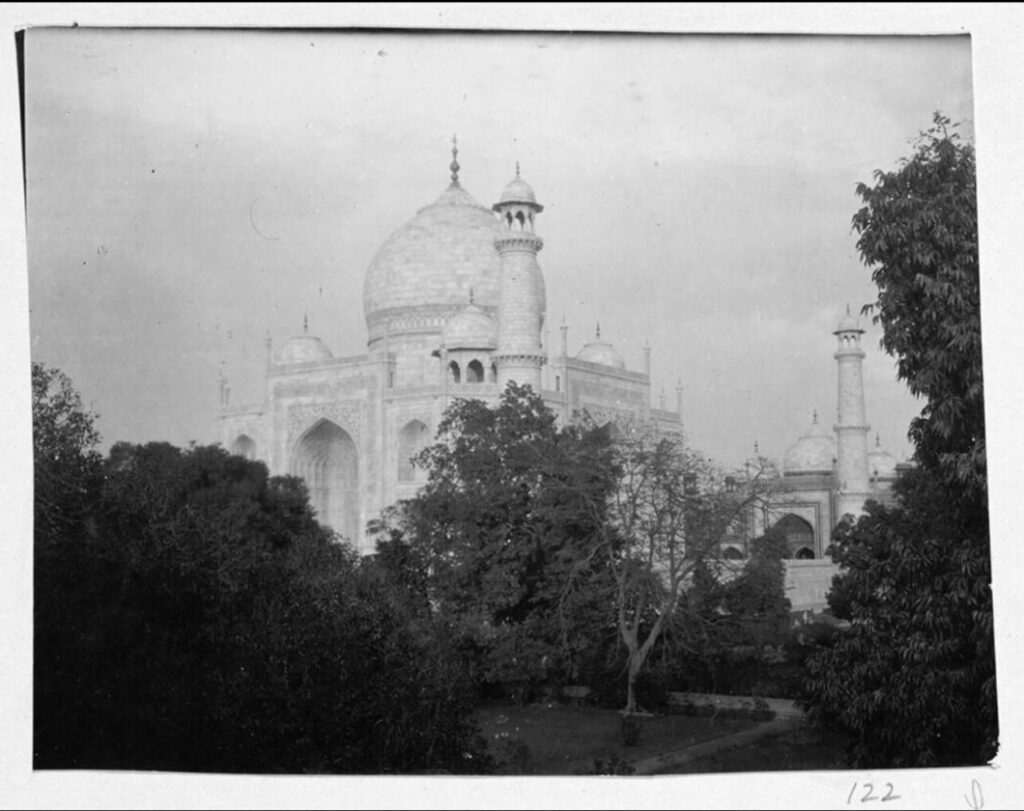
In December 1902, Gertrude journeyed to India as a guest of the modernity-themed Delhi Durbar hosted by the Viceroy of India, Lord Curzon. Gertrude still followed Edwardian norms. This time, her younger half-brother Hugo joined her. His presence as a male family member would maintain respectability and reduce scrutiny.
The durbar was held to mark King Edward VII’s accession as Emperor of India. Lord Curzon had spent years planning the opulent multi-day event. The idea was to create pageantry from local traditions that had been intensely hybridized with European traditions.
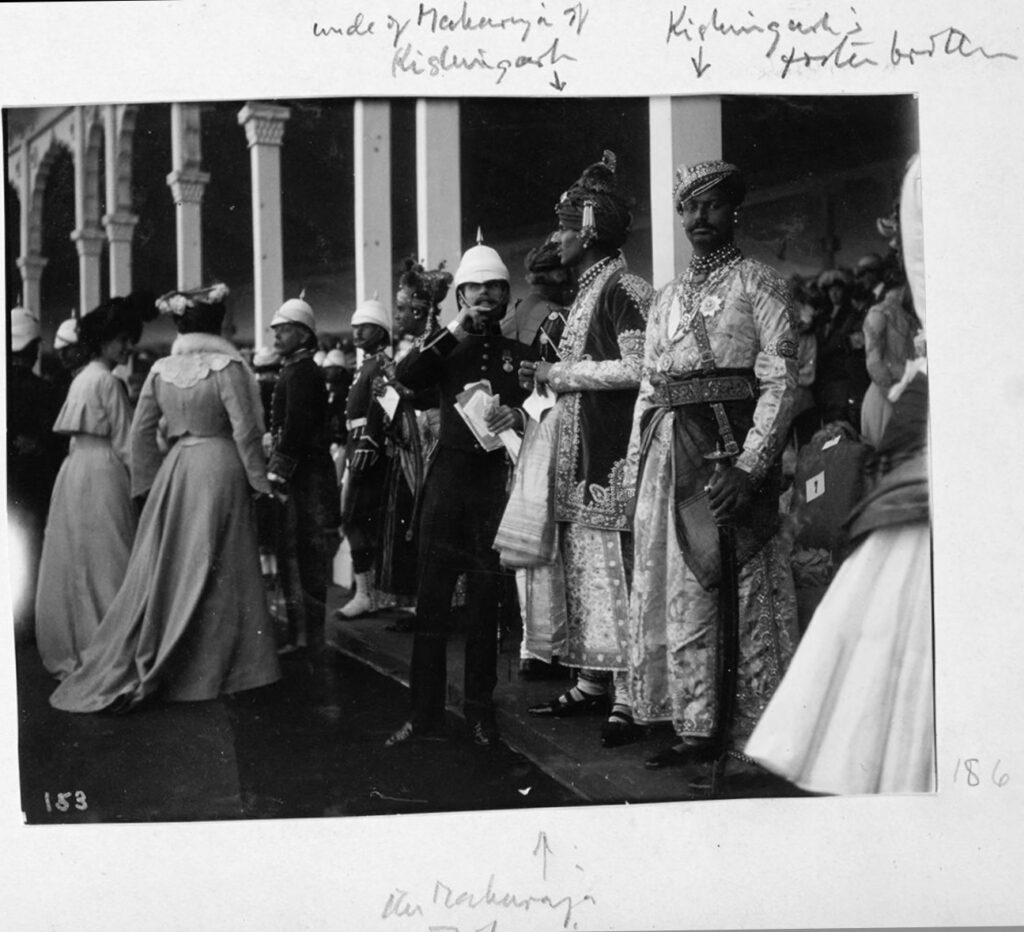
Just over 160 ruling native Indian princes attended the events, including maharajas, rajas, nawabs, nizams, khans, and chiefs of smaller states. The princes of India traveled in procession astride elephants, clad in jewels, playing the part of exotic imperial vassals. What Gertrude and other attendees witnessed in the procession of princes was the public display of rank as organized under the British Raj. In many cases, these princes had been shaped over generations through British control of succession and influence on education, producing rulers selected for compliance with the colonial administration. [2]
It was a grand, extravagant event. However, contemporary observers noted the dissonance between spectacle and reality. In a conversation with Gertrude, A state’s financial advisor stated that his Raja’s private encampment, its manicured garden, colored lights, and tents costing £20,000 as financial ruinous on his state’s already bankrupt financial situation [3] The comment exposes the Durbar not as a celebration of princely sovereignty, but as an internally financed performance imposed upon states already fiscally constrained by empire.
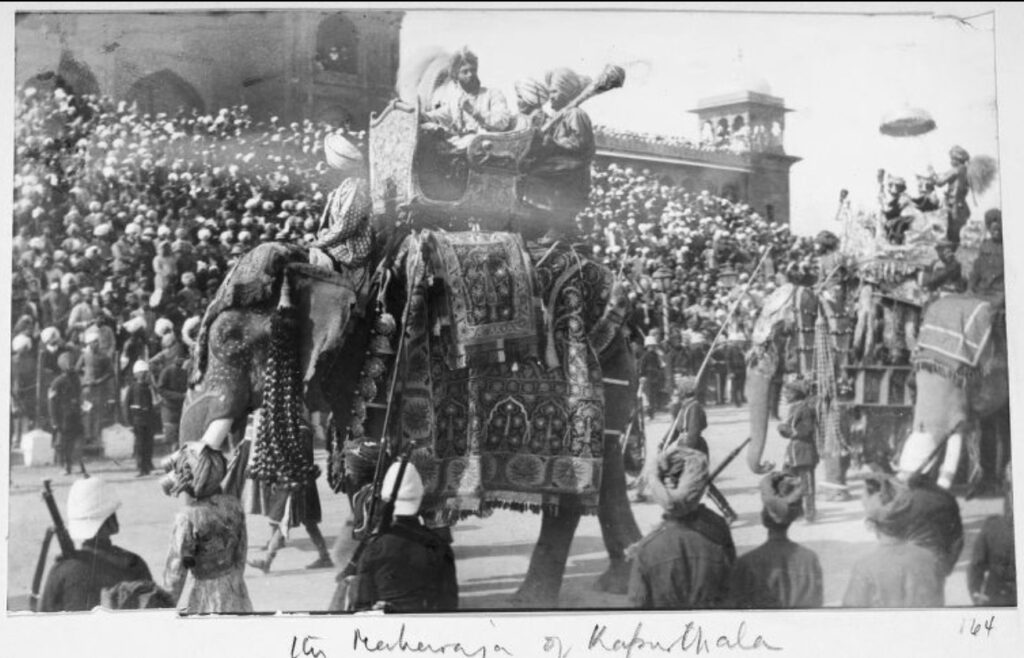
On the 7th, Gertrude Bell attended a spectacle within the Durbar amphitheatre. She recorded detailed impressions of the procession, noting Ladakhis in masks, Jaipuris in coats of mail, elephant carriages belonging to Ulwar and Baroda, and gold and silver guns pulled by bullocks for Scindia. She described Shan musicians in large hats beating gongs, elephants painted with leopards on their faces, musicians of many kinds, men in padded armour, camel carriages, and gold and silver palkis with long horses and seats supported by silver cheetahs. Covered ekkas drawn by bullocks followed. The procession also included armed performers on stilts, dancers, men from Kashmir and Baluchistan distinguished by stature and dress, and a ruler from Nabha whose appearance drew particular attention. Altogether, Bell concluded, it was “every fantastic thing that the mind of man could conceive.” [5]
From the arts exhibition that recast functional craft traditions as static “Indian art,” to the maharajas’ bejeweled regalia staged for imperial spectacle, Lord Curzon’s Durbar presented not India as it was, but India as British authority permitted it to be.
Observing Empire
“The great interest of the Durbar has been the way in which it has brought together people from all parts of the world, from Muscat [Masqat] to Burmar [Burma (Myanmar)], so that one has been able to hear so many different points of view. And they are all willing to talk, these people; enchantingly willing, even to an outsider”[6]
In Bell’s India writings, people appear as integral to the landscape itself—moving through it, living lives foreign to her, and shaping it through political, religious, and social motivations. This is in contrast to her earlier letters and diary entries from Japan. In the latter, people are more often framed as figures within an ordered scene.
Bell’s letters and diary entries are striking for the density of description; she records movement, sound, and social arrangement with a precision that allows scenes to speak for themselves. Her writing suggests a habitual attentiveness rather than a single guiding purpose. She records what she sees carefully, often without interpretation, as if description itself were a way of situating both place and self.
Gertrude seems to have approached travel as work rather than diversion, recording landscapes, peoples, and political structures with sustained attention. Her writings reveal a genuine interest in historical and cultural sites, drawing from traditions native to the subcontinent. Although often described as an atheist, Gertrude Bell rarely disparaged religion in her writing, treating belief less as a matter of personal conviction than as a durable social and political structure that demanded understanding rather than dismissal. While Hugo, who would later join the clergy, visited Christian churches as they traveled, Gertrude observed mosques, Hindu temples, and Buddhist sites, noting belief without endorsing or attacking it.
Gertrude’s extensive photography displays her habit of close observation, fixing landscapes, architecture, and social arrangements in visual form much as her writing fixed them in prose. Yet her photographs were not simply snaps of the “exotic.” At one point, Bell recorded the details of a priest of Hanuman with whom she sat on the steps of his temple to watch the sunset, so that she could later send him a copy of the photograph he had agreed to let her take.
A daughter of empire, she nonetheless recognized that there was far more beneath the surface than imperial display allowed. Yet at the same time, she never forgot that, as she put it, “we took India with the sword, and we hold it by the sword.” [7]
An Englishwoman in an Anglicized Land
“He [Maj. D. S.] told me many tales and said he was bringing up his little Raja like an Englishman and keeping every bad influence from him, but he is very Sikh, too Sikh he thinks.” [9]
In India, the Bell siblings traveled along the edges of empire, where curiosity, privilege, and authority overlapped. That overlap made their experience feel unusually intimate, curated, and at times ceremonial. Gertrude and Maurice’s earlier trip to Japan had taken place in a country where foreign access was tightly controlled, yet one that already possessed a developed mass-tourism infrastructure. In British-controlled India, however, they were treated like visiting dignitaries, for the most part. There was a brief encounter while traveling in Vrindavan, where a beggar followed Gertrude, crying out for bakhshish and yelling, “She has everything and I nothing.” [10]
When Gertrude ran into Aga Khan III, a prominent leader and future president of the All-India Muslim League, she congratulated him on a recent presidential address, a conventional acknowledgment within imperial elite society. The encounter, which occurred unexpectedly while shopping, shows that the Bells and a senior leader in his own country were operating within overlapping elite worlds. It points to an imperial social sphere held together by short, transcontinental chains of personal connection, in which individuals were separated by only a few degrees of acquaintance.
Bell was clearly aware of the indoctrinatory character of colonial education, yet she recorded it as a matter of the everyday machinery of empire. The following quote is from the Bell’s encounter with schoolboys reciting English hymns and an outdated royal anthem. The experience further underscores the performative nature of colonial education, in which loyalty to the Crown was taught.
“ ‘Longliveourgraciousqueensendhervictorioushappyandglorious,’ all said at the top of a high squeaky voice. The favorite poem—we heard it at least six times—began ‘Father of all.’ It was a hymn, I think. H. looked over an examination paper one little boy was answering and read, ‘The Lakes of Scotland are Adeego and Ladogo.’ We are at a loss to interpret this.”[11]
The Bell’s experiences in India unfolded within a landscape where Englishness was not merely present but enforced, from princely households to schoolrooms, imperial authority shaped identity through instruction and performance. Bell moved comfortably within this world, yet her observant writing preserves its strains and contradictions, showing an empire maintained not only by power, but by indoctrination.
Conclusion
Gertrude Bell’s writings and photographs from her time in India do not resolve the contradictions of imperial rule; they register them. India marks a shift in Bell’s relationship to what she observed: she was no longer merely encountering difference in a foreign land, but moving within a system shaped by the same imperial structures that had enabled her family’s industrial fortune. By the time of her 1903 Durbar travels, the Bell Bros. enterprise had already begun to be dismantled through liquidation and consolidation, even as the imperial world that sustained it remained intact. Bell absorbed the details of that world as it existed in the moment, simultaneously familiar and foreign, recording its hierarchies, rituals, and routines. In doing so, she was engaging in forms of observation and proximity that would later shape her work.

Notes & Citations
[1] Gertrude Bell, Photograph: Taj Mahal, Agra, India, 24–25 December 1902, GB/3/2/1/122, Gertrude Bell Archive, Special Collections, Newcastle University. https://gertrudebell.ncl.ac.uk/d/gb-3-2-1-122.
[2] Codell, Julie, ed. 2012. Power and Resistance: The Delhi Coronation Durbar. Ahmedabad: Mapin.
[3] Gertrude Bell, diary entry, 2 January 1903, GB/2/8/2/1/2, Gertrude Bell Archive, Special Collections, Newcastle University. https://gertrudebell.ncl.ac.uk/d/gb-2-8-2-1-2
[4] Gertrude Bell, Photograph: Delhi Durbar – State Entry procession with Maharaja of Kapurthala (29 December 1902), GB/3/2/1/164, Gertrude Bell Archive, Special Collections, Newcastle University, Delhi, India. https://gertrudebell.ncl.ac.uk/d/gb-3-2-1-164
[5] Gertrude Bell, diary entry, 7 January 1903, GB/2/8/2/1/7, Gertrude Bell Archive, Special Collections, Newcastle University, India: Delhi. https://gertrudebell.ncl.ac.uk/d/gb-2-8-2-1-7.
[6] Gertrude Bell, letter to Dame Florence Bell, 2–7 January 1903, GB/1/1/1/1/13/1, Gertrude Bell Archive, Special Collections, Newcastle University. https://gertrudebell.ncl.ac.uk/d/gb-1-1-1-13-1.
[7] Gertrude Bell, diary entry, 10 February 1903 (GB/2/8/2/2/10), Gertrude Bell Archive, Special Collections, Newcastle University, Kolkata, India. https://gertrudebell.ncl.ac.uk/d/gb-2-8-2-2-10.
[8] Gertrude Bell, Photograph: Delhi Durbar—Coronation Durbar at the Durbar Horseshoe, with Maharajas, British dignitaries, and guests (1 January 1903), GB/3/2/1/186, Gertrude Bell Archive, Special Collections, Newcastle University, Delhi, India. https://gertrudebell.ncl.ac.uk/d/gb-3-2–1-186.
[9] Bell, diary entry, 2 January 1903, GB/2/8/2/1/2.
[10] Bell, Gertrude. 1903. Diary entry, 1 February 1903. GB/2/8/2/2/1. Gertrude Bell Archive, Special Collections, Newcastle University, Deeg, India. https://gertrudebell.ncl.ac.uk/d/gb-2-8-2-2-1.
[11] Gertrude Bell, letter to Sir Thomas Hugh Lowthian Bell, 22–25 December 1902, GB/1/1/2/1/7/11, Gertrude Bell Archive, Special Collections, Newcastle University, Jaipur, India. https://gertrudebell.ncl.ac.uk/d/gb-1-1-2-1-7-11.
For readers who wish to follow ongoing research, subscription is available in the footer.