The region in which the mob violence unfolded, and where most of Part II and all of Part III will center, rests in lands surrounding what is today Wheeling, West Virginia. Geographically, this stretch of the Ohio River begins downstream from the “Forks of the Ohio,” the confluence of the Allegheny and Monongahela Rivers at present-day Pittsburgh. From there, the region runs west and south along the Ohio to the northern tip of West Virginia, encompassing Wheeling and its surrounding settlements on both sides of the river, near the present-day Ohio–West Virginia border.
On Buffalo Trails
This territory was a plentiful wilderness in the eighteenth century, thick with buffalo, deer, turkey, and other game. Yes—the American bison, a creature now considered synonymous with the Great Plains, once roamed Appalachia. In fact, Wheeling was built atop a bison trail.[1] Place names across West Virginia—Buffalo Lick and Buffalo Flat preserve that heritage metaphorically and linguistically.
Moreover, this region represented a rare instance in the imperial history of land expropriation in the Americas: the land colonists coveted was not occupied by longstanding Native villages year-round. Few permanent Native settlements existed in the Upper Ohio Valley after the Shawnee and Lenape[2] were pushed westward by the Six Nations following their defeat in what modern historians call the Beaver Wars. Instead, Shawnee, Ohio Haudenosaunee (often referred to by colonists as “Mingo”), and Lenape groups used the area seasonally. They returned seasonally to hunt, seeking prime winter hides in the cold months, and fresh meat again in the spring, while their more permanent towns stood along the Muskingum, Scioto, or Sandusky rivers amongst others.
This pattern is reflected in later featured encounters. In meetings recorded between George Washington and Guyasuta or Michael Cresap and Killbuck, Native groups appear not as permanent residents of the Wheeling area but as hunting parties and travelers passing through. Logan’s family, too, were likely in the valley during the spring hunt.
La Belle Rivière
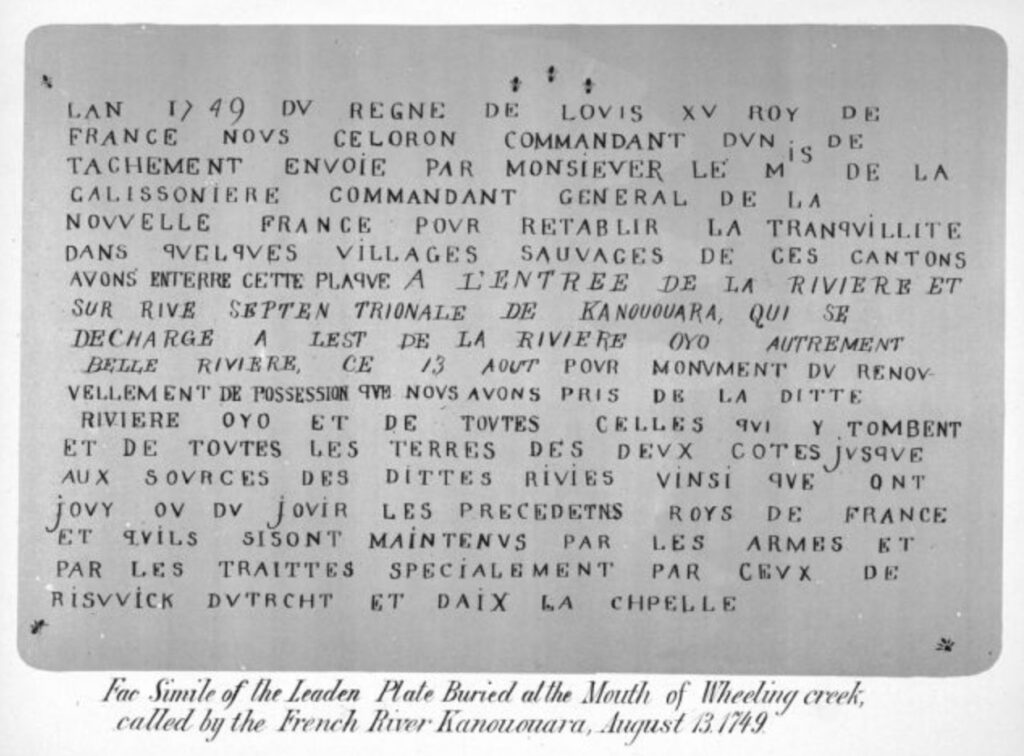
In 1749, the French dispatched Pierre Joseph Céloron de Blainville, commander of a force composed of Troupes de la Marine, local militia, and select Native allies, to explore and assert sovereignty over the Ohio River Valley. As he moved down the river, Céloron buried inscribed lead plates at the mouths of tributaries, each one declaring France’s claim to the valley. At least six of these markers were planted, though only one survives. Unearthed in 1846 at the mouth of the Kanawha River and now preserved by the Virginia Museum of History & Culture, it records the French name for the stream as Chinodahichiltha—a name that, like France’s ambitions in the Ohio Valley, never endured.[3] No French toponyms took root in the Upper Ohio.
Americans still like to recall that the French once called the Ohio, La Belle Rivière—“the Beautiful River.” Yet even this was not a French invention. “Ohio” itself derives from a Haudenosaunee word (ohiːyoʼ), usually glossed as “great” or “beautiful river.” What the French translated into La Belle Rivière was already an Indigenous name. The valley’s most enduring toponym, in other words, is Haudenosaunee, not French.
Interestingly, neither of the names the French recorded in 1749 was French in origin. Kanououara, their rendering of Wheeling Creek, was an Algonquian word, likely from the Lenape language, preserved imperfectly through French ears. Chinodahichiltha, inscribed on the lead plate at the mouth of the Kanawha, was also an Indigenous name, probably Algonquian or Siouan in derivation, captured in distorted French spelling. What survives in their journals and inscriptions are not French place-names but fractured echoes of Native words.[4]
During the expedition, Céloron’s party identified only one significant settlement along the Ohio: Logstown, a multiethnic Native and trader community. There, he encountered hunters from the Carolinas who had pushed into the valley to trade.[5] Céloron ordered them to carry a message back to their colonial governor that essentially said, stay out. As far as French officials were concerned, the Ohio Valley fell squarely within their imperial sphere. Logstown linked Indigenous hunters to European markets voracious for pelts, and the French intended to protect that trade at all costs. To a modern reader, when hardly anyone wears fur anymore, it can be startling to realize just how much of North America’s early conflicts, Native and colonial alike, were driven by control of the fur trade.
The Native Peoples of the Upper Ohio River Valley
As previously noted, the valley was the hunting grounds of Shawnee, Lenape, Seneca, Gayogohó:nǫ (Cayuga), Wyandots, and many other tribes. Modern place names such as Old Mingo Bottom, the site of modern Follansbee, near Harmon Creek on the West Virginia side of the Ohio, survive as an enduring testament that the European settlers were aware that their newly claimed land had only recently been forcibly abandoned by westwardly moving Native tribes. Research that preceded the dedication of the Mingo monument at West Virginia’s Mingo Flats suggests that about sixty “Mingo” families had once lived at Old Mingo Bottom.[7]
Native names and identities are almost always flattened in historical accounts of this era and after. It’s human nature — and a long-standing habit of colonial record-keeping — to simplify a world that was far more complex. And I’m not exempt from that danger. Even as I attempt to call out these oversimplifications in the paragraphs ahead, I know I risk repeating them, because the surviving sources themselves are already filtered through layers of translation, assumption, and erasure..
Haudenosaunee
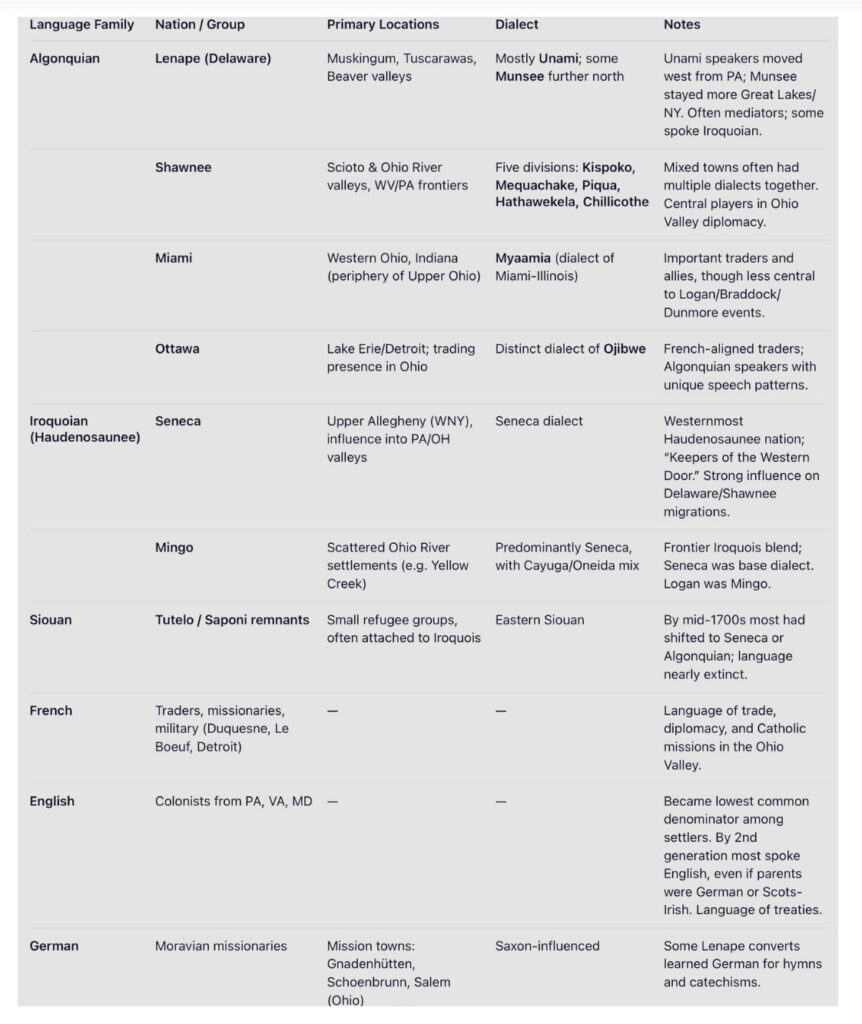
Haudenosaunee were the people of the original Five Nations confederacy, the Six Nations: Kanienʼkehá꞉ka (anglicized Mohawk), Onyota’a: ka (Oneida), Onondagaono (Onondaga), Gayogohó:nǫ (Cayuga as aforementioned), and Seneca, who became the Six Nations with the addition of the Tuscarora for the majority of the eighteenth century and beyond. The name ‘Iroquois’ was an exonym assigned by Algonquian speaking Native American peoples, often unfriendly to the Haudenosaunee, that colonists picked the name up. Which name should be used then? Haudenosaunee is more respectful. The modern members of the Haudenosaunee consider themselves, Ongweh’onweh, which means human beings.
“Mingo”
“Mingo” was a colonial catch-all used to describe Iroquoian speaking migrants, mostly Seneca or Cayuga (including Logan’s family), who had resettled in the Ohio Valley. Mingo is entirely a colonial outsider term, an English corruption of the Algonquian mingwe/minqua — a slur used by Lenape and other Algonquian neighbors for the Iroquois. Colonists picked it up and used it to degrade what they saw as a base and contemptible “tribe.”[8]
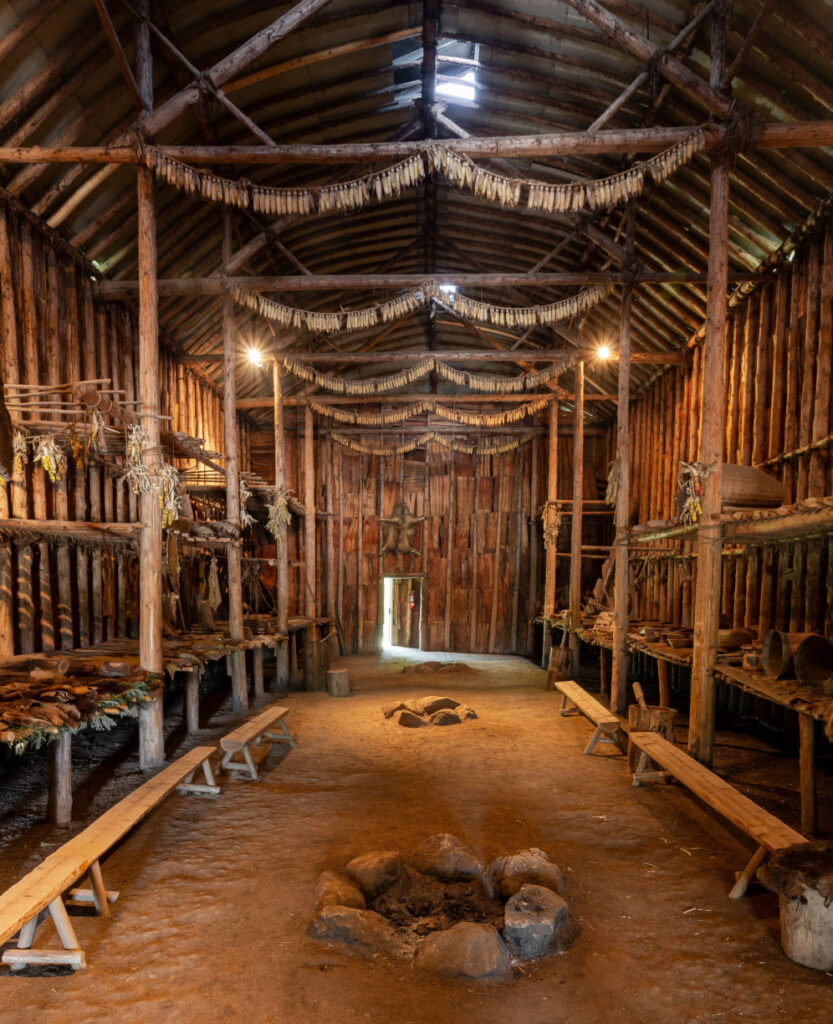
An interesting paradox is at work here. Colonists seized on Mingo as a degrading shorthand for what they thought was a separate “tribe.” They were clueless and insulting — but not blind. What they stumbled onto, despite themselves, was a fundamental cultural shift. Living beyond the “Longhouse”, the western Haudenosaunee adapted to frontier conditions, intermarried, brokered diplomacy with Algonquian neighbors, and raised a generation that saw itself as “Ohio people.” Over time, this frontier group developed its own political voice, living outside direct Haudenosaunee authority yet still drawing on Iroquois language, diplomacy, and kinship. In that sense, the “Mingo” were not only a distinct people in colonial eyes — but they also operated as a separate body in the Ohio Valley world, bridging Haudenosaunee, Algonquian, and colonial spheres. The colonist recognized that culturally the western Haudenosaunee were different than the eastern.
Regardless, from the Haudenosaunee perspective, the “Mingo” were not a distinct seventh nation. They were Seneca (Onödowáʼga:ʼ), Cayuga (Gayogo̱hó꞉nǫʼ), and occasionally Oneida families who had left the Longhouse and moved west. In their own terms, they remained members of their nations. The Longhouse didn’t create a new wampum seat or acknowledge a “Mingo nation. As far as the Six Nations thought, the Ohio Haudenosaunee were “hunters” on the fringe and did not consult them in the decision making process. [9]
The tragedy is that the term “Mingo” continues to exist. I thought, surely, a better term must exist. The short answer is that no single replacement term exists today for “Mingo” because the word was always an outsider construction based off a region. There are no modern tribal members to fight for accurate naming when there is no tribe.
– Seneca & Cayuga descendants — When referring to the Ohio Valley groups, Haudenosaunee people today usually say Seneca (Onödowáʼga:ʼ) or Cayuga (Gayogo̱hó꞉nǫʼ), because that’s who those families really were. The Ohio “Mingos” were still members of their home nations, just living west.
– Modern Seneca Nation (New York) and Cayuga Nation — Their histories mention that “segments of our people migrated west” rather than using the word “Mingo.” It’s framed as part of the Seneca and Cayuga diaspora, not a separate identity.
Over time, as the Native peoples were forced together into the reservation system, descendants of Ohio Haudenosaunee were reabsorbed into their home nations or neighboring Native communities. All that is left to preserve the fact that they were a culturally distinct people is a colonizer assigned slur. Modern historians often avoid the term, preferring “Ohio Seneca” or “Ohio Iroquois” to signal origin and distinctiveness without perpetuating the insult. Why would a scholar use “Iroquois”? When do they know it’s inaccurate? If you publish a book or article today on the Haudenosaunee, many readers will only find it (via library searches or bibliographies) if “Iroquois” appears somewhere in the title, keywords, or index. So yes, historians sometimes still use it — not out of ignorance, but to make their work discoverable in the existing scholarly ecosystem.
For clarity, this blog will use ‘Ohio Haudenosaunee’ — a term that acknowledges their roots in the Confederacy and their unique Ohio Valley experience — while occasionally retaining ‘Mingo’ where necessary for historical context. I cannot abandon the word Mingo entirely. Unlike the Lenape, whose real name has become widely recognized, “Mingo” still appears in the sources and remains part of how the group is remembered.
Lenape
The people whom colonists called the “Delaware” were originally Unami and Munsee speakers along the Delaware and Hudson River valleys. Their true self-designation was Lenape, meaning simply “the People.” The name Delaware had nothing to do with them: it was imposed by the English after Lord De la Warr, an aristocrat and governor of Virginia in 1610. When Captain Samuel Argall sailed into the river and bay, he named it “Delaware” in honor of the governor. Over time, colonists extended Delaware beyond its narrow beginnings. By the late 18th century, they used it to describe all Unami and Munsee speaking people, even those pushed far west into Ohio and beyond. The irony is that the Lenape themselves did not think of themselves as a single, united nation until the pressures of removal forced them into it. Colonial usage made “Delaware” a political identity before the people had chosen it.[10]
Today, the descendants of these communities use both terms: Delaware as the official tribal name, and Lenape as a synonym that carries an older, self-determined meaning. In Oklahoma, where most Lenape live today, the southern Unami dialect is the language still being taught and preserved.. The more accurate name, Lenape, will be used for the tribe here throughout this blog series.
Shawnee
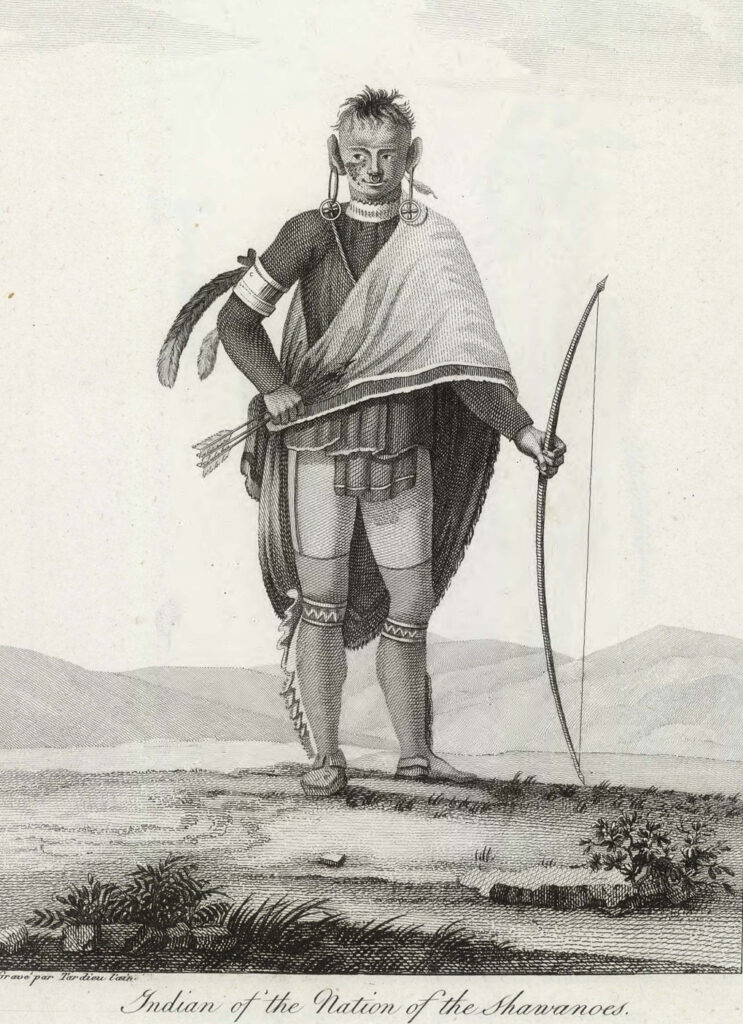
Among the Native nations active in the Upper Ohio Valley, the Shawnee were perhaps the most mobile and fragmented. Having been displaced repeatedly from earlier bases in the Southeast, they resisted being tied to a single place. Indeed, whether the Shawnee ever possessed a fixed “homeland” in the traditional sense is a subject of debate.
The Shawnee were not a confederated group. They were composed of five principal divisions: the Chalahgawtha (Anglicized as Chillicothe), Kispokotha (Kispoko), Thawekila (Hathawekela), Pekowitha (Pekowi), and Mekoche. Each division maintained its own leadership and responsibilities but was united under the broader Shawnee identity. They organized themselves less as a centralized tribe than as a set of kin-based divisions, each associated with towns that could shift location and leadership. These divisions often cooperated but primarily pursued independent courses, a flexibility that was both a strength in survival and a source of tension in politics.
The Kispoko division of the Shawnee was widely regarded as the most warlike of the tribe’s five divisions. By the end of Lord Dunmore’s War, as one of the chiefs, Puckeshinwau, lay drawing his last breaths on the banks of the Ohio after the Battle of Point Pleasant, he reportedly urged his young sons, including a six-year-old boy named Tecumseh, to continue the fight against white encroachment. That call would echo across decades of resistance.
Over time, the Chillicothe (Chalahgawtha) division tended to take on the leading diplomatic role. That did not preclude them from war or raiding, but if outsiders met with Shawnee envoys, they were more likely than not dealing with Chillicothe leaders.
Shawnee politics were decentralized, their war parties fluid, and history is never as neat as the texts written after the fact would have us believe.
What’s In a Name
Edward Said’s “imaginative geography” theory from Orientalism also applies here. Said wrote about the Middle East, but his core idea is that imperial powers imposed names to define and dominate others. So too in the Ohio Valley: by collapsing diverse communities into terms like ‘Mingo’ or ‘Delaware,’ colonists re-drew Indigenous identities on their own terms. Today, around the world, many Indigenous nations are known more widely by colonizer-assigned exonyms than by their own names. In the United States today, more Native nations are commonly referred to by English exonyms than by their autonyms — the names they use for themselves.
What’s in a name? At the time of this writing, several U.S. military bases formerly named after Confederate generals are being reinstated—albeit now officially dedicated to non-Confederate figures who happen to share the same surnames. Similarly, the federal government has referred to Denali as Mount McKinley in official communications. These controversies aren’t just about semantics, they reveal that names are political tools, carrying weight far beyond common reference. Regardless of which side you favor in any naming debate, admitting to preferring one name over another acknowledges personal investment. Naming is never neutral. It asserts authority, shapes memory, and rewrites the past. Renaming, like naming itself, is a form of battle.
When colonists labeled diverse Indigenous peoples as “Mingo” or “Delaware,” they weren’t making simple clerical errors—they were asserting control over how these peoples would be remembered, represented, and governed. As mentioned earlier, the name Mingo survives while Lenape has gradually replaced Delaware—not because one term is more accurate, but because the Lenape people still exist to demand correction. In the case of the “Mingo”, historians are left referencing a group by a name never their own—one intended initially as a slur. To misname is to misrepresent, and to misrepresent is to obscure sovereignty. It is easier to seize land when its stewards have already been reduced to vague categories or insults.
Languages of the Upper Ohio Valley (18th c.)
Notes and Citations
[1] Benjamin Duvall-Irwin, “Tracing Bison in the Appalachian Forest,” Appalachian Forest National Heritage Area, November 13, 2024, https://www.appalachianforestnha.org/america250-in-the-appalachian-forest-stories/tracing-bison-in-the-appalachian-forest.
[2] In modern usages Mingo Bottom more often refers to a location on the Ohio side of the Ohio river. I differentiate the West Virginia / formerly Virginia side by referring to it as Old Mingo Bottom.
[3] Céloron Plate | virginia museum of history & culture. Accessed August 24, 2025. https://virginiahistory.org/learn/celoron-plate.
[4] Leaden Plate Buried at Wheeling Creek,” Wheeling History, Ohio County Public Library. Accessed August 24, 2025. https://www.ohiocountylibrary.org/wheeling-history/5012
[5] H. W. Temple, “Logstown,” Western Pennsylvania Historical Magazine, accessed August 23, 2025, https://journals.psu.edu/wph/article/view/1170/1018.
[6] Leaden Plate Buried at Wheeling Creek,” Wheeling History, Ohio County Public Library.
[7] Price, Andrew, and William Henry Cobb. 1921. Monument to, and History of the Mingo Indians; Facts and Traditions about This Tribe, Their Wars, Chiefs, Camps, Villages and Trails. Monument Dedicated to Their Memory near the Village of Mingo, in Tygarts River Valley of West Virginia. F.B. Jenvy. 23.
[8] William Henry Cobb. 1921. Monument to, and History of the Mingo Indians; Facts and Traditions about This Tribe, Their Wars, Chiefs, Camps, Villages and Trails. Monument Dedicated to Their Memory near the Village of Mingo, in Tygarts River Valley of West Virginia. F.B. Jenvy. 5.
[9] Edward G. Everett, “Pennsylvania’s Indian Diplomacy, 1747-1753,” Western Pennsylvania History (Penn State Journals), accessed [September 24 2025], https://journals.psu.edu/wph/article/view/1895/1743.
[10] Bruce Obermeyer, Delaware Tribe in a Cherokee Nation (Lincoln: University of Nebraska, 2009) 37–38, 52–58; excerpted in “Removal History of the Delaware Tribe,” delawaretribe.org, accessed 20 August 2025.