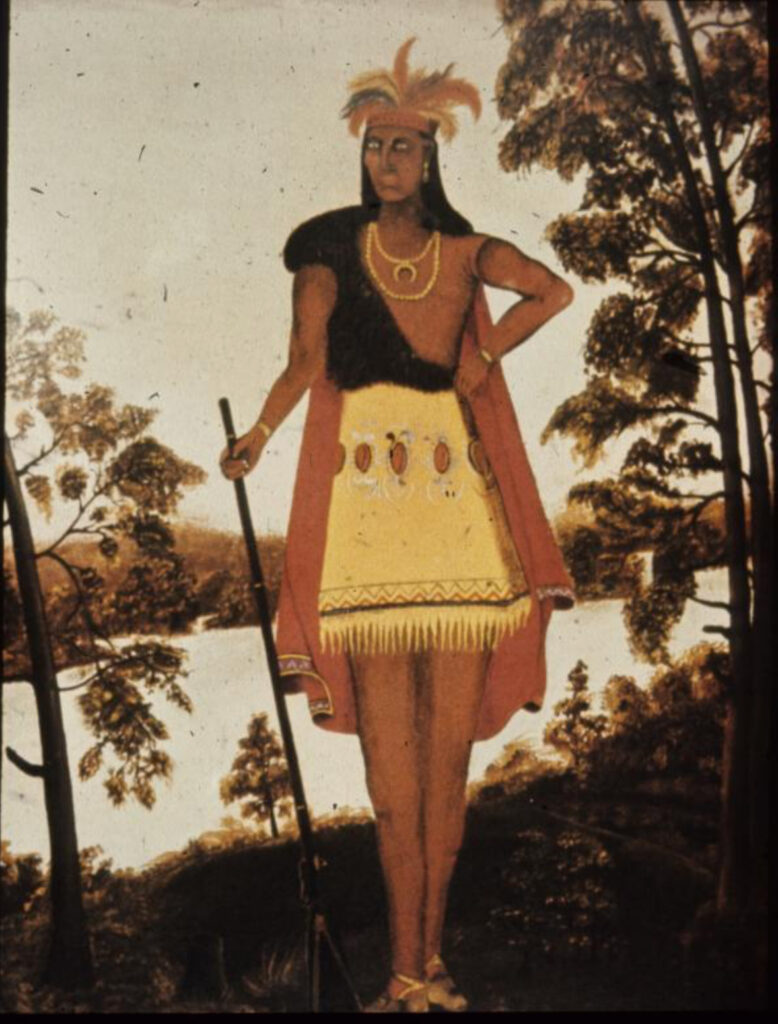
Shikellamy was no ordinary frontier figure. A Cayuga by birth but a long-time resident of Pennsylvania, he rose to become the vicegerent of the Six Nations in the Susquehanna Valley—a post that the British often translated as “viceroy.” Frederick C. Johnson later described him as possessing “an executive mind” and “more than ordinary ability,” a leader whose “counsel was eagerly sought by the government of the Six Nations” as they struggled to keep order among the region’s many peoples and competing interests.[1] Some later colonial-era accounts claim he was born a white colonist and adopted into the Haudenosaunee, but no contemporary evidence supports this. Such stories were a common trope in settler narratives, often used to explain away the authority or political sophistication of prominent Native leaders.
From his seat at Shamokin (present-day Sunbury, PA), Shikellamy served as the Six Nations’ chief representative to Pennsylvania officials and Moravian missionaries alike. He brokered trade, mediated disputes, and kept watch over the Lenape, Shawnee, and other groups that clustered along the Susquehanna. Though often portrayed in colonial records as a loyal ally of the British, he was first and foremost a servant of the Haudenosaunee (Iroquois) Grand Council, tasked with balancing diplomacy in one of the most volatile zones of the eighteenth-century frontier.
Emergence of Authority: Shikellamy’s First Entrance into Imperial Politics
In 1728, Shikellamy appeared in Pennsylvania’s records at a Philadelphia council with James Logan, William Penn’s secretary, later Provincial Secretary and President of Council, Sassoonan, the “King of the Delaware” in colonial eyes at that time, and the Shawnee. The Six Nations assigned him in this instance to supervise the Shawnee, to ensure their spokespeople did not act outside what Haudenosaunee authority allowed.[2] Colonial Records of Pennsylvania, Vol. III, notes that in Haudenosaunee eyes, the Shawnee were to be treated “as women only, and desired them to plant corn & mind their own private business, for that they [the Six Nations] would take care of what related to peace & war.”[3]
The arrangement stabilized Pennsylvania’s frontier, but at the cost of Shawnee autonomy, and it set the pattern of migration that pushed them westward in search of freedom from oversight. For the Lenape, whose fate was tied to the same Haudenosaunee suzerainty, subordination came less through Shikellamy himself than through public rebukes in treaty councils. Taken together, these humiliations reveal the reach of Haudenosaunee domination in the seventeenth and eighteenth centuries: stability for Pennsylvania and leverage for the Six Nations, purchased by erasing the political independence of neighboring peoples. Pennsylvania’s political elite rarely spoke directly with Native leaders. Instead, they relied on their interpreter-diplomat, Conrad Weiser, to manage communication through Shikellamy, the Haudenosaunee’s representative—reinforcing the layered distance between provincial authority and the Native nations it sought to govern through the Six Nations. Their cooperation stabilized Pennsylvania’s frontier politics, but it also bound Shikellamy to a colonial system that gradually undermined the very communities he sought to protect.
One day, this dual subjugation, of autonomous tribes by both the Six Nations council and colonial authorities, would reverberate with far-reaching consequences. Few figures revealed the underlying threat of those impending consequences more clearly than Philadelphia’s chosen intermediary, Weiser. His diplomacy was never neutral. He openly promoted squatter expansion as a tool of remolding the backcountry in the Anglo-European image, wagering that once settlers seized ground, Native leaders would have no choice but to negotiate on colonial terms. The strategy secured him the confidence of Pennsylvania’s authorities but left a bitter memory. After Weiser’s death, John Logan Shikellamy, Tachnechdorus, condemned him as “one of the greatest thieves in the world for lands.” [4]
The Covenant Chain
In its prime, Shamokin was more than a community; it was Shikellamy’s seat of power. In 1732, an agreement between the Haudenosaunee and Thomas Penn recognized him as a colonial envoy. His responsibilities extended beyond diplomacy with Pennsylvania officials to mediating with the Shawnee along the Susquehanna corridor of central Pennsylvania, as well as with the Lenape.
Historians widely agree that Pennsylvania, and, more broadly, British colonial authorities, deliberately strengthened Haudenosaunee authority through what both parties referred to as the Covenant Chain. This diplomatic alliance united the Six Nations and the colonies. This arrangement empowered the Haudenosaunee to dominate neighboring nations, even to the point of ceding lands without their consent. Shikellamy and his family stood at the heart of this chain: diplomats among nations, navigating the fine line between alliance and accommodation, peace and dispossession.
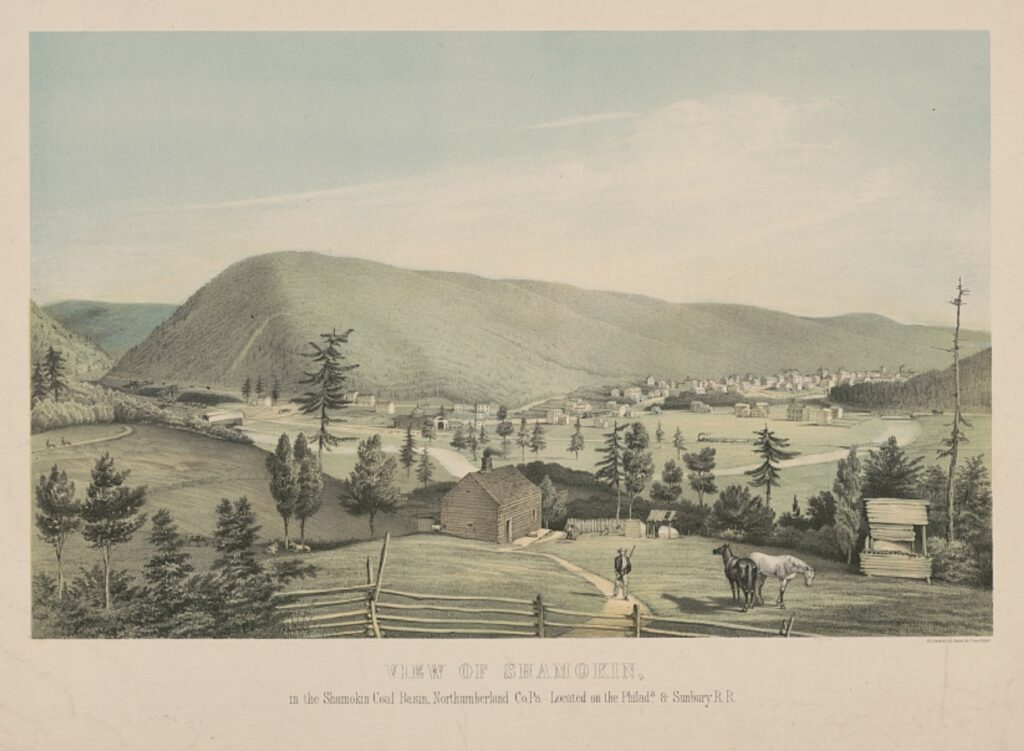
Shamokin
Shamokin was a key diplomatic hub where the Six Nations Confederacy, the Shawnee, the Lenape, and other Indigenous groups, under Haudenosaunee protection, such as the Tutelo, coexisted. Though they shared the settlement, each group maintained its internal governance. Shamokin functioned as a crossroads of Indigenous diplomacy, trade, and politics, with Shikellamy acting as the Haudenosaunee appointed overseer and intermediary to colonial authorities.
Shamokin’s importance lay as much in geography as in politics. The town sat at the confluence of the North and West Branches of the Susquehanna, the eastern anchor of the Shamokin Path—a well-worn corridor that cut across the Alleghenies toward the Forks of the Ohio. Shamokin, in reality, Schahamokink, means “place of the eels” in Lenape. To colonial officials, it was “the easiest path through the mountains,” a roadway already worn smooth by centuries of Native American footsteps.[6] That ease gave Shamokin its power. Traders, war parties, and envoys all moved along this road, making the town both a threshold and a bottleneck: nothing passed between the Susquehanna Valley and the Ohio Country without notice. For the Haudenosaunee, this meant leverage—they could monitor and regulate traffic westward. For Pennsylvania officials, Shamokin became an unavoidable first stop in diplomacy, a clearinghouse where messages to distant Shawnee or Lenape towns had to be passed. Geography itself gave Shiekellamy his strength as vicegerent, turning Shamokin into a true gateway of frontier politics.
Moravian missionary Martin Mack called Shamokin “the most important Indian town south of New York’s Tioga Point and in Pennsylvania.” However, what Native nations valued as a hub of power and exchange, the missionary experienced as a place of menace. When Mack and his wife Anna arrived in 1746, he described it as “the very seat of the Prince of Darkness,” fearing the “constant danger” of living amid what he disparaged as “drunken savages.” Yet Shikellamy, the Oneida who presided over the town on the Haudenosaunee’s behalf, saw things differently. He saw promise. He requested that Mack build a blacksmith shop there, recognizing the need for ironwork to support both daily life and diplomacy, a task the labor-driven Moravians gladly undertook. [7]
The missionaries counted about fifty huts and some three hundred residents, a community substantial enough to anchor Haudenosaunee influence in Pennsylvania. When attacks made life in this pro-British bastion too perilous, the Moravians withdrew in 1755. The following year, Fort Augusta was built — as archaeological findings confirm — directly on top of the remains of Shamokin. By then, only seven years after Shikellamy’s death, the town no longer had the strength to resist displacement.
The 1743 Virginia Crisis
In 1743, Shikellamy’s skills as a mediator were tested when a band of Haudenosaunee warriors, possibly joined by some Shawnee, crossed into Virginia near the Potomac. Colonial records described the raiders simply as “Iroquois,” a label often used loosely at the time: it might mean a Haudenosaunee person, someone under their protection, or even just “any Native from the north.” The ambiguity makes it difficult to know exactly who composed the party, though it was likely a mixed group. Their intent, however, was clear — to reach the Great Trading Path, a well-traveled corridor leading to the Catawbas, long-standing enemies of the Six Nations throughout the seventeenth and eighteenth centuries. Each side, with its own network of allies, acted as a magnetic force, pulling smaller nations into their orbit and into the revolving cycle of conflict. While Pennsylvania anchored its diplomacy to the Haudenosaunee, the colonial governments of the Carolinas built their alliance network around the Catawba Nation, but that didn’t stop intertribal warfare. Why would it? The colonies weren’t united with each other outside of answering to the same foreign power.
As they journeyed south toward Catawba controlled territory, the raiding group found game scarce in an over hunted landscape. The colonists considered “tamed,” but the Native travelers found it barren of wildlife. They requested food from their Virginia based British governed “allies,” but the settlers, unconcerned with the politics of imperial friendship with allied Native communities, refused. The hungry Natives “killed a hog.”[9] Weiser was not referencing wild game in this journal entry. He meant domesticated pigs, the free-ranging livestock settlers raised on the frontier. To frontier families, livestock was more than property: it was survival. Outrage spread quickly, and a mob of settlers prepared to retaliate, even attempting to capture by force and imprison the Native party.
The settlers pursued under a white flag, which the Native party understood as a “token of peace.” But as the settlers drew closer on horseback, they opened fire. The skirmish left eight settlers and three Haudenosaunee dead, with several more on both sides gravely wounded.
At Shamokin, the crisis was seen as a direct threat. Retaliation against settler communities seemed imminent. What prevented a wider war was Shikellamy’s intervention. Through Conrad Weiser, he conveyed the Native account of events to Pennsylvania’s leaders, and then he attended a full Haudenosaunee council with representatives from all six nations. Governor George Thomas, briefed by Weiser on Shikellamy’s account, wrote to Virginia’s Governor Gooch:
“If the inhabitants of the back parts of Virginia have no more truth and honesty than some of ours, I should make no scruple to prefer an Iroquois testimony to theirs.”
Gooch admitted the events had been represented to him differently, but he, too, was inclined to believe the Haudenosaunee version. To mend relations, Virginia authorized £100 sterling in gifts to be presented to the Six Nations council.[10] Through such diplomacy, Shikellamy prevented what might have been the spark of a frontier war.
The Pennsylvania Council minutes, combined with Weiser’s account, preserve a window into Shikellamy’s diplomatic world. Faced with a crisis of international scope—drawing in two colonies and the Six Nations, and threatening to unravel the Covenant Chain—he steered events away from escalation. His intervention kept a frontier clash from spiraling into a war that might have altered the course of colonial history. His sons were almost certainly present; as they often accompanied him to councils, they would have seen firsthand that words, if carefully chosen, could be as powerful as weapons.
Conclusion
Shikellamy understood the strategic value of the Six Nations’ alliance with the British colonies. Still, he also believed that the land’s Indigenous peoples should not lose their autonomy or way of life in the process. From his seat at Shamokin, he worked to preserve peace, manage settler encroachment, and ensure that colonial ambitions did not drown out Native voices. Yet he walked a difficult line, not only with colonial officials but also within Indigenous circles. His close ties to Pennsylvania authorities, especially James Logan, and his role in mediating land disputes and treaty negotiations earned him the trust of some, but the suspicion of others. Among his critics were Native groups who questioned the authenticity of his family’s identity, seeing them as compromised by ties to colonial authorities and clouded by too much friendship with colonists.
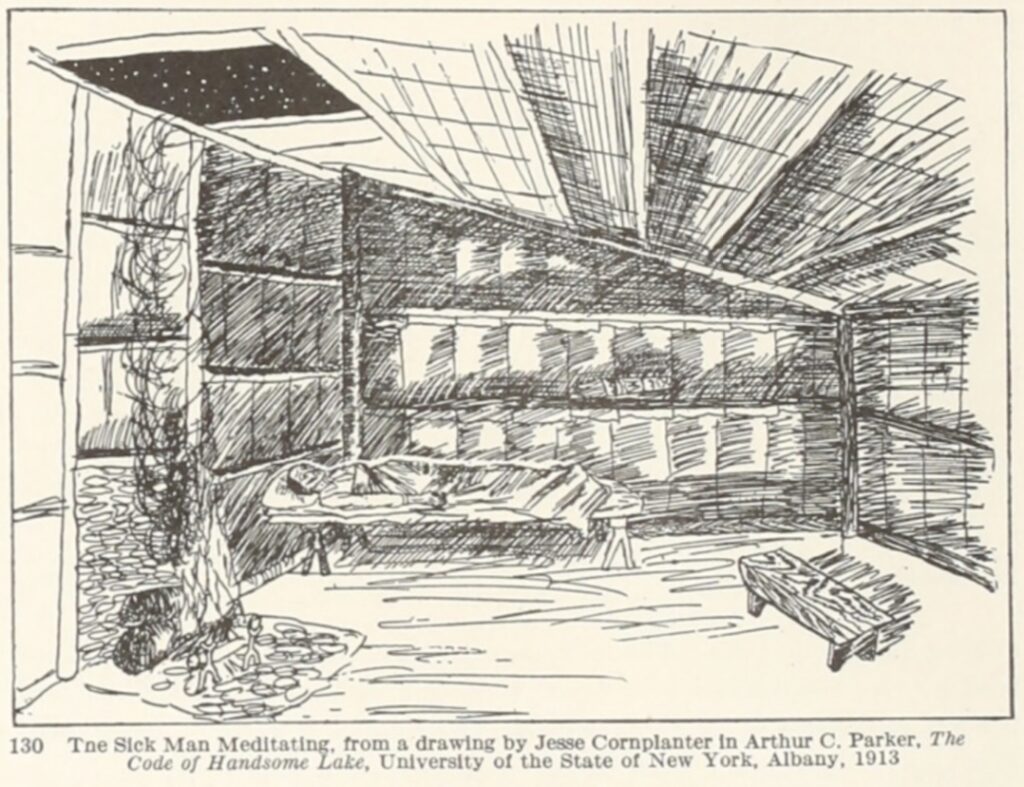
Shikellamy is remembered as the father of at least five children—three prominently attested sons (John Logan/Tachnechtoris, James Logan, and Taylayne/John Petty) and two daughters. His daughters are less securely documented, though some accounts preserve the name Koonay for one of them. The family was struck hard by the epidemic that swept through Shamokin in 1747–1748. Both John and James Logan Shikellamy lost children to the sickness; one of them is said to have buried as many as five that year. James Logan’s first wife also died in the outbreak, compounding the grief. The devastation did not stop there. On October 21, 1747, Shikellamy’s wife—named Neanoma in the Moravian diaries and remembered as the mother of John and James—also died. Missionaries at Shamokin quietly noted her burial.[14] These losses weakened the family just before Shikellamy himself succumbed to fever in early 1748.
Shikellamy’s death left a void in Pennsylvania’s fragile diplomacy. For nearly two decades, he had been the linchpin between the Haudenosaunee Grand Council, Pennsylvania’s leaders, and the Native communities of the Susquehanna. His son, John Logan Tachnechdorus, [15] inherited the office of Haudenosaunee vice-regent, taking on the role of intermediary between Pennsylvania officials and the Native peoples of the Susquehanna Valley. However, in the face of such devastating losses to the population and without Shikellamy’s steady hand, Shamokin faltered. Moravian missionaries observed that the “mission at Shamokin did not flourish after Shikellamy’s death,”[16] but they may as well have spoken for Shamokin itself. The missionaries abandoned the mission at Shamokin altogether in 1755 at the outbreak of the Seven Years’ War. The community was burned and abandoned by its residents a year later.
If he had lived, Pennsylvania’s diplomacy in the 1750s likely would have been smoother, with fewer missteps and flashpoints. Shamokin might have remained a stronger Native hub during the Seven Years’ War instead of collapsing. However, the significant currents—the Haudenosaunee siding with the British, settler encroachment accelerating, and Native autonomy eroding—would still have progressed. His presence could have bought time, but it would not have reversed the tide.

Notes & Citations
[1] Frederick C. Johnson, Moravian and Indian Occupancy of the Wyoming Valley (Pa.), 1742–1763, (Wilkes-Barre, PA: [Wyoming Historical and Geological Society.], 1895),[page 20].
[2] Francis Jennings, The Ambiguous Iroquois Empire: The Covenant Chain Confederation of Indian Tribes with English Colonies from Its Beginnings to the Lancaster Treaty of 1744 (New York: Norton, 1984), [307].
[3] Colonial Records of Pennsylvania, vol. 3 (Harrisburg: State of Pennsylvania, 1838), 334.
[4] James H. Merrell, Into the American Woods: Negotiators on the Pennsylvania Frontier (New York: W.W. Norton, 1999), 296.
[5] S. Duval & Co., View of Shamokin, in the Shamokin Coal Basin, Northumberland Co., Pa., Located on the Philada. & Sunbury R.R., lithograph, c. 1850s. Library of Congress. https://commons.wikimedia.org/wikiFile:View_of_Shamokin,_in_the_Shamokin_Coal_Basin,_Northumberland_Co._Pa.Located_on_the_Philada.%26_Sunbury_R.R._LCCN2015647835.jpg.
[6] George P. Donehoo, Indian Villages and Place Names in Pennsylvania (Harrisburg: Pennsylvania Historical Commission, 1928), 9.
[7] Frederick C. Johnson, Moravian and Indian Occupancy of the Wyoming Valley (Pa.), 1742–1763 [pages 8 & 48].
[8] James H. Merrell, Into the American Woods: Negotiators on the Pennsylvania Frontier, 170
Jennings. The Ambiguous Iroquois Empire: The Covenant Chain Confederation of Indian Tribes with English Colonies from Its Beginnings to the Lancaster Treaty of 1744. 355
[9] Francis Jennings, The Ambiguous Iroquois Empire: The Covenant Chain Confederation of Indian Tribes with English Colonies from Its Beginnings to the Lancaster Treaty of 1744. 354
[10] Colonial Records of Pennsylvania, vol. 4 (Harrisburg: State of Pennsylvania, 1838), 653-655.
[11] Shikellamy. c. 1820. Artist unknown. Philadelphia Museum of Art, Garbisch Collection, 1966.
[12] The question of Logan’s Native name has long been a subject of debate. Variants such as Tah-gah-jute, Sayughtowa, and Sogogeghyata appear in the records, yet modern scholarship increasingly regards the popularized Tah-gah-jute as unreliable. Rather than attempt to settle a controversy that cannot be resolved with certainty, I will follow the convention of referring to him as James Logan, the name by which he was most consistently identified in colonial records and remembered in later history.
[13] Gabriel, Ralph Henry, ed. The Pageant of America: A Pictorial History of the United States. Vol. 2, “The Lure of the Frontier.” New Haven: Yale University Press, 1929. Drawing by Jesse Cornplanter p. 69.
[14] Martin Mack, Martin Mack’s Diary, September 29, 1747–December 31, 1747, entry for October 21, 1747, Shamokin mission, in The Shamokin Diaries, Bucknell University, accessed September 2025, https://shamokindiary.blogs.bucknell.edu/texts/the-english-text/martin-macks-diary-september-29-1747-december-31-1747/#_ftn63.
“The Shamokin Diaries: Index of Persons,” Bucknell University, accessed September 2025, https://shamokindiary.blogs.bucknell.edu/people/.
[15] John Logan, Tachnechtoris, should not be confused with his brother James Logan. That is a separate naming controversy that will be addressed later in the series.
Merrell, Into the American Woods: Negotiators on the Pennsylvania Frontier, 104
[16] Frederick C. Johnson, Moravian and Indian Occupancy of the Wyoming Valley (Pa.), 1742–1763, 47.
For readers who wish to follow ongoing research, subscription is available in the footer.