The English were trading on the Ohio River by the early eighteenth century, and “long hunters” had already begun making the months-long journeys into the interior — the kind of frontier odyssey that would later epitomize the life of Daniel Boone. Yet English settlement still hugged the Atlantic seaboard. In 1747, after years of lobbying by Tidewater elites, London investors, and Virginia planters — including Lawrence and Augustine Washington, George Washington’s half-brothers — King George II granted the Ohio Company of Virginia a charter for 200,000 acres in what is now western Pennsylvania, West Virginia, Maryland, and Ohio.[1] The Company’s aims were twofold: seize a share of the fur trade profits that had long enriched the French, and parcel out land for speculation and resale to colonial settlers. To advance this project, the Company hired frontiersman Christopher Gist to survey the land and negotiate with Native nations.
Native–English Relations on the Eve of the Ohio Company
For the moment, the Ohio River Valley remained largely untouched by European settlement. By mid-century, English colonists had secured control over much of the eastern seaboard, while Native nations who had once lived there were increasingly forced westward — the product of broken alliances, wars, and coerced removals. The Ohio Valley was the next prize in this cycle of expansion and displacement.
The colonial governments believed they could contend with the Native peoples living beyond the dense forests that separated the coastal plain from the interior, but they underestimated the consequences of breaking the informal buffer that had long existed. By pushing English settlement and trade into the Ohio Valley, colonists not only threatened Native homelands but also provoked a furious French response. The French saw the Ohio Company’s activities as erasing the line of separation that had long kept rivals at bay and as a direct threat to their fur trade networks.
In 1750–51, Ohio Company surveyor Christopher Gist scouted the Forks of the Ohio and identified it as the ideal site for a fort, just upriver from the Native trading settlement of Logstown. He may or may not have known of the warning Pierre Joseph Céloron de Blainville had issued to Carolina traders there only a couple of years earlier, but he would soon learn how far the French were prepared to go. In 1752, French and Ottawa forces attacked Pickawillany in northwest Ohio, killing Miami allies of the British and signaling their determination to resist English encroachment.
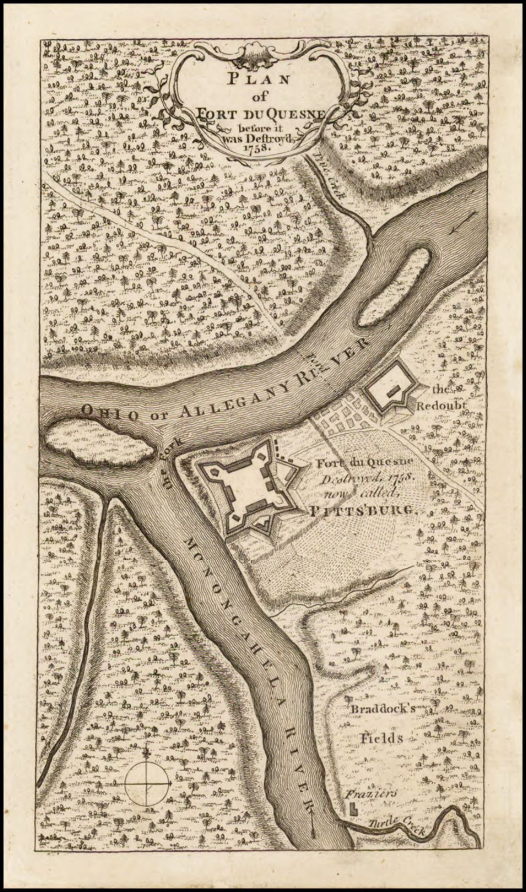
Yet Gist’s choice at the Forks also sparked friction from a different adversary. In 1754, Pennsylvania’s Governor Hamilton wrote to Virginia’s Governor Dinwiddie protesting that the intended Virginia fort site lay within Pennsylvania’s chartered territory. [2] The colonies were not united. They behaved more like rival provinces competing for advantage than as members of a single empire. The French, meanwhile, expressed their displeasure more directly. As Virginia’s building project was underway, French forces with Native support seized the site and transformed it into their own stronghold: Fort Duquesne. At that moment, La Belle Rivière, the French name for the Ohio, remained firmly outside English control.
The Spark that Ignited the World’s First (Well… Depending Who You Ask) World War[4]
The groaning valve of European competition on the North American frontier finally burst into open war in 1754. In May that year, a young Virginia officer named George Washington led a force of colonial militia and Ohio based Haudenosaunee allies in an attack on a small French detachment at Jumonville Glen. The clash left French commander Joseph Coulon de Jumonville dead. Washington later claimed he was horrified when his ally, the Seneca leader Tanaghrisson (the Half-King), struck Jumonville with a tomahawk and, according to some French accounts, even washed his hands in the dead man’s brains. Whether that grisly act occurred remains uncertain — some historians accept it, others dismiss it as French propaganda.
The French moved quickly to avenge the killing. By July, they surrounded Washington’s makeshift fortification at Fort Necessity and forced his surrender. In the surrender articles, written in French, Washington unknowingly signed a statement admitting to the “assassination” of Jumonville. It was a humiliating initiation for the young officer, and for Britain, a prelude to the much larger struggle that would soon engulf Europe and its empires: the Seven Years’ War.
Most historians mark the beginning of the Seven Years’ War in North America, known here as the French and Indian War, at Jumonville Glen and Fort Necessity. It was the first direct clashes between French and British colonial forces — or at least, the ones most historians single out. Washington’s ambush is remembered as the spark under the pretense that for the first time, the two empires themselves collided. And frankly, saying that America’s first president started the Seven Years’ War just reads well. In reality, a British force had already been compelled to surrender a fort at the Forks of the Monongahela to the French the month prior — an event reported in the Pennsylvania Gazette on May 9, the same day Benjamin Franklin published his iconic Join, or Die cartoon. Washington would have been well aware that the war had already started because he had sent the report of that loss.
“The Back Settlers in Virginia, are so terrify’d by the Murdering and Scalping of the Family last Winter, and the Taking of this Fort, that they begin already to abandon their Plantations, and remove to Places of more Safety. —The Confidence of the French in this Undertaking seems well-grounded on the present disunited State of the British Colonies” – The Pennsylvania Gazette, 9 May 1754. (There is a possibility Franklin wrote this article, because he was directly quoted it in its entirety in a letter to Richard Partridge, the Colonies’ London Agent.) [5]
For frontier families, the “war” had already begun. Long before Washington marched into the Ohio country, raids, kidnappings, and killings were a brutal fact of life along the Pennsylvania, Maryland, and Virginia frontiers. Jumonville Glen may have been the empire’s opening shot — but it was not the frontier settlers’.
Fort Duquesne
Mary Jemison, later famous for her captivity narrative, remembered the terror vividly. She alone survived the fate of the rest of her relatively newly immigrated Scots-Irish settler family from an attack by Shawnee and French on their western Pennsylvania squatter’s settlement. Traveling toward Fort Duquesne as a captive, she saw the scalps of her family among those carried as trophies; her mother’s, she recalled, was instantly recognizable by its red hair. Just downriver of the fort, she later recalled seeing the burnt heads, limbs, and other fragments of white-skinned bodies.[6]
James Smith, a colonial captive taken by the Lenape, recalled being brought to Fort Duquesne after his capture. Like Jemison, he was spared through adoption into a Native community. From within the fort, he witnessed preparations for, and the aftermath of, Braddock’s disastrous 1755 campaign against the French and their Native allies. [7]
The Battle of the Monongahela and the Failure of Old World Tactics
“I cannot describe the horrors of that scene, no pen could do it. The yell of the Indians is fresh on my ear, and the terrific sound will haunt me till the hour of my dissolution” [8]
When Braddock advanced toward the Forks of the Ohio, he carried more than wagons and cannon. He carried the legacy of the Battle of Culloden, where less than a decade earlier disciplined volleys and steady ranks had shattered the Jacobite charge. At Culloden, order triumphed over irregularity, and repression followed. The Duke of Cumberland’s troops executed wounded Highlanders, burned villages, summarily put suspected sympathizers to death, and all in all achieved deliberate terror.[9] To Braddock, such military discipline was proof of civilization.
Braddock expected the same formula to tame the Ohio; every European leader did. The Duke of Cumberland had personally chosen him for this mission. Braddock has not fare well in history’s eyes; what once passed for discipline came to look like folly. He refused to adapt to woodland tactics, dismissed colonial advice, and insisted on European discipline in terrain that made it impossible. At Culloden, the British inflicted a campaign of repression that made clear who counted as “civilized” subjects and who did not. Braddock carried that same Old World disdain across the Atlantic. Colonial provincials in his army were treated as disorderly and subject to harsher punishment than the king’s regulars.Young men like Daniel Boone and Daniel Morgan were present on the campaign as teamsters—not yet the seasoned woodsmen they would later become, and with no authority to influence Braddock’s disastrous route. Critics later noted that the indirect Virginia supply route burned precious time and resources — a miscalculation that compounded the army’s struggles. Their heavy artillery and wagons slowed them down as well, not least because they had to keep stop and remove trees from the route so wheeled additions could follow. However those critiques underestimate the difficulty of journeying from eastern to western Pennsylvania in the mid 18th century.
If colonists were scorned, Native allies fared little better. Historically the Lenape and Shawnee had been allies of the British, but treatment of Natives by the colonist had since soured that former good will. The army’s soldiers gawked at Native allies who accompanied George Croghan, describing them as curiosities: “faces painted red, yellow, and black… ears slit and hung with pendants,” and their war dance as “droll and odd.” Braddock himself staged receptions in his tent, complete with guards saluting, fifes and drums, speeches, rum, and even a bullock for feasting. Yet he ignored their counsel. Scarouady, the respected Oneida chief, later complained that Braddock “looked upon us as dogs, and would never hear anything we said to him.” Of the small Native contingent that joined him, only eight remained by the time the British force met it’s end on the Monongahela. [10]
However, Braddock’s failings aside, to point to him as the sole reason for the mission’s collapse is the standard oversimplification of a disastrous military loss. Edward Braddock (1755) and Arthur St. Clair (1791) are almost bookends of that frontier cycle, their monumental defeats remembered less for structural failings than as the personal ruin of their commanders. Washington’s reaction, then as president, to St. Clair’s disaster was arguably his own “legions lost” moment — a visceral reckoning that shook the young republic to its core. Yet no one knew better than Washington, shaped by 1755, that defeat was rarely so simple, and that its roots ran deeper than individual error.
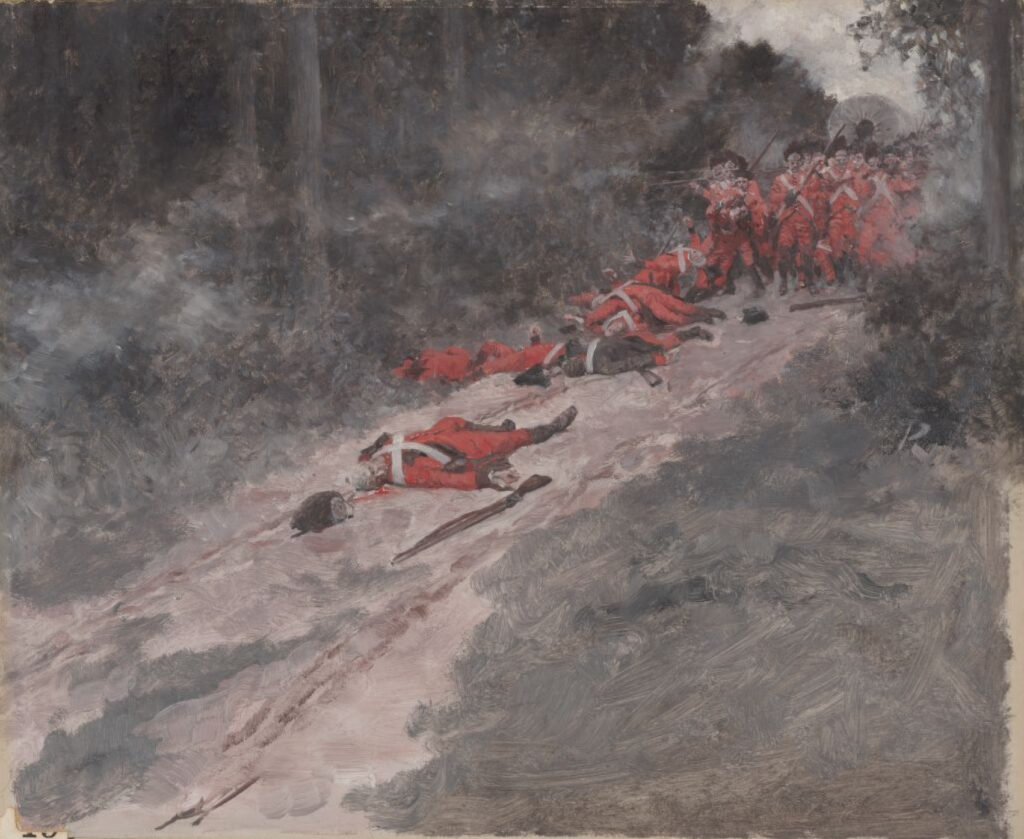
At the Monongahela, the forest inverted the empire’s script for operational control on the battlefield. There was no massed charge to repel, only scattered fire from cover that turned Braddock’s column into a trap of its own making. Faced with a enemy whose war cries pierced through the air and picked off soldier’s one by one like an invisible demonic force, the discipline of king’s regulars collapsed. [11] Braddock fell attempting to steady those who remained under him into a ordered retreat. With his gasping breath he demanded his body be left behind, however those under him, to include Washington refused to leave him to desecration.
At Culloden in 1746, it was the British who executed prisoners; at the Monongahela in 1755, according to James Smith, nearly every prisoner captured by the French and their Native allies was killed soon after. When pressed in correspondence after the war and in British intelligence reports, French officers denied issuing any such orders. They claimed they had little control over their Native allies once the fighting ended.[12] Many contemporaries blamed the French regardless, but the impending disaster at Fort William Henry in 1757—where Native forces ignored French promises of safe surrender and murdered hundreds of capitulated British and provincial soldiers—demonstrated that Native allies often pursued their own agendas rather than European instructions. Native nations had long traditions of warfare, and they did not simply conform to European rules of battle. In the end, two-thirds of Braddock’s 1,300 men were lost, leaving the frontier defenseless.
The colonials had been dismissed as inferior in the scheme of civilization. However when Braddock was struck down and the column dissolved in panic, it was a provincial officer, George Washington, who managed to rally fragments of the broken army and pull survivors from the killing ground. Among them was Thomas Gage — wounded in the fighting, his failure to secure the high ground contributed to the defeat. A decade later he would command British forces against Washington in the Revolution. One man limped back to uphold imperial order, the other rose with the frontier and came to embody the promise of its future.
The Long Frontier War
Overall command of the British expedition devolved onto Colonel Thomas Dunbar. Rather than hold the frontier, Dunbar chose to abandon it, marching the remnants of the regular army back to Philadelphia. The retreat left Virginia and Pennsylvania’s far-flung settlers, many of whom had already illegally pushed onto Native homelands, suddenly exposed. They had assumed imperial armies would guarantee their safety; instead they found themselves defenseless as raids erupted across the backcountry.
Braddock’s 1755 defeat traumatized the colonies, yet it was only the beginning of North America’s Seven Years’ War upheavals.
Fort Duquesne emerged as a potent symbol of French and Native strength in the contested Ohio Valley. For the next three years, Fort Duquesne functioned not only as a strategic outpost but also as a launchpad for psychological warfare, spreading terror throughout the Anglo-American backcountry. Months after Braddock’s defeat, the French Commander of Duquesne wrote that the Shawnee alone had hundreds of prisoners.[14] The fort cast a long shadow for settlers across western Pennsylvania: raids became a constant threat, and the fear of violence hung over daily life. While large-scale British offensives stalled, more minor skirmishes and assaults on frontier homesteads became routine. In a 1756 letter from Fort Duquesne, Jean-Daniel Dumas reported that within eight days of Governor Contrecœur’s departure, he had already “sent out six or seven parties” against the frontier. By 1757, under a new commander, French officers admitted that “parties were always out.”[15] What settlers remembered as random terror was a deliberate French strategy: a war of attrition meant to keep Pennsylvania and Virginia in panic and prevent the backcountry from stabilizing.
Yet, French forces at Fort Duquesne were isolated in a hostile land — dependent on Canada for resupply and always at risk of losing Native support as allies withdrew during disease outbreaks or decided that helping the French no longer served their interests. French detachments themselves were harassed and picked off by Native groups aligned with the English — and sometimes by unaffiliated Native enemies. The long game did not favor France.
When the outnumbered French abandoned Fort Duquesne in 1758, they destroyed it by igniting its gunpowder stores. The explosion reverberated far beyond the banks of the Ohio — marking the end of French pretensions in the valley and the beginning of a new imperial order. General John Stanwix, tasked with securing Britain’s new frontier line, ordered the construction of Fort Pitt. This permanent imperial stronghold projected British authority into the Ohio Valley more firmly than the French had ever managed. However, the fleur-de-lis was gone from the valley, yet raids and kidnappings continued for settlers. For Native peoples, it had never been about advancing French ambitions. They were defending homelands and avenging their own.
By the war’s end in 1763, the British Empire was victorious — but at what cost? In seven years, it had nearly doubled its imperial debt, the interest alone threatening to shred the empire from within. Across the globe, the war reshaped empires, from Canada to the Caribbean to India. France exits our narrative’s stage here, but not unmarked. Napoleon traced the fall of the Bourbon dynasty back to the humiliations of the Seven Years’ War.
In 1763, the diplomats in Europe declared peace. On the Ohio frontier, no one had asked the Native nations whether the war — their war for survival — was finished.
Notes and Citations
[1] “Guide to the Ohio Company Papers, 1736-1813 DAR.1925.02.” ULS Digital Archives. Accessed September 15, 2024. https://digital.library.pitt.edu/islandora/object/pitt%3AUS-PPiU-dar192502/viewer.
[2] I should address the “empire” nomenclature, some say Britain wasn’t an actual empire until after the Seven Years War. I however was afraid calling Britain a kingdom might confuse people unnecessarily.
[3] Stanford University Libraries. A Map of the British and French Dominions in North America with the Roads, Distances, Limits, and Extent of the Settlements. London: John Mitchell, 1755. Accessed June 14, 2025. https://purl.stanford.edu/cm845jc4820.
[4] Winston Churchill once called the Seven Years’ War the first “world war.” On balance, it was at least as global in scope as the later wars that inherited the title. See Winston S. Churchill, A History of the English-Speaking Peoples, vol. II, The New World (London: Cassell, 1956), 170.
[5] Benjamin Franklin to Richard Partridge, May 8, 1754, The Papers of Benjamin Franklin, Founders Online, National Archives, https://founders.archives.gov/documents/Franklin/01-05-02-0085.
Pennsylvania Gazette (Philadelphia), May 9, 1754, [news item beginning “Philadelphia”], https://www.newspapers.com/image/39399280/.
[6] Seaver, James E. Life of Mary Jemison: Deh-he-w̃-mis. Buffalo, N.Y: Print. House of Matthews Bros. & Bryant, 1886. 56.
[7] Smith, James. Captives Among the Indians: First-hand Narratives of Indian Wars, Customs, Tortures, and Habits of Life During Colonial Times. Edited by Horace Kephart. New York: Outing Publishing Company, 1915. https://archive.org/details/captivesamongind00keph/page/22/mode/2up.
[8] Francis Parkman, Montcalm and Wolfe, vol. 1 (Boston: Little, Brown, and Company, 1897), 219.
[9] The Duke of Cumberland was King George II’s son and King George III’s uncle.
[10] Francis Parkman, Montcalm and Wolfe, 204.
[11] Francis Parkman, Montcalm and Wolfe, 216.
[12] Francis Parkman, Montcalm and Wolfe, 330
[13] Howard Pyle. “Braddock’s defeat, Battle of Monongahela.” Painting. [ca. 1890–1896]. Digital Commonwealth, https://ark.digitalcommonwealth.org/ark:/50959/c247gh00d (accessed June 15, 2025).
[14] Jean-Daniel Dumas to Macarty, November 10, 1755, Archives Nationales Colonies C13, 39:1725, quoted in The Nest of Robbers, Western Pennsylvania History (2021): 168.
[15] Jean-Daniel Dumas to the minister, July 24, 1756, Archives Nationales, Colonies, C13, 39, quoted in The Nest of Robbers, Western Pennsylvania History 168.
For readers who wish to follow ongoing research, subscription is available in the footer.