Pennsylvania often stood at the center of frontier diplomacy during the Seven Years’ War. The confluence of the Allegheny and Monongahela rivers — today’s Pittsburgh — was more than the gateway to the Ohio Valley. From the Native perspective, it was also the gateway east, the funnel through which trade, diplomacy, and eventually armies flowed from the seaboard. Whoever held the Forks controlled the corridor between two worlds.
However, Virginia’s frontier was no less exposed, no less bloodied, and no less central to the invasion of Native lands or resistance to violence. Beyond the Alleghenies lay the Shenandoah and Greenbrier valleys, where Scots-Irish families carved out farms in Native homelands. Here, too, treaties on paper clashed with reality on the ground.
The Hollow Treaty: Broken Promises and Paper Boundaries
The Treaty of Easton, signed in Pennsylvania in 1758, declared that all lands west of the Alleghenies would remain Native soil. For the British, it was a strategic concession. They had seen what Native alliances could do in the French cause — most vividly on the Monongahela in 1755, where Braddock’s army was cut to pieces. With the war still in the balance, Britain could not afford mass Native support for France. Easton was meant to secure neutrality, if not outright alliance, and to reassure Native nations that their homelands would be protected.
But the ink had barely dried before the treaty’s promises were undermined. The calculus changed when Fort Duquesne fell to the British later that same year. With the French driven from the Forks of the Ohio, Anglo-American interest in respecting Native land west of the Alleghenies evaporated. Easton had bought a temporary peace, but in retrospect it was hollow: a treaty kept only so long as Britain needed Native allies, and quietly voided once the French threat was gone.
Frontier lore recalls the moment Daniel Boone nearly shot a Native child he stumbled across, only to realize a musket was trained on him — fire, and he would be fired upon. The tale is usually told as Boone’s stroke of luck, proof of his quick judgment and situational awareness. Rarely is it imagined from the other side: that Boone was ready to kill a defenseless child simply because he could. Boone hunted mostly through North Carolina and Kentucky, but his fame spread quickly across the frontier, including Virginia. Stories like his reveal settler attitudes across the frontier, to include the Shenandoah and Greenbrier valleys, reinforcing the belief that Native families were obstacles to be eliminated rather than neighbors to be respected. Boone’s infamy offers a glimpse into what Anglo-American society considered acceptable.
How would you feel with armed strangers roaming your neighborhood, ready to shoot your children on sight? For Native families, the danger was not simply the presence of a few hunters — some of whom they traded with and even befriended — but the society those hunters represented. White men walking unchallenged across Native homelands, killing game, striping forests, and even threatening children. They knew that the larger Anglo-American world placed little value on Native lives. Individual relationships might be cordial, but the underlying reality was apparent: in the eyes of colonial society, Native families were obstacles, not neighbors. That knowledge hung over every encounter in the woods.
For settlers in the 1760s Shenandoah Valley, land was not seized directly from Native families but purchased from other Anglo-Americans who had once in a earlier period marked tomahawk claims — crude blazes on trees, later formalized by a deed. The paper proved legitimacy to them, no matter whose soil it was. British authorities attempted to dictate where settlement should stop, but such efforts only stirred colonial resentment. What good was a royal proclamation compared to a deed in hand or a cleared field ready for the hoe and plow? To settlers, the land was theirs; to Native peoples, it was stolen; and to the Crown, it was a problem best managed on paper. Each attempt to restrain land-hungry provincials weakened the bond between colony and empire, even as the vise on Native homelands tightened.
The Beginning of War on Kerr’s Creek
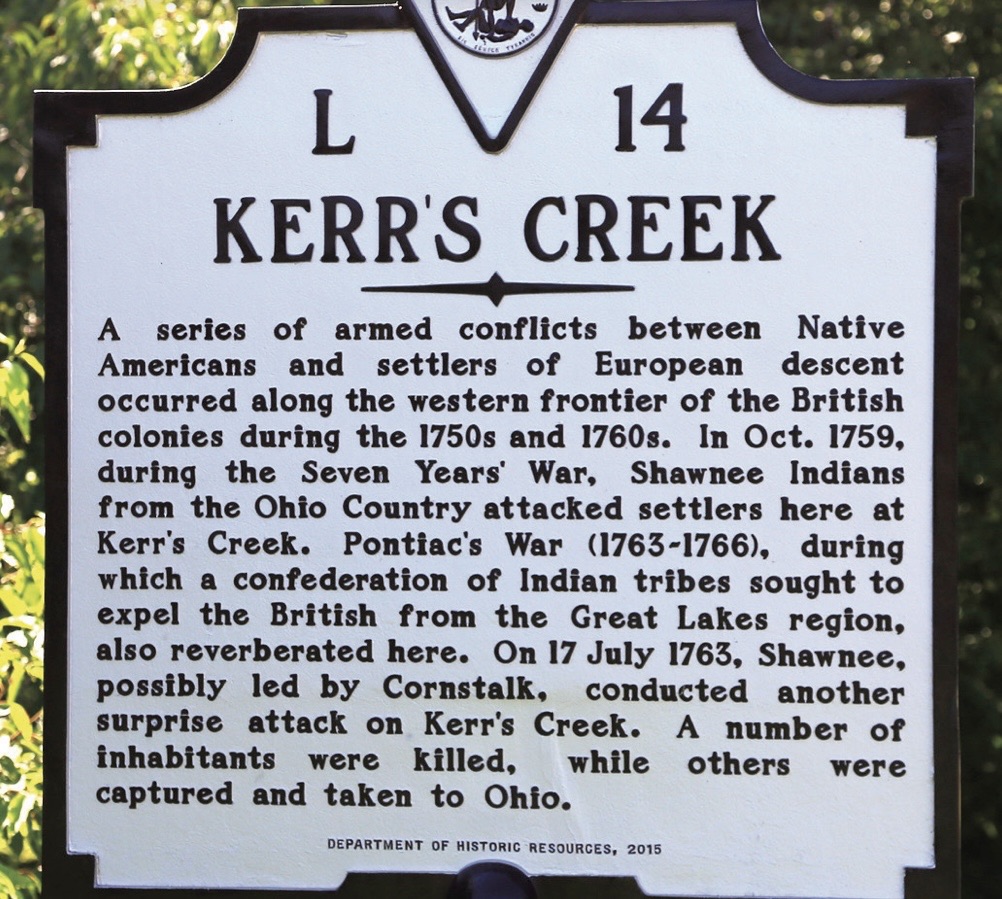
The first raid on Kerr’s Creek (pronounced Karr’s) came on 10 October 1759, striking while many Scots-Irish settlers were away at Timber Ridge Presbyterian Church. The attack came on a Wednesday, not a Sunday, which doesn’t discredit the traditional account. It was common for frontier families to travel 10 to 15 miles to attend religious sermons, and itinerant preachers traveled irregular circuits, which meant irregular service days. Tradition holds that tension was high, that a Native man had been seen in the trees days prior. [1] However, anxious rumors were common, and their worries were dismissed.
Today, Interstate 64 cuts across the ground that John and Agnes Gilmore once claimed as their own. Gilmer Creek still bears their name. Many modern highways follow ancient Native paths — the tried and true routes through mountains and valleys. If Google Maps had been drawing the routes, it would have chosen the same corridors. In this case, the path known as the Buffalo Trace ran near where I-64 now crosses the Valley.
When the war party struck, four neighboring families bore the brunt. Five members of the large Hamilton family were murdered in and around their clustered cabins. John and Agnes Gilmore, parents and grandparents to many in the settlement, were also killed. The attacks on the Cunninghams and McKees claimed the matriarchs of both households. Tradition holds that a McKee daughter survived scalping in the 1759 raid, but the record doesn’t clearly fix her name.
Kerr’s Creek was not chosen at random. It lay on the edge of Virginia’s settlement line, exposed to raiding parties moving through the Allegheny passes. By the late 1750s, families had clustered there — Hamiltons, Gilmores, Cunninghams, McKees, Logans, Irvins — making it both a tempting prize and a stark reminder of Native land being overrun. Unlike later raids, the attackers carried off no captives. The war party struck swiftly and withdrew, leaving behind grief but also a warning of what frontier life would bring again and again. Contemporary reports blamed “Indians” or “Shawnee.” Later tradition attached a name: Cornstalk.
Cornstalk: the Specter in the Valley
“Cornstalk, the celebrated Shawnee chief, led the party at Kerr’s Creek.”
“At the head of the savages was Cornstalk, whose name was long a terror to the border.”
“The noble but dreaded Cornstalk swept down upon Kerr’s Creek, leaving death and ashes in his path.” [2]
The first time Cornstalk appeared in colonial documents was not as a raider but as one of five hostages delivered to Colonel Henry Bouquet at Muskingum in November 1764. Bouquet demanded hostages as security to ensure the Shawnee and their allies would surrender all captives. The irony is unmistakable: history remembers Cornstalk both as the supposed leader of the raiding parties who carried settlers off, and as the hostage given up to guarantee those captives were restored. His documentary trail begins as an instrument of peace, yet his legend was forged in blood. Believed to have been the grandson of Shawnee chief Paxinosa, Cornstalk carried the weight of a respected lineage. Yet within little more than a decade, the man who first entered the record as a guarantor of peace was transformed in settler memory into the very embodiment of Shawnee violence. How did a hostage become the frontier’s Specter?
Cornstalk may have led a raid in the late 1750s or early 1760s. It would explain how his name first entered settler rumor, but it remains only an assumption. No contemporary colonial record places him at Kerr’s Creek in 1759 or 1763, nor at Greenbrier. His name first appears not in war reports but in the hostage roll at Muskingum in 1764. Cornstalk’s legend was born in the gap between the documents and the tradition. Over time, the memory of raids needed a face, and Cornstalk — already known as a Shawnee leader by the 1760s and later killed by settlers in 1777 — became the convenient villain to hang them on.
1763 Death Returns to Kerr’s Creek and the Greenbrier
The events of 1763 resist neat retelling. Later genealogical and local histories admit that “people were too busy surviving to record for posterity.” Much of what we know comes not from contemporaneous records but from family tradition written down decades later, which often blurs episodes together. One set of accounts has the Clendenin homestead struck at Muddy Creek, another emphasizes the fall of Cunningham’s blockhouse, and others recall Kerr’s Creek as the central site of loss. Whether these attacks happened separately or as part of a single wave of Shawnee raids that swept across the Greenbrier and Rockbridge settlements is hard to disentangle. Even by 1773, contemporary reports conflicted, and later retellings only muddied which families were struck together and which fell apart.
Nor was there a single Shawnee commander directing these blows. The Shawnee were divided into towns and bands, each with their own leaders. Raiding parties often set out independently, driven by anger, opportunity, or the need for captives to replace losses. To frontier families, it felt like a coordinated assault — death arriving from every direction — but in reality, these may have been overlapping strikes by different Shawnee war parties converging in the same season.
In July 1763, a series of raids struck the Greenbrier River settlements. Muddy Creek was hit first. The home of Archibald Clendenin Jr., fifteen miles away, was next.[3] A man named Conrad Yaokim was said to be the only person who directly escaped alive from the Clendenin place. Ann Clendenin, wife of Archibald, is also said to have slipped away from the raiding party as it retreated. Two of her children were killed, while two younger children and her brother John Ewing were remained captive.[4] Family lore has it that a Clendenin infant and toddler died shortly after capture. The Lenape adopted Jane Clendenin, while her uncle was taken into the Shawnee — a fate that, given his age, would likely have required him to run the gauntlet first.
In 1759, John and Agnes Gilmore had been killed in the first raid on Kerr’s Creek. In July 1763, their son Thomas Gilmore was killed in the second. His sister-in-law, Elizabeth Gilmore, and her daughter, Elizabeth, were also taken.[5] A Jane Gilmore, later freed, may have been Thomas’s wife, Jennie, mother of John. Some records suggest Thomas and Jennie also had daughters who were carried off but never reappeared in the record.
In this same wave of attacks that struck Kerr’s Creek, raiders descended on Jonathan Cunningham’s blockhouse at Big Spring. The small fortification, built to shelter families in times of danger, was overrun. Accounts differ on the scale of the massacre — some later estimates put the dead at fifty or more — but the numbers matter less than the effect. Whether the death toll was dozens or simply many, the result was the same — an entire cluster of families vanished. The “McKee burying ground,” about seven miles north of present-day Lexington, Virginia, was the place of burial for many of those killed that day. A recent survey with ground penetrating radar revealed dozens more burials than the surviving headstones would suggest — silent testimony to a loss too large for tradition alone to preserve.[6]
Changelings
The raids of 1763 left deep scars on the Valley. Across the frontier, families were shattered—parents murdered, children killed, others carried off, and lineages broken. For some, the story ended in a burial ground. For others, it carried them west, across the mountains, into Shawnee, Lenape, and Ohio Haudenosaunee (otherwise known as Mingo) towns, where captives were adopted to replace lost kin. Within a year, a boy or girl taken from the frontier might be speaking a new language, working the hunt or the fields in a new way, and calling unfamiliar faces mother and father.
Mary Jemison, whom I highlighted previously, was one such captive: taken in 1755, she was adopted by two Seneca women who had lost a brother at the Battle of the Monongahela—Braddock’s Defeat. Fully adopted, given the name Dehgewanus, and eventually married within the Seneca. She lived with the Seneca the rest of her life, never returning permanently to colonial society.[8]
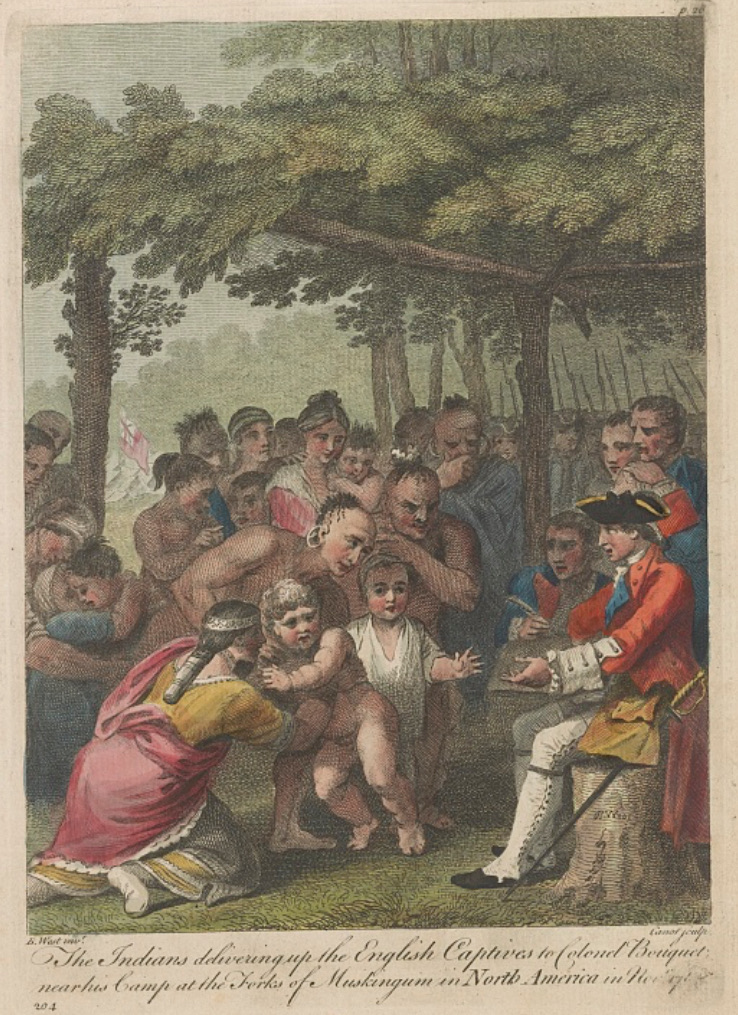
It was these lives—the missing and the adopted—that Colonel Henry Bouquet demanded in 1764. After his costly victory at Bushy Run and the relief of Fort Pitt opened the road to the Ohio, Bouquet led his column deep into Native country and issued an ultimatum: return the captives or see your villages burned. He could back the threat, for by then most Native groups that had fought in the so-called Pontiac’s Rebellion were exhausted, divided, or had shifted south and west. At Muskingum that autumn, hundreds assembled: Native leaders on one side, weary redcoats and provincials on the other. Between them stood, in effect, the captives themselves—the living symbols of the war’s human cost.
Captivity created the cruelest paradox of the Ohio Valley: every reunion for one family was a bereavement for another. For the Native families who had adopted a captive, being forced to surrender them reopened a wound; for the settler parents or surviving kin, not recovering them turned a temporary loss into a permanent one—compounding the grief of those killed in the same raids that had carried the captives away.
The exchanges were wrenching. Native mothers wept as children they had come to love were torn from their arms. Some adoptees screamed and refused to leave. Others escaped into the woods rather than return with the strangers who claimed them as family. For frontier settlers, each restored captive was proof of survival and providence. For Native families, the exchange felt like theft.
According to the detailed captivity rolls taken during Bouquet’s 1764 campaign, 64 men, 108 women, 50 boys, and 34 girls—a total of 256 people—were returned to their families after a year or more in captivity that fall.[9] But to their long grieving kin, it was not the same person who had been taken. Children, especially, had been transformed. Among Native peoples, discipline did not follow the “spare the rod, spoil the child” ethos. Outside of an agricultural economy, children were not burdened with dawn-to-dusk chores, and the Presbyterian eccentricities of the backcountry held no sway. Children who had once sat dutifully through sermons now chafed in the pew, more at ease in the woods than in the fields. Many no longer spoke English or even remembered their Euro-American names.
The Scots-Irish settlers had a name for a similar but different phenomenon: changelings. In Old World folklore, these were fairy-switched infants, children, or adults carried off and replaced by an eerie double. Whether settlers ever spoke of returned captives as changelings is uncertain. The folklore was alive among Scots-Irish communities, but such superstitions rarely reached the printed page of the God-fearing backcountry. In the Old Country, a changeling was not merely a swapped infant but an alien presence: a toddler who cried without ceasing, an adult who no longer fit the rhythms of their household, a child who refused ordinary food, defied discipline, or shrank from the church pew. On the American frontier, the resemblance could be deeply unsettling. To families steeped in changeling lore, a child who returned from Native towns speaking a new language, restless in sermons, and at ease in the woods was not simply altered — they were strange, transformed, as if the wilderness itself had stepped into the child’s place.

The New Peace
Here, Britain, like France before it, departs our narrative. Except for one eager earl and his ambitious lackey, Britain henceforward will appear only as a distant power in the Ohio Valley, issuing decrees it could not enforce.
The real consequences of the conflict fell unevenly: Native nations faced mounting pressure and dispossession, while the colonists who would one day form the United States, a white dominated republic, emerged as the long-term beneficiaries.From the councils at Muskingum in 1764 flowed nearly a decade of uneasy peace. For the first time in years, settlers in the Valley could plant without fear of sudden Native war parties, and trade along the Ohio revived. Yet it was a peace bound to paper and circumstance, not to trust. Native leaders had given up captives, not land, and British officers promised restraint they could not enforce. The Shawnee and their neighbors knew the tide of settlers would not stop at the Alleghenies, only pause. That pause lasted until 1774, when Virginia’s ambitions and frontier bloodshed touched off Lord Dunmore’s War and drew Cornstalk into the story as both commander and, once again, hostage.
Epilogue: Cornstalk’s Choice
Cornstalk understood that captives and hostages were the fragile coin of frontier diplomacy. After Point Pleasant in 1774, he offered his son Elinipsico to the Virginians as a pledge of peace. Three years later, under a flag of truce, he went further still, placing himself under their power at Fort Randolph to warn of unrest among the Shawnee. It was a choice for peace, but one that cost him his life. When a relation of John Gilman was killed near the fort, the shock and anger of the garrison boiled over.[11] Cornstalk, his son, and Red Hawk, within their confinement, were shot down by militiamen. Some retellings later misremembered the slain settler as John Gilman himself, the same captive taken in 1863 and returned a year later, heightening the Anglo-European account’s chronicle tragedy by folding the series of murders into an amplified story of vengeance. The irony remained: a family long scarred by loss at Kerr’s Creek stood among Cornstalk’s killers. Legend holds that Cornstalk met his fate calmly, accepting death with composure. Years earlier, children had come back from captivity as strangers, transformed into changelings in their parents’ eyes. Cornstalk’s fate was not so different: recorded first as a hostage of peace, later immortalized as the specter of war, and finally as a tragic figure wrapped in frontier romanticism.
In European lore, the greatest parental fear was that one’s child might be stolen and replaced by something alien. For Native families, this nightmare was lived reality. From the seventeenth through the twentieth century, colonial and federal authorities systematically manipulated Native parents’ devotion to their children as an instrument of assimilation. First through missionary schools, then through federally funded boarding schools and state-run adoptions, Native children were removed from their homes, remade in Euro-American molds, and often returned as strangers to their own people—if they returned at all. What remained folklore in Europe became colonial policy in America, only formally curtailed with the passage of the Indian Child Welfare Act in 1978. In the end, it was not fairies but colonizers who proved the true developers of changelings.

Notes and Citations
[1] The Washington and Lee University Special Collections & Archives are currently closed to on-site researchers due to a significant renovation project. I had hoped to consult their holdings on the three Kerr’s Creek raids, but that was not possible at the time of writing.
[2] Alexander Withers, Chronicles of Border Warfare (Clarksburg, VA: Joseph Israel, 1831), 136;
Joseph A. Waddell, Annals of Augusta County, Virginia, from 1726 to 1871, 2nd ed. (Staunton: Samuel M. Yost & Son, 1886), 107;
William Henry Foote, Sketches of Virginia, Historical and Biographical, Series I (Philadelphia: Wm. S. Martien, 1850), 249
[3] Charleston, WV, is named after Charles Clendenin, a brother, uncle, or some other close relation of Archibald Clendenin.
[4] Alvin E. Ewing, a twentieth-century descendant of John Ewing, is the chief source for the Clendenin captivity narrative. While family lore is often retold until it becomes more mythos than history, Ewing claimed to have based his account on entries from a Clendenin family Bible. If those notes were recorded in the lifetime of John Ewing or his immediate descendants, they should be considered more than just legend.
Alvin E. Ewing, The Clendenin Massacre and Captivity of Jane Clendenin and John Ewing (privately printed, ca. 1930s), reprinted by the Ewing Family Association, https://www.ewingfamilyassociation.org/members/WER/db_Material/ClendeninArticles.pdf.
[5] “List E, Muskingum, November 15, 1764,” in The Papers of Colonel Henry Bouquet (Pittsburgh: Historical Society of Western Pennsylvania, 1883), 248; https://journals.psu.edu/wph/article/view/2529/2362 “Return of Captives at Fort Pitt, January 5, 1765,” Pennsylvania Magazine of History and Biography 20, no. 3 (1896): 262; https://journals.psu.edu/wph/article/view/2529/2362 Joseph A. Waddell, Annals of Augusta County, Virginia, from 1726 to 1871 (Staunton: C. R. Caldwell, 1902), 435. “Descendants of John and Agnes Gilmore, Rockbridge County, Virginia,” in Gilmore Family of Rockbridge County, Virginia, Jerry and Joanne’s Southern Connections (RootsWeb), accessed September 2, 2025, https://freepages.rootsweb.com/~qvarizona/genealogy/gilmore.html.
[6] As traditional forms of record-keeping gave way, gravestones endured. A family Bible could be lost in a cabin fire, and enslaved families were uprooted with no record kept at all. But a testament carved in stone had a chance to outlast upheaval. In many cases, these markers are the only surviving primary sources that someone lived — and died — in a place. Rockbridge Historical Society, Uncovering Rockbridge County History at Kerr’s Creek, YouTube video, 1:10:12, posted March 30, 2025, https://www.youtube.com/watch?v=6mFO26lLs7E.
[7] Canot, Pierre Charles, Engraver, and Benjamin West. The Indians delivering up the English captives to Colonel Bouquet near his camp at the forks of Muskingum in North America in Novr./ B. West invt. ; Canot sculp. , 1766. [Philadelphia: William Smith] Photograph. https://www.loc.gov/item/2012647230/.
[8] Dictated late in her life, Jemison—known among the Seneca as Dehgewanus—told her story to James Seaver, a local doctor. Seaver shaped the manuscript to fit the Euro-American captivity genre’s familiar formula of raid → captivity → moral lesson. Yet Jemison’s voice breaks through, especially in her descriptions of adoption, Seneca culture, and the wars she witnessed.James E. Seaver, A Narrative of the Life of Mrs. Mary Jemison (1824; repr., New York: American Scenic and Historic Preservation Society, 1910).
[9] The Papers of Colonel Henry Bouquet (Pittsburgh: Historical Society of Western Pennsylvania, 1883); https://journals.psu.edu/wph/article/view/2529/2362
[10] As historians, we walk a line—between overemotional sentiment and the risk of forgetting that history happened to real people.
[11] On the Gillilan/Gilman spelling: The name appears in contemporary and later sources under multiple spellings, including Gillilan, Gilman, and Gillman. As previously mentioned, Gilmer Creek, though similarly spelled, reflects a related local usage. For consistency, this essay uses “Gilman.”
For readers who wish to follow ongoing research, subscription is available in the footer.