After the 1768 Treaty of Fort Stanwix, the British Crown fixed the Ohio River as the boundary between colonial and Native lands. That line was more suggestion than law for land-hungry settlers, and the suggestion of a restriction was loudly decried. Pressure to expand westward was mounting—and it would soon erupt into conflict. Beyond the “western river” lay territory the Crown still recognized as Native sovereign land. These lands were closed to speculators, settlers, and hunters but remained open to licensed traders, who became the only legal link across the boundary.
Fort Pitt was the gateway west: every convoy of soldiers, traders, or surveyors passed through its palisades before drifting down the Ohio toward the Scioto, Vincennes, or Kaskaskia. By the early 1770s, a settlement known as Pittsburgh had begun to grow around Fort Pitt. People often used the two names interchangeably—the fort for the garrison, Pittsburgh for the cluster of traders’ houses and shops—but both referred to the same contested hub at the Forks of the Ohio.
George Croghan and the Middle Ground
George Croghan emigrated to Britain’s colonies from Ireland in the 1740s as a young man in his twenties. Early upon his arrival, he established himself on the Susquehanna River, trading with the Native peoples of the region. In 1748, George Croghan, William Trent, and Philadelphia merchant Robert Hockley organized a trading firm that linked the city’s capital to the Ohio Valley frontier. Croghan supplied Native hunters at Logstown and beyond, while Trent and Hockley managed the flow of goods and credit in Philadelphia. What began as a joint venture in pelts and powder became one of the first large-scale experiments in colonial capitalism on the Ohio.
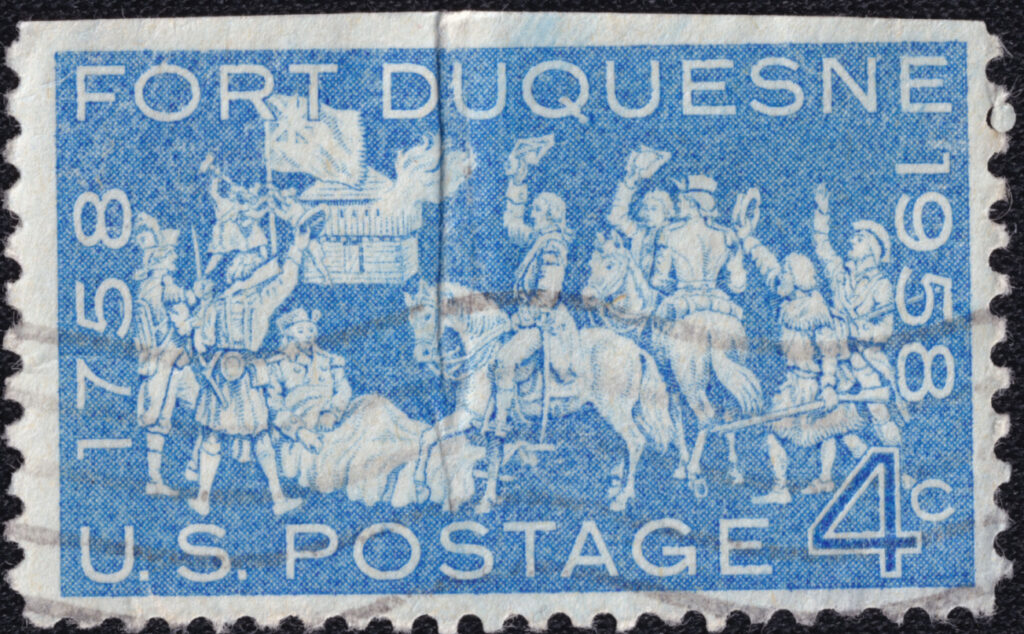
Croghan’s partner, Trent, was more than just another frontier trader. He was embedded in the history of the Forks of the Ohio from the very start. By the early 1750s, William Trent was already positioned as the merchant-contractor for the first British fort at the Forks, provisioning the garrison before the French swept down to destroy the project before building Fort Duquesne. The stockade ceized by the French when they captured the area was called Trent’s Fort. In that sense, Trent predated nearly every other trader—laying claim to the site before it became the epicenter of imperial conflict. His career would later take a darker turn there when, during Pontiac’s War in 1763, his own account books recorded the distribution of smallpox infected blankets from Fort Pitt to nearby Native communities.[1]
When Croghan arrived at Logstown in 1748, he entered a town whose senior stakeholders were Native leaders. Tanacharison, the Seneca “Half King,” represented Six Nations authority, while Scarouady (Monacatoocha) spoke for the Shawnee in his role as Haudenosaunee (Iroquois) appointee. Croghan quickly proved adept at frontier diplomacy, navigating between Haudenosaunee oversight and Shawnee interests to secure his trading foothold. By the 1750s, he was financing and operating posts across the Ohio Country: at the mouth of the Great Miami River, within the Miami stronghold of Pickawillany, and even a modest outpost at the mouth of the Cuyahoga on Lake Erie. Though minor in his time, that Cuyahoga post would become the commercial seed of what is now Cleveland, Ohio.
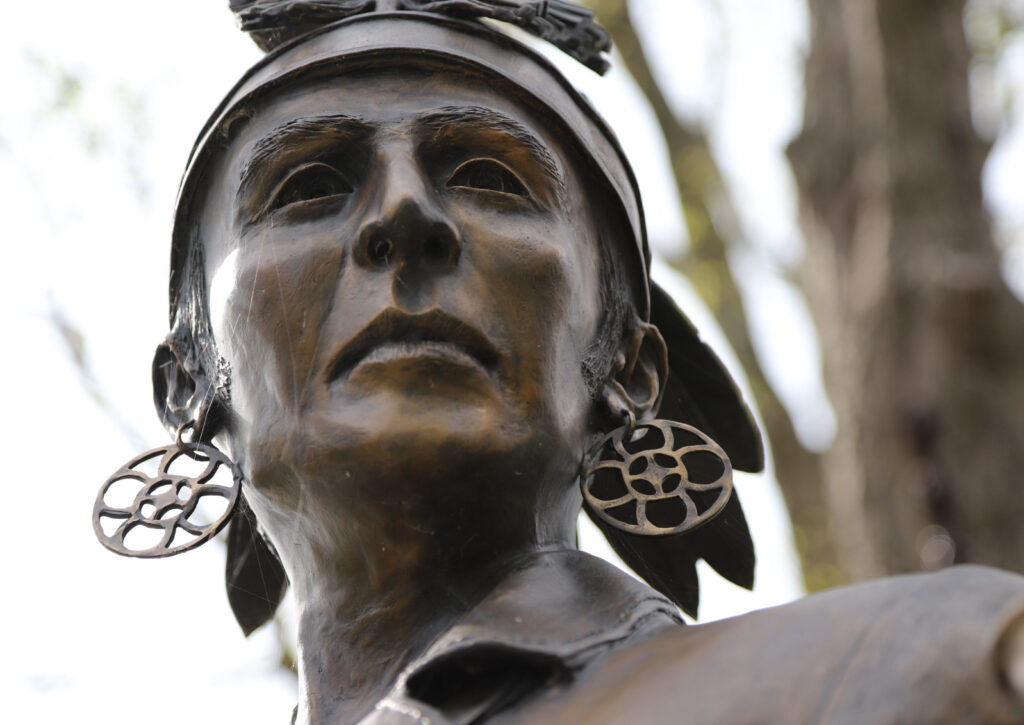
Croghan’s success rested on his reputation for fair dealing, a trait that set him apart from many other traders. He learned Native languages, gave gifts with regularity, and deferred to council protocols that others ignored. Before long, he was no longer merely a trader but a broker of relationships. He mediated disputes, eased frictions between colonial officials and Native councils, and even traveled as a diplomatic representative when trust was at stake. Croghan also formed a union with a Mohawk woman at some point in the 1750s, described in some sources as a relative or adopted kin of Joseph Brant (Thayendanegea) who was at the very least in someway connected to his extended family circle.[2]
By the mid-1750s, Croghan had become the dominant British trader in the Ohio Valley. Contemporary observers estimated that “there were nearly three hundred traders on the Ohio, and Croghan controlled a third of them,” a measure of how far his reach extended beyond Logstown.[3]
Collapse
The Seven Years’ War and the follow on Pontiac’s War conflict were devastating for frontier traders. Many saw their hard won networks collapse overnight, and their reputations suffered. Native communities increasingly viewed them less as partners and more as “rum-carriers” or “whiskey traders”, regardless of the type of alcohol they supplied. Stories circulated of unscrupulous traders who seized horses, stripped families of goods, or even attempted to take children as payment for debts. When that fragile balance collapsed, the entire frontier economy unraveled with it.
A British trader was killed alongside countless Miami people, including their leader Chief Memeskia, or “Old Briton,” when a French allied force descended on Pickawillany in 1752. Memeskia’s death was made all the more infamous by reports that his heart was cut out and eaten—both as vengeance for siding with the British and as a ritual act of consuming courage. The detail horrified colonists and underscored the ferocity with which alliances and enmities were enforced on the frontier.
The firm, Baynton and Wharton’s trading house, nearly collapsed under the weight of attacks on frontier traders. Their posts were overrun, their shipments seized or destroyed, and their debts mounted as creditors pressed them from Philadelphia. By 1765, the firm was staggering. The addition of George Morgan that year, bringing both new capital and restless energy, gave the business a second life. We know so much about Baynton, Wharton & Morgan’s ventures because the firm’s eventual bankruptcy at the end of the 18th-century led to extensive legal wrangling. Their correspondence and account books ended up in state custody, preserved today in the Pennsylvania State Archives—an extraordinary record.
Ruffled Shirts and Silk Handkerchiefs for Pelts, Powder, and Wampum: Baynton, Wharton & Morgan at Fort Pitt
Baynton and Wharton began operating out of Philadelphia in 1757, when the city was the preeminent harbor of the colonies. After Pontiac’s War, already experienced in managing international shipments, under the encouragement of George Croghan and now partnered with George Morgan, they sought to corner the Illinois market. With the French expelled, someone had to supply the frontier forts and trade with the Native peoples of that region, and Baynton, Wharton, & Morgan seized the opportunity. The road to Fort Vincennes and the other frontier posts of Illinois County began at Fort Pitt. Baynton and Wharton already kept a store at Fort Pitt/Pittsburgh, but their ambitions widened with George Morgan’s arrival. What had been a frontier depot became the heartbeat of a larger design: to use Fort Pitt as the hinge from which they could swing open the Illinois market. From that hub, goods moved down the Ohio and into the Wabash and Mississippi valleys, tying the empire’s furthest edge back to the Philadelphia warehouses. The firm’s first trade convoy into the Illinois country arrived in 1766.
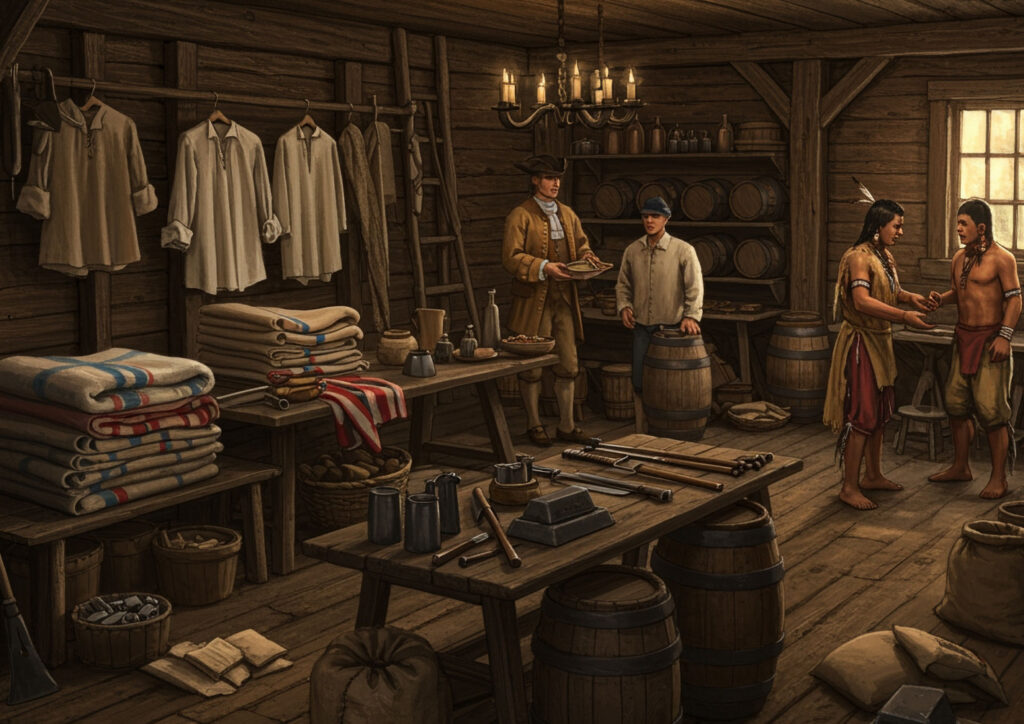
While they imported green tea, Lisbon wine, chocolate, and almonds to cater to colonial households on the east coast, Native buyers sought a different selection: bridles and saddles for their horses, rum and flour for daily use, and textiles that carried utility and status. Lace-ruffled shirts, calico shirts, and plain linen offered choices across the spectrum of appearance, while match coats, a rectangular woolen cloth worn like a blanket cloak, practical for warmth and bedding—remained a staple trade item.[4] These purchases reveal a Native economy not simply of necessity but of adaptation, blending European materials into existing dress, ceremony, and mobility systems.
Fort Pitt Ledgers
The account books from Fort Pitt reveal a frontier economy where well-known Native figures—Captain Bull, Shingas’s son, and the Grenadier Squaw—appear beside regionally recognized men such as an earlier Lenape Blue Jacket, White Mingo, and White Chestnut, and, further still, alongside anonymous entries like “Big Music Man’s Friend,” a label invented by the clerks. A man called Latort’s Black Cousin acquired a lacy ruffled shirt, flour, powder, and leggings by paying with land, while most others paid with skins. Cash was scarce on the frontier, but pelts circulated as both medium and measure of value, underwriting everything from rum and powder to the wages of armies. Even General Forbes paid for his ruffled shirts with skins. One entry notes Shingas’s son settling an account with a belt of wampum.[6] In January 1767, a “young Delaware fellow” walked away with rum, a silk handkerchief, and a French match coat; by March, Captain Bull had bought shirts, rum, and leggings. These ledgers show not only the flow of goods but also the hybrid forms of exchange: most debts were cleared with furs, some with wampum, and a few marked cryptically as settled “by deed.”
The books also record Native women as active participants in trade, from “the Grenadier Squaw,” whose large purchase of rum, flour, and a rug dwarfed most others, to Gibson’s Shawnee wife, listed in April 1767 as acquiring a shroud. Her presence in the ledger opens a window onto John Gibson himself, who was not only a trader in his own right but would later rise to prominence as an interpreter and frontier officer. Gibson’s marriage tied him directly to the Shawnee community, a bond that made him a trusted broker between worlds. His name appears in many of the same records as Croghan’s, suggesting the overlapping networks of men who straddled commerce, diplomacy, and war in the Ohio Country.
Baynton, Wharton & Morgan’s push into the Illinois Country was ultimately a failure, not the rugged story of frontier enterprise their boosters imagined. In 1767, the firm turned to human trafficking as part of its strategy, sending George Morgan to transport and sell enslaved Africans in Illinois. Selected for their French language skills, these men and women were marketed to the region’s former French inhabitants like any other commodity. It was a stark reminder that the Ohio Valley economy was never separate from the Atlantic slave trade but deeply entangled with it. Far from the romance of frontier legend, Pennsylvania’s most ambitious trading house also profited as slave transporters and sellers.
Conclusion
By the late 1760s, Fort Pitt had become the hinge of empire, where Philadelphia’s merchants, Native hunters, and frontier brokers all converged. The ledgers record rum and ruffled shirts, match coats and wampum, land deeds and skins—all proof that the fur trade was more than a market; it was the fragile balance on which the Ohio economy rested. Yet even as traders pushed deeper into the Illinois Country, the beaver trade that underwrote it all was already beginning to falter. The next post reveals the hidden costs of an economy built on the beaver.
Notes and Citations
[1] Trenton, New Jersey, takes its name from William Trent Sr. (c.1653–1724). In addition to his career as a Pennsylvania merchant and later Chief Justice of New Jersey, he purchased an estate at the Falls of the Delaware in 1719 that was soon called “Trent’s Town.” See Edwin P. Tanner, “The Settlement of Trenton, 1679–1720,” Pennsylvania Magazine of History and Biography 41, no. 3 (1917): 241–59.
[2] Their child, Catharine (also known as Adonwentishon), was raised among the Mohawk and was a respected figure in her own right, who later married Brant himself.
[3] King, James C. “Indian Credit as a Source of Friction in the Colonial Fur Trade.” Western Pennsylvania Historical Magazine 49 (January 1966): 59. https://journals.psu.edu/wph/article/view/2783/2615
[4] Baynton, Wharton & Morgan Papers, Roll 2234, Pennsylvania State Archives (Harrisburg).
[5] You will note, AI assigned one of the Native American shoppers two upright feathers. Within the Haudenosaunee system, this was an Oneida identity marker. I wonder what it says about AI in 2025 that it can reproduce cultural signals without context or prompt. I also asked my spouse—who is the Information Technology–savvy one—for their opinion on generative AI, but they couldn’t get past the light fixture. In reality, a frontier trading post would not have had a hanging chandelier; more likely, tallow candles in wall sconces or tin/iron holders lit the room.
[6] Wampum—beads made from white and purple shells strung into belts or strings—functioned as currency and were recorded in Native diplomacy. It carried symbolic authority in councils and treaties while circulating as a trade exchange medium. See Lynn Ceci, The Value of Wampum among the Seventeenth-Century Algonkian (Journal of Middle Atlantic Archaeology 2, 1986): 1–26; and Charles H. Peck, “Wampum: A Study in Indian Money,” American Anthropologist 16, no. 2 (1914): 267–275.
For readers who wish to follow ongoing research, subscription is available in the footer.