I decided to start this blog to discuss historical sites I’ve visited over the past decade, but a strange coincidence happened recently, so I think I’ll start sooner.
My grandma is visiting for the holidays, and I thought it would be great to see either Monticello or Mount Vernon. They were the same distance from us, but she and I had visited Monticello together many years prior, back when my older two were still in diapers.
After our visit, we were on our way to Honey Pig—because eating Korean food is what I imagine George Washington would do, or at least that’s what I told myself after my husband said, “Hey, let’s go to Honey Pig.” Anyway, there we were, on our way to Honey Pig, when a Facebook memory popped up: exactly ten years ago, we took a picture standing in front of Monticello. I couldn’t help thinking about how much had changed. Not just that, I went from two kids who could barely walk to three kids, or that my 2025 husband took off work for the week of Christmas this time when he didn’t in 2015 (growth, babe 😉).
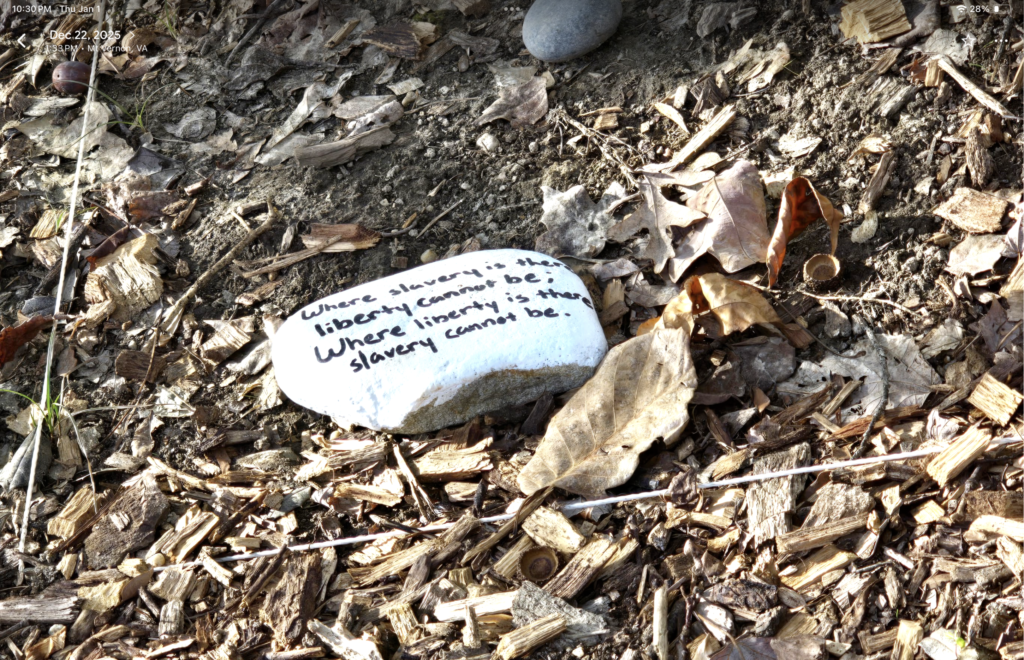
Ten years is a long time. It’s hard not to notice the differences—not just between the two residences and the men they are associated with, but in how their stories are presented compared to a decade ago. Slavery and the benefits these men derived from forced, racialized labor are no longer treated as an unspoken truth beyond the veil.
At Mount Vernon, this shift is immediately visible. The museum includes a large LEGO-based model of the estate and its surrounding grounds, using visual scale to show the number of African Americans who lived and worked there. The display makes clear the scope of Washington’s enslaved workforce and the central role it played in sustaining the estate. Ten years ago, my experience at Monticello felt different. At the time, Sally Hemings was notably absent from the site’s presentation of Jefferson’s personal and domestic life, a silence that felt increasingly conspicuous given how widely known her story had already become.
I know that discussing slavery in the context of the Founding Fathers is often treated as divisive, but the way these stories are told, and usually avoided, is itself part of the historical record. This isn’t a post comparing the treatment of slavery at Monticello and Mount Vernon. The differences in how each site interprets slavery are not accidents of federal policy but the result of private institutions making interpretive decisions at different times.
Ten years ago, when I visited Monticello, both sites were still relatively early in that process. I remember Monticello actively excavating the cabins of the formerly enslaved, just as Mount Vernon had begun using ground-penetrating radar the year before to identify the unmarked sites of African American graves.
Monticello: Temple to Ideas
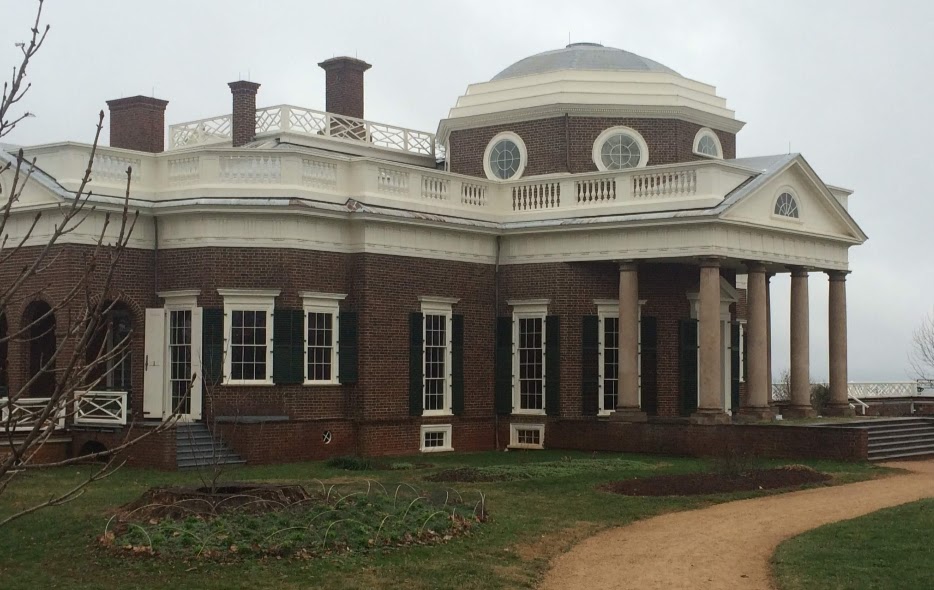
Monticello was based on a Renaissance architectural model associated with Andrea Palladio, particularly his Villa La Rotonda near Vicenza, Italy. Even the name Monticello reflects Jefferson’s Italian influences, translating roughly to “little mountain.”
Although Jefferson spent years in Europe as a diplomat in Paris, he never traveled to the Veneto region or saw Palladio’s buildings in person. His exposure to Palladio came instead through I Quattro Libri dell’Architettura, which shaped how Palladian ideas entered the United States through Jefferson and other early American admirers.
If you’ve visited the University of Virginia near Monticello—or even its nearby major hospital complex—you’ll likely recognize the same architectural language: colonnades, symmetry, and classical forms. Those elements trace directly back to Jefferson’s reading of Palladio. Yet one need not visit Virginia’s Piedmont to encounter the United States’ architectural inheritance from the Italian Renaissance. In 2010, the U.S. Congress recognized Andrea Palladio as the “Father of American Architecture,” acknowledging the lasting influence of his work on American building traditions more than two centuries after his death.
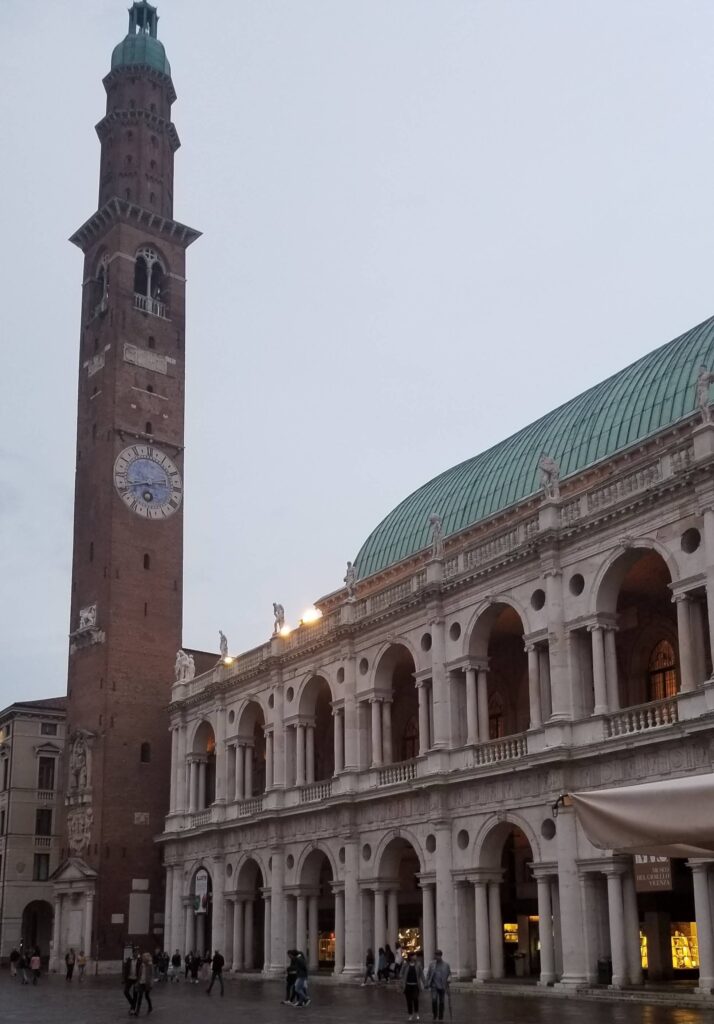
A 1973 New York Times article argued that much of the domed and colonnaded architecture used for banks and courthouses throughout the United States ultimately derives from Palladian influence. [1] To be honest, my first visit to Vicenza’s Palladian Basilica was briefly complicated by an initial sense of a lack of novelty—I had seen this before. Fortunately, that immediate reaction quickly passed as the original asserted itself and overpowered the flash-in-the-pan sensation.
Overall, Monticello in 2015 felt more like a physical expression of Jefferson’s ideas than a presentation of how the estate actually operated. There was little sense of the daily work required to run the plantation or of the financial decisions that left Jefferson heavily in debt at the end of his life. Jefferson’s famously meticulous ledgers may have been mentioned, but my memory recalls a narrative that emphasized innovation far more than operation.
Enslaved people were acknowledged on the main tour, but only briefly. Discussion of slavery itself remained optional, allowing visitors on the core tour to choose whether they wished to engage with it more deeply. When it was addressed, interpretation tended to center on the posthumous sale of people who had lived at Monticello—and within Jefferson’s extended family—for generations to pay off his debts. Little attention was given to their lives or labor before that moment. While this history was not unknown, it was not made evident in the tour’s structure. When I later learned that many of the people enslaved at Monticello had longstanding ties to Jefferson’s extended family that predated—and in some cases outlasted—his own direct involvement with the estate, it felt like a significant omission.
That raises an unavoidable question of interpretation: should a presidential site focus primarily on the individual as a national leader, or should it fully reckon with the estate itself and the people whose labor sustained it long before—and long after—his presence? Presidential libraries and memorials have traditionally emphasized the figure of the leader. Plantation estates, however, should do more. They should resist that kind of narrowing.
I plan to revisit Monticello in 2026, with the intention of observing it again more evenly and with the benefit of distance.
Mount Vernon: Grounded in Place
Jefferson was committed to agrarianism as an idea: farming as moral philosophy, a model of citizenship, and a republican virtue. He wrote about agriculture, theorized its role in the new nation, and imagined it as the backbone of the republic. In practice, however, his management of Monticello was often uneven, financially unsuccessful, and removed from the daily realities of plantation life.
Washington, by contrast, was a farmer. He knew his crops and fields, paid close attention to weather patterns, and soil fertility. He personally oversaw agricultural labor and experimentation.
Mount Vernon isn’t just the manor house. It’s the stables, gardens, greenhouse, and animal pens. It was the land where hundreds of enslaved people worked, lived, and where many died.
You don’t need to look far for the source of Washington’s architectural influences when he remodeled Mount Vernon. When he inherited the property, it was far removed from the twenty-one-room house it would become—a modest, one-story planter’s home rather than a statement residence.

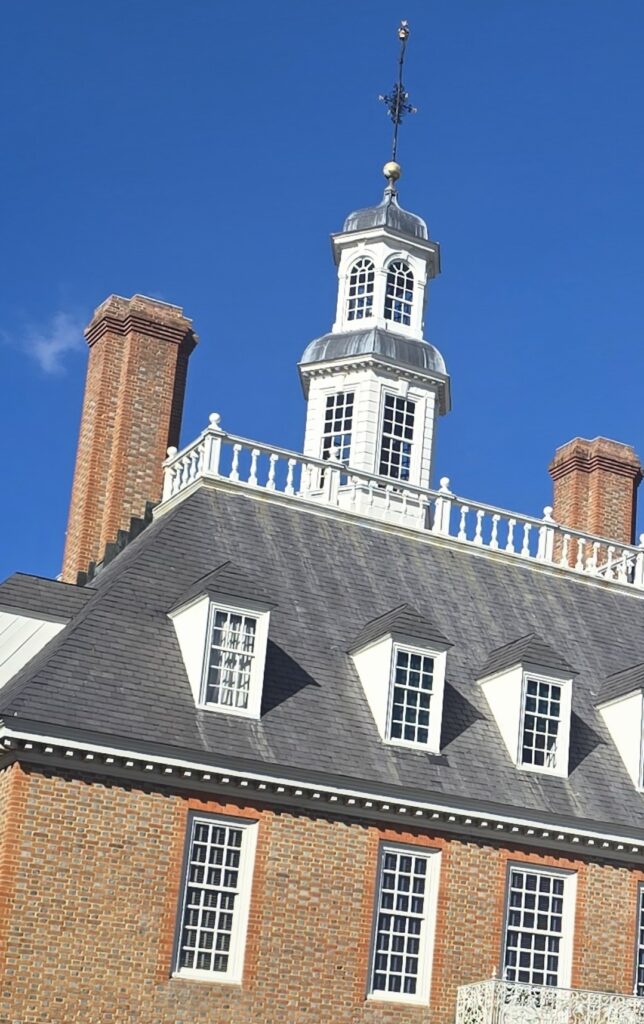
Mount Vernon vs Governor’s Palace in Williamsburg VA
The addition of a second and third story, topped by a cupola in the 1770s, appears to deliberately borrow from the visual grammar of Williamsburg’s Governor’s Palace. That choice signaled authority and belonging within Virginia’s ruling class, even as Washington himself stood at the threshold of a new political era.
Washington’s land speculation endeavors, as well as his position as land manager of his wife, Martha Dandridge Custis Washington’s estate, made the couple extremely wealthy. Seeing a camel at the home of America’s first president took us all by surprise. Every year, the Washington family would rent a camel for Christmas, so for the last two decades, one named Aladdin has visited the estate for the December holidays.
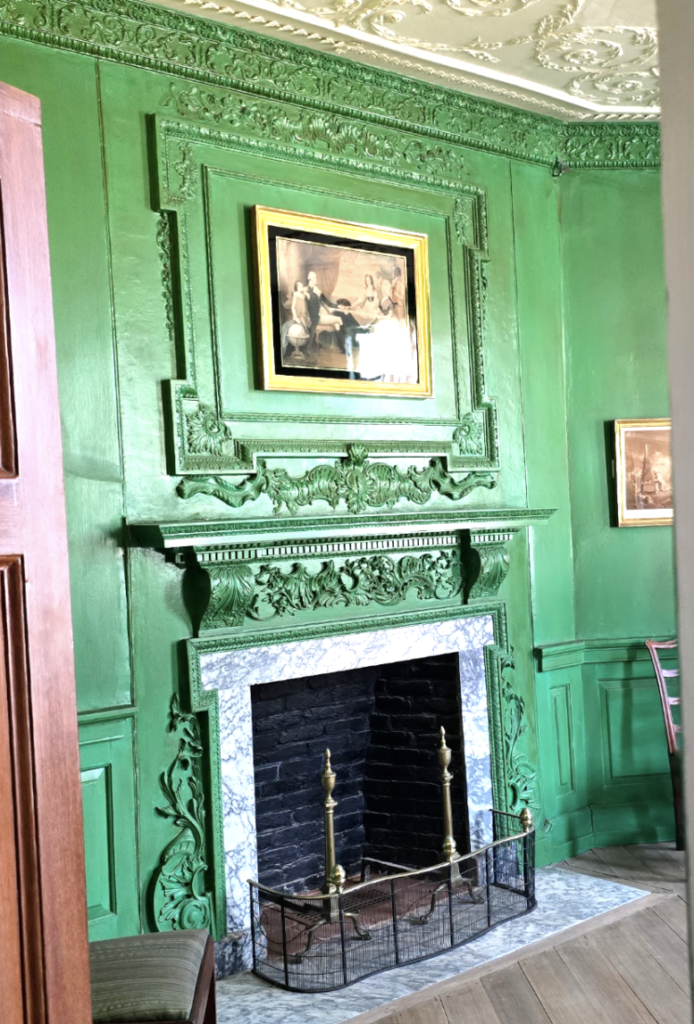
Look at this paint. It’s verdigris-green, a product of copper corrosion. Not only was it expensive to procure and install (extremely), but it was costly to maintain as well. Additionally, throughout the site were hints of the ease of access they had to luxuries such as sugar and chocolate. Washington was a big hot chocolate drinker.
Conclusion
Washington lived his life with his feet firmly on the ground. His leadership helped establish both the structure of American governance and the expectation that power could be relinquished peacefully. Thomas Jefferson lived mainly in a realm of ideas, shaping the language and ideals of the republic even when the practical realities fell short.
It is along this divide—between ground and ideas—that many Americans continue to wrestle with how they understand these two founding figures. They are remembered as illustrious men who laid the groundwork and philosophies that would grow into the modern United States. Yet both also held hundreds of people in bondage. Monticello and Mount Vernon were great estates because the labor of others sustained them. I watched two people, born sixty-nine years apart, process this complex legacy in their own ways—and I couldn’t help but feel that this is how it should be.

Notes & Footnotes
[1] David L. Shirley, “From the Courthouse to the White House, Palladio Had Interest,” New York Times, August 26, 1973, 125. Accessed via TimesMachine. https://timesmachine.nytimes.com/timesmachine/1973/08/26/issue.html.
George and Martha Washington’s tombs.