Series Introduction
In 1774, before the first shots of the American Revolution rang out in Massachusetts, another war was already smoldering in the Upper Ohio River Valley. It was a conflict born of violence, land hunger, and displacement. And, like so many frontier stories, it left behind more questions than answers.
So much has been written about colonial frontier “Indian” raids, the Yellow Creek massacre, and Logan’s Revenge that you might think the story is settled. Yet at the heart of Lord Dunmore’s War lies not a single long-overlooked tragedy, but a saga of grief that ignited cycles of vengeance and left wounds that echoed for generations. For 250 years, rumor and myth have written the script, drowning out Native and settler voices alike to preserve a grand origin tale.
This account does not aim to glorify settlers or vilify Native peoples—or the other way around. Both communities left behind records, silences, and memories, and both suffered violence. The problem is that later retellings often flattened the story into myth, erasing nuance for the sake of legend. By returning to the surviving documents and testimony, my goal is not to take sides but to recover complexity, even where the sources clash
Diplomacy on the Muskingum
In 1774, Koquethagechton, known to the colonists as the “Delaware” Chief White Eyes, journeyed to Wakatomika, a Shawnee village along the Muskingum River in modern Ohio. He undertook his mission on behalf of the European settlers. A war between the European colonists and a Shawnee-led alliance was looming.
Once at Wakatomika, Keiga-tough-qua, known as Cornstalk, an appointed Shawnee diplomat and leader, told White Eyes that for the peace to be maintained with Anglo-European colonists, Dr. John Connolly, Commandant of the Fort Pitt-based Virginia militia, needed to maintain better control of his region.[1] Cornstalk emerges as a figure who urged restraint in the face of a growing Shawnee call for retaliation. Yet only a decade earlier, he had been the specter settlers feared—the name whispered in frontier cabins to frighten children into obedience.
But it was too late—war was inevitable. History can only speculate whether Logan’s vengeance-seeking “Mingo” war party was already in the Monongahela River basin, watching from beyond sight as those who had once been his neighbors went about their lives, waiting for the moment to strike. Within days, the first solidly documented reprisal raid savagely claimed the lives of a settler family on Ten Mile Creek.
Before the year’s end, the violence on the Ohio would subside, as both the colonies and Native nations were swept into a different kind of upheaval—one that would transform the continent and, ultimately, the world. The struggles of 1774 were soon relegated to a footnote in the larger story of the United States, remembered dimly if at all against the blaze of the Revolution.
Fuel for the Anti-Jeffersonian Fire
Decades later, in 1797, old ghosts were stirred when Maryland’s Attorney General, Luther Martin, published attacks on then Vice President Thomas Jefferson. William Cobbett’s Porcupine’s Gazette—a staunchly Federalist and therefore anti-Jefferson paper—was only too glad to give Martin a platform. Martin charged that Jefferson, while governor of Virginia, had slandered his long-deceased father-in-law, Michael Cresap, by branding him the butcher of Logan’s family in his 1781 Notes on the State of Virginia.
Suddenly, those involved in the Yellow Creek Massacre, men who had long escaped accountability, began reaching for anything to justify their actions, no matter how flimsy. And by then, the truth was already fading. Like so many along the Ohio River and the colony’s western frontier, the story of Yellow Creek had been twisted by hearsay, legend, and self-preservation. The surviving witnesses had nearly twenty years to reshape what they remembered, and human memory, especially when guilt is involved, is anything but reliable.
A Case Where the Perpetrators Held the Only Voice — and the Rise of Frontier Gothic
It says a lot about the vacuum of history that the murderers of Logan’s family have received as much space on the written page as they have. Some claimed the Greathouse family had narrowly escaped a Native attack only days earlier, thanks to the quick thinking of a frontier matriarch. Others insisted that Koonay, Logan’s sister, came to the Baker home to warn them of an impending assault. These versions weren’t just questionable—they were desperate attempts to recast killers as victims.
Yet these self-serving recollections are the very sources historians must rely on today. It is like reconstructing a courtroom drama with only the defense’s testimony. No wonder, then, that so many have ignored the plain evidence: Koonay’s daughter was only two months old, which makes it impossible that Koonay herself was so far along in another pregnancy that the killers could have torn an unborn child from her womb to scalp it. (If you are unfamiliar with the commonly told Yellow Creek narrative, that detail may feel abrupt—but it reflects how grotesque exaggerations entered the tradition.) And yet storytellers, knowing the perpetrators’ testimony was suspect, have too often concluded that the most sensational version must therefore be true.
Later retellings discarded the complexities of the record and built upon only on the most lurid rumors. By the mid-nineteenth century, “Indian Wars” histories had cemented the image of an unjust massacre of innocents by amplifying the carnage, and that version stuck. This example shows how, in the tragic and tangled frontier events of the decades before the Revolution, history was often set aside in favor of a “worst of times” narrative. Scholars call this mode Frontier Gothic: a style of 19th-century history and fiction that reveled in lurid depictions of violence—massacres, scalping, rape, mutilation, burning cabins—until horror itself became the dominant memory of the frontier.
Frontier Vindication – the Acception Not the Rule
Fortunately for the murderers, the public’s renewed interest in the Yellow Creek affair was never about the victims themselves. It was about proving that lauded frontiersman Michael Cresap, the man Native orator James Logan believed responsible for the deaths, had not been present at the killings. The rest of Cresap’s life, he lived under that shadow, vilified by Thomas Jefferson in Notes on the State of Virginia and in colonial newspapers. Yet fate offered him two reprieves. First, he died during the Revolution and was buried with honors outside Trinity Church in New York, remembered as a soldier rather than a murder suspect. Second, one of his daughters married Maryland’s Attorney General, Luther Martin, who spent decades trying to vindicate his children’s grandfather.
Two men came to dominate the narrative: Cresap and Logan—though neither was present at the massacre that their names are tied to. Cresap’s name was partially redeemed, not by truth but by politics, legacy, and timing. Logan, meanwhile, was immortalized not by vengeance but by grief.
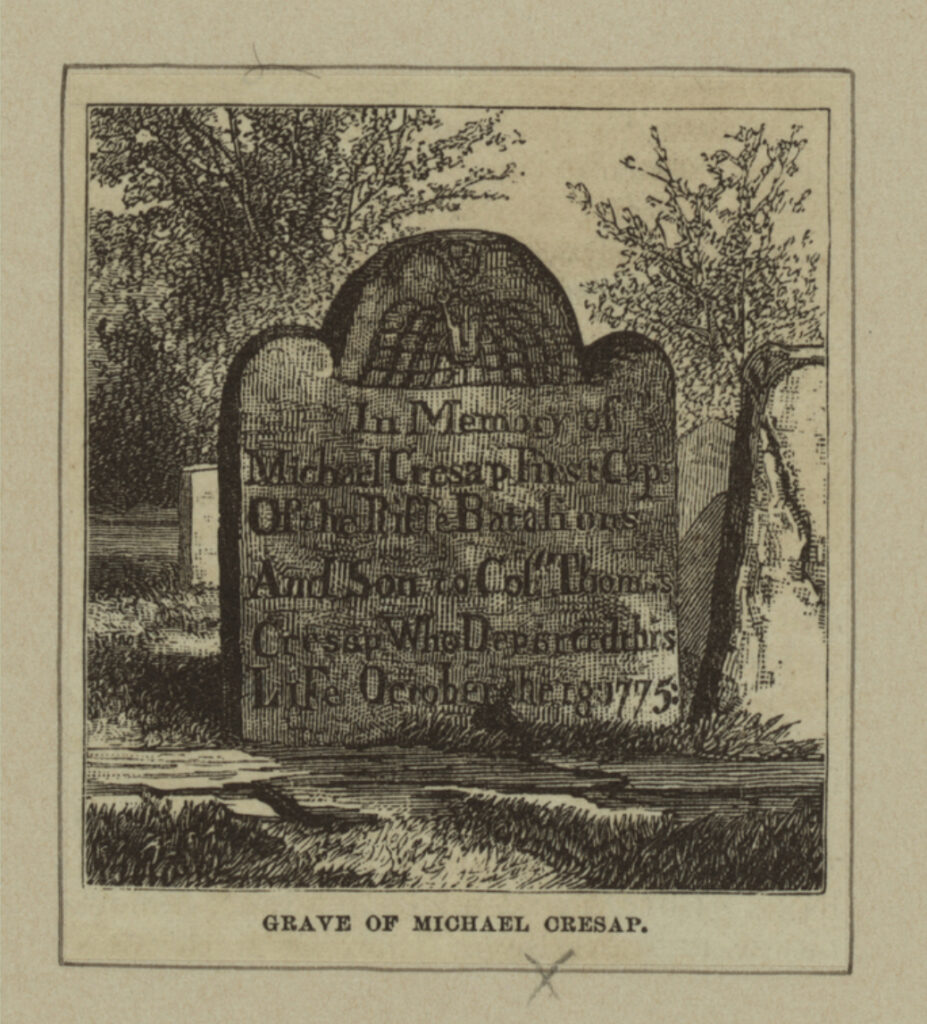
It is unusual for frontier history to extend redemption, yet that is what happened with Michael Cresap. Through politics, family advocacy, and sheer timing, he was gradually recast from murderer to patriot. Logan, too, found a kind of reprieve—his grief and abilities and an orator elevated him into tragic immortality. In a way the path of Cresap and Logan’s legacies are similar to that of Cornstalk. For decades, he was blamed for every raid or killing in the Ohio Valley, whether or not he was present. Even in 19th-century county histories and “Indian Wars” books, his name became shorthand for menace.Yet, in time, Cornstalk was recast—no longer simply a villain but a tragic, romanticized figure. Statues and state-park memorials turned him into the Shawnee equivalent of a frontier martyr, remembered more for his unjust death than for the hard choices he made in life. Memory on the frontier is vacillating.
Facts Matter, Right? Right?
“Facts matter in history” is, in truth, a comforting lie. What endures are theories and narratives. So why dig into what actually happened? Isn’t re-envisioning the past dismissed as “woke”? The answer is that how we choose to remember 1774 says as much about us as it does about those who lived it. The most patriotic thing a historian can do is tell the truth, even when it is uncomfortable—because history is not for the past. It is for the living so that we can shape the future.

Notes and Citations
[1] Hazard, Samuel. Pennsylvania Archives. Vol. 4, Series 1. Philadelphia: Joseph Severn’s & Co, 1853. 497-498. https://archive.org/details/pennsylvaniaarch04harruoft/pennsylvaniaarch04harruoft/page/n5/mode/2up.
[2] Whether ‘Logan the Orator’ was John Logan or his brother James Logan is a controversy amongst historians, but family narrative of the Shikellemy family that survived on the Cornplanter reservation into the 20th century identifies James Logan as the infamous Logan. Logan’s primary given name is also a subject of debate. I have chosen to only use the name Logan was known to by the colonists due the fact that his relationship as a “friend of the white men” is well substantiated and referenced in “Logan’s Lament”. “Founders Online: Enclosure II: Hugh Mercer’s Copy of Logan’s Speech, 13 February 1798 …” National Archives and Records Administration. https://founders.archives.gov/documents/Jefferson/01-30-02-0070.
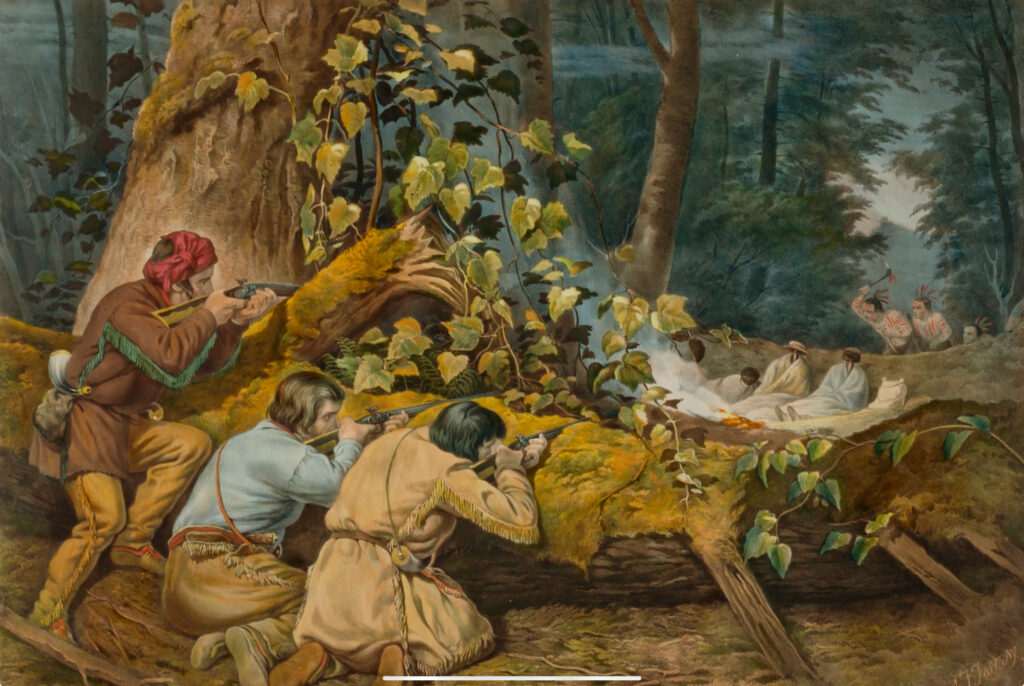
[3] Arthur Fitzwilliam Tait. The Hunter’s Stratagem. 1862. American Frontier Life series. Chromolithograph.
[4] The Miriam and Ira D. Wallach Division of Art, Prints and Photographs: Print Collection, The New York Public Library. “Grave of Michael Cresap.” New York Public Library Digital Collections. Accessed June 14, 2025. https://digitalcollections.nypl.org/items/27098050-c54d-012f-4d14-58d385a7bc34
For readers who wish to follow ongoing research, subscription is available in the footer.