The Ohio Valley of the mid-eighteenth century was no wilderness waiting to be claimed. It was a lived in landscape, Shawnee hunting grounds, Lenape towns, and Haudenosaunee (Iroquois) corridors, where every settler cabin and surveyor’s chain marked an intrusion. Every Anglo-European who moved west pressed against the intersecting worlds of Native American life like a gathering weather front. Squatters with their axes and speculators with paper deeds formed a mounting strain. Even when not openly violent, their presence disrupted the land and rhythms of Native life. Interlopers ignored the sacred and refused to respect boundaries.
The pressure was relentless, the metaphorical barometer falling in the face of violent raids, false treaties, and continuous rumors of war. Still, settlers themselves were not entirely free actors. They, too, were being pushed by colonial elites hungry for a dominion of their own, and by the debts and poverty that narrowed their choices.
East of the mountains, land in the colonies grew nearly as scarce as in the Old World the newly arriving settlers had fled. Speculators and elites claimed vast tracts on paper, leaving ordinary families little choice but to look west. Debts mounted, tenancies offered no security, and the promise of freehold ownership across the Alleghenies became irresistible. This was the cruel paradox of frontier life: the very men and women who saw themselves as victims of a rigged colonial system became the instruments of another dispossession. Fleeing one enclosure, they enacted another.
The men and women who crossed this ground — Gibson, Croghan, Washington, White Eyes, Cornstalk, Guyasuta, the Gilmans, and countless unnamed captives and traders — shaped the world that would explode in Lord Dunmore’s War and soon after, the Revolution.
George Washington, who first traveled west with frontiersman Christopher Gist and then crossed the Potomac at Swearingen’s Ferry with Braddock’s army, will soon return as a surveyor and speculator, reading Native fields as future plats. Speculators in Philadelphia plotted paper claims, while squatters cut tomahawk marks into trees. For Native families, these advances were not abstractions but the daily loss of game, soil, and safety.
Leaders like Cornstalk and White Eyes fought to balance war and diplomacy, while Guyasuta shifted roles as circumstances demanded — first ally, then adversary, and later mediator. Traders like George Croghan and John Gibson bound themselves to Native communities through marriage, adoption, and commerce. The Gilman family, struck by raids and captivity, stood as one of many settler households that bore the cost of this contested ground.
Part I has shown how Native peoples felt the tightening vise of Anglo-American expansion. Every act of frontier violence, every captive taken or returned, every ledger entry in a trader’s book was a sign that strain was mounting. By the 1770s, the Ohio River Valley was no longer just a corridor of trade — it was a fault line, where Native homelands met the ambitions of settlers and speculators. The contest would only grow sharper in the decade to come.
Figures like Washington, the Butler brothers, and John Gibson would later win renown in the Revolution, but history has largely bleached over the fact that long before independence, they were already bound to the contested landscapes of the West — the Allegheny Plateau, the bends of the Monongahela, and the valleys that funneled into the Ohio River. Their fortunes, reputations, and survival were forged in Native homelands before they ever saw a Revolutionary battlefield.
With the 1770s, the fragile peace at the Forks gave way. Tribes weighed impossible choices, settlers pressed harder, and the Ohio River itself became less a boundary than a battleground. Part II begins with the river as artery and fault line — a place where disease, hunger, and broken treaties surged downstream as surely as the current itself.
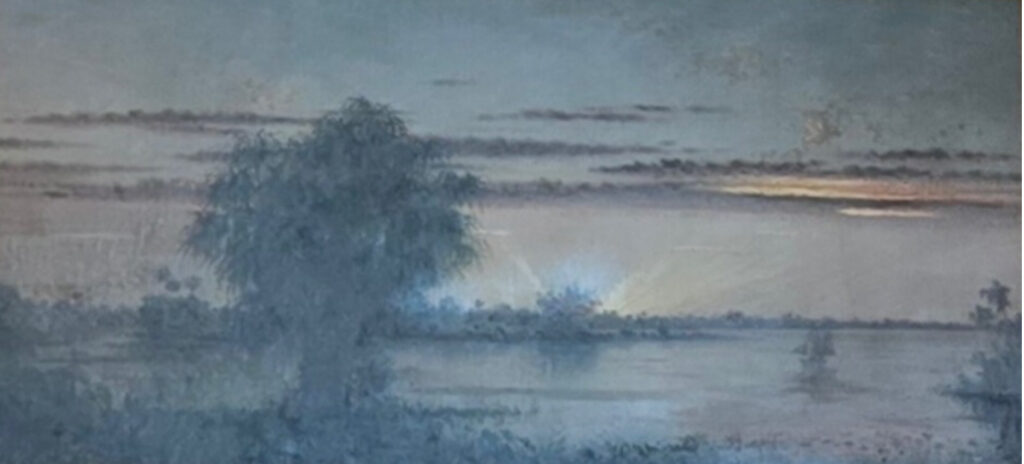
Henry Ward Ranger’s Landscape with River View, Sunrise captures a serene moment — soft light spilling across still water, the day breaking calm and steady: the quiet majesty of an American river at dawn. Though painted more than a century after the frontier era, its mood of stillness over flowing waters resonates with the Ohio of the eighteenth century. The Ohio, like every American river, carried more than reflection. Beneath its tranquil surface ran currents of memory, pressure, and contest. For Native peoples, rivers like the Ohio were homelands, highways, and boundaries; for settlers and speculators, they were arteries of ambition.[1]
Notes & Citations:
[1] Henry Ward Ranger, “Landscape with River View, Sunrise” (ca. 1910). White House Collection. Photograph by the author.
For readers who wish to follow ongoing research, subscription is available in the footer.
One response to “Part I, Post 11 – Part I Recap: The Ohio as Fault Line”
Love it