Why did people risk death by disease or storm to cross the Atlantic? While religious freedom was a motivating factor for some—Puritans in New England, or New Christians fleeing Brazil’s Inquisition-era persecutions—the vast majority came for land, opportunity, and the promise of a better life. Even the Quakers after the 17th century were emigrating to join an established, powerful Quaker colony. They were expanding west for land and opportunity like everyone else rather than fleeing persecution. Too often, religion overshadows economics in popular memory, which is unfortunate. Historical materialism, is a way of looking at history that sees struggles over wealth, work, and resources as the primary forces shaping how societies change.
In the eighteenth century, thousands left Europe searching for land and opportunity in the American colonies. German Palatines fleeing war and debt, English Quakers seeking a state administered by their own religious principles, Dutch farmers pursuing fertile soil, and others crossed the Atlantic. However, none came in greater numbers than the Ulster Presbyterians—better known today as the Scots-Irish.
In the early seventeenth century, the British Crown experimented with colonization by planting Scottish immigrants in the Ulster counties of Ireland. The project was intended to secure loyalty to the Crown and impose English order on a restive region. Instead, it produced friction. (Shocking. I know) The Scottish settlers never blended into a “united English” mindset with their Irish neighbors. Instead a storm of religious division among Episcopalians, Presbyterians, and Catholics was instigated. By the eighteenth century, Irish absentee landlords were pressing ever-higher rents, while economic and social pressures pushed the Scots on Ulster’s margins to seek opportunities elsewhere.
The Land Bubble
These immigrants crossed the Atlantic hoping to claim farmland of their own. However, they found a crowded colonial society where land was increasingly monopolized by elites clinging to Old World models of tenancy. No one braved an ocean only to live under the same system they had fled, but that is exactly what awaited them. The influx of land-seeking newcomers collided with an older colonial population, many of whom had been in North America for a generation or more and likewise had no desire to remain tenants of an aristocracy, but they were constrained by lack of other recourse.
By 1775, for example, half the residents of Prince George’s County, Maryland, were non-landowners. Many toiled as tenant farmers, working the soil in exchange for harvest shares rather than wages.[2] With so much acreage tied up by wealthy investors and colonial elites, both immigrants and long-settled colonists were pushed westward, into the frontier and beyond. The colonial dream of land glimmering just beyond the western horizon called to the landless, promising a chance to redirect their lives and shape the fortunes of descendants yet unborn.
Complicating matters however, the very landlords settlers sought to avoid were scooping up western plots as they came available. Speculators, uninterested in farming themselves, bought land purely to rent or resell for profit. The pattern was inescapable: whenever colonists tried to escape tenancy, speculation closed in ahead of them. New arrivals who wanted ownership had few options but to move further west into contested territory. The result was a land bubble: an ever-growing demand for land that outpaced availability, forcing settlement deeper into Native country despite treaties and imperial decrees.
Defying Treaties, Crossing Boundaries
Land was wealth, land was freedom, and land was out of reach in much of Europe.[4] The North American colonies offered what the Old World could not: the possibility of ownership. This desire to claim and work one’s own soil drove waves of Germans, Scots-Irish, and others across the Atlantic. For them, the frontier was more than a wilderness; it was an open door to a new life for themselves and their descendants. (Note – I highly recommend White Trash: The 400-Year Untold History of Class in America by Nancy Isenberg)
But every open door to a settler was a closed gate to someone else. For the Native nations, the wave of newcomers was not just migration but invasion. These settlers came armed not only with rifles but also with entitlement. As the invaders understood it, divine will and imperial power sanctioned their claims.
It wasn’t a great situation. In 1750, Pennsylvania authorities burned the home of a nine-year-old boy named Simon Girty Jr., the same individual of that name who would later be known as the ” frontier public enemy number one, the “traitor.” Simon Girty Sr. and his family were squatting on native land in what is now Central Pennsylvania’s Shermans Creek. Colonial authorities had warned Girty Sr. and fellow squatters for years to leave amid constant overtures from Native tribes for settler authorities to deal with their own.[5]
Unmet Expectations
In The Invasion of America, Francis Jennings argues that colonists expected to find a “pristine wilderness,” a land free of the entrenched competition that Scots immigrants to Ulster had faced with the Irish.[6] To European eyes, the New World had no rival peoples to contest fields and villages, only “savages” who lived in forests. Such people, they believed, could be brushed aside when confronted with the superior force of “civilization.” Daniel K. Richter takes the point further: by promoting the narrative that settlers erased the reality of Native sovereignty and diplomacy, turning powerful nations into bit players in their own homelands.[7]
The reality could not have been more different than land hungry settlers envisioned. The frontier wasn’t empty, regardless of settler attempts to will it into emptiness by casting Native peoples as savages, erasing their sovereignty, and walking straight into a land already deeply peopled and claimed. New arrivals to the Pennsylvania backcountry would have found that it was already webbed with trails like the Shamokin Path, Peholand Trail, and Kittanning Path, which for centuries provided a conduit for civilization and continued to do so. When settlers marched west, they followed these same paths, sometimes literally walking in the footprints of those they imagined had no claim. What immigrants mistook for emptiness was a peopled, mapped, and storied landscape.
Just as dangerous as the violence itself was the mythmaking. By casting Native peoples as obstacles to progress, colonists built the moral scaffolding for dispossession. Expansion was not the peopling of an empty land. However, a collision of worlds—one that redrew borders, erased villages, and ignited wars whose legacies still shape the American landscape today.
Recommended Reading


Notes & Citations
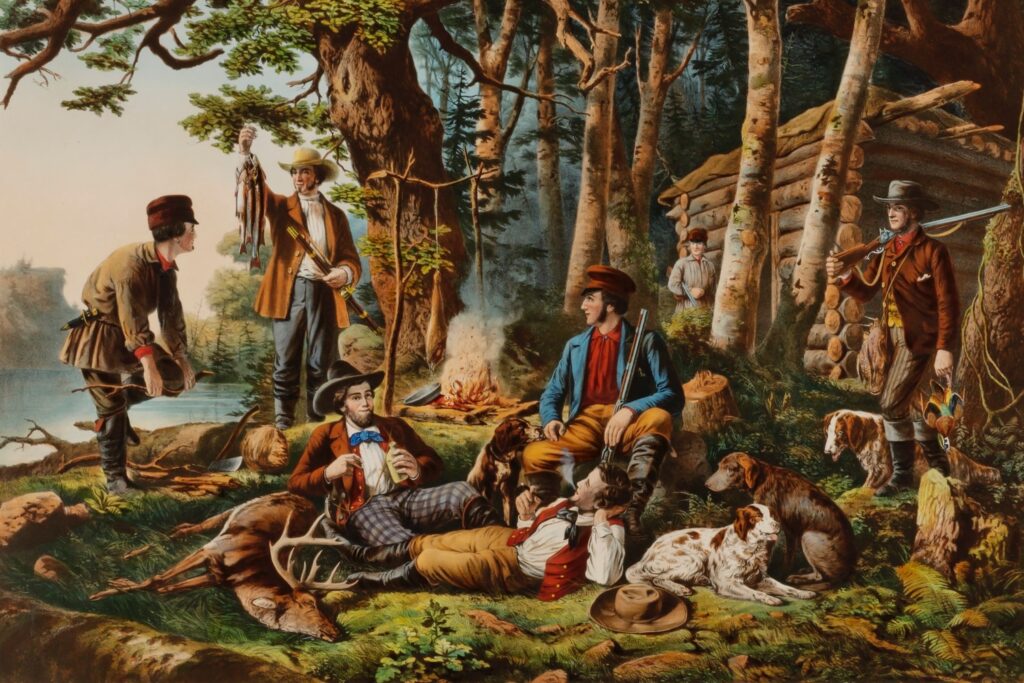
[1] Louis Maurer and Nathaniel Currier, Camping Out. “Some of the Right Sort”, 1855, hand-colored lithograph on paper, Smithsonian American Art Museum, transfer from the National Museum of American History, Division of Graphic Arts, Smithsonian Institution, 1973.122.15.
[2] “Sarson, Steven. “Landlessness and Tenancy in Early National Prince George’s County, Maryland.” The William and Mary Quarterly 57, no. 3 (July 2000). 571 & 577. https://doi.org/10.2307/2674185.
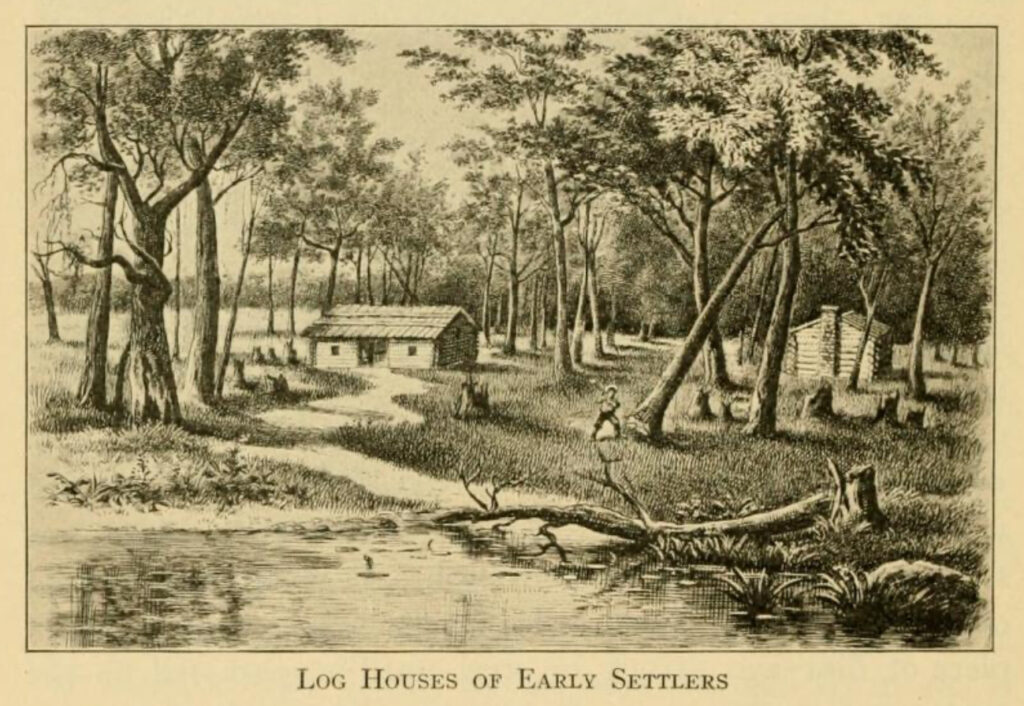
[3] Barnes, Everett. American History for Grammar Grades. [Boston, New York etc. D. C. Heath & co, 1913] Pdf. https://www.loc.gov/item/13018508/. 162.
[4] Writing this reminds me of a work associate in 2024 who casually asked his landlord if she would ever consider selling the house he rented, because he would love to buy it. She looked at him as if he had lost his mind and explained that the homes she had accumulated over her lifetime were her income stream. It strikes me how much perspective shapes judgment. In the 1770s, land seemed endless. Jefferson would later urge Americans to push west and plant farms as if unclaimed western lands would never run out. In that world, railing against wealthy speculators was framed as patriotic, because there was always more land to seize, from Native peoples and other non-Anglo Americans, and redistribute. Today the frontier is long closed. For the first time, turning renters into buyers would not mean opening new territory but reallocating existing property—taking opportunity from speculators rather than expanding into new ground. History repeats itself, only the lens of time changes. But has the can that’s been kicked down the street for three centuries finally reached a wall?
[5] Rupp, Israel Daniel. The History and Topography of Dauphin, Cumberland, Franklin, Bedford, Adams, and Perry Counties, Pennsylvania. Lancaster, PA: G. Hills, 1846. 555.
[6] Francis Jennings, The Invasion of America: Indians, Colonialism, and the Cant of Conquest (New York: W. W. Norton, 1975), 15–18.
[7] Daniel K. Richter, Facing East from Indian Country: A Native History of Early America (Cambridge, MA: Harvard University Press, 2001), 8–12.
For readers who wish to follow ongoing research, subscription is available in the footer.