In the spring of 1763, Britain believed the war for North America was finished. The Treaty of Paris had been signed, the French expelled from the Ohio Valley, and London’s ministers shifted their gaze back across the Atlantic. On the ground, however, the reality looked very different. For Native nations, Britain’s triumph ended a fragile balance. For all their faults, the French understood diplomacy as exchange: powder, cloth, tools, and weapons given in recognition of Native sovereignty, and received in turn with alliance. The British rejection of material diplomacy was a product of foreign policy of assumed superiority, one that would cause violent aftershocks to rip through the western frontier.
Into the uncertainty stepped prophecy and resistance. A voice rose to call for North America’s Native peoples to return to their ancestral ways, to reject the corruption brought by Europeans. Another Native leader gathered grievance and vision, forging despair into revolt. Within months, forts that had stood for decades toppled in rapid succession, and the “peace” Britain claimed at Paris dissolved in fire and war.
Rum Carriers of Death
“Your traders now bring scarce anything but rum and flour; they bring little powder and lead, or other valuable goods. The rum ruins us. We beg you would prevent its coming in such quantities by regulating the traders.” — Oneida deputy Scarouady, speech to the Pennsylvania Provincial Council, October 3, 1753.[1]
Native tribes watched as the British colors replaced the French’s in the Ohio River Valley’s far-flung forts with trepidation. The French had long cultivated Native alliances with regular gifts: powder, lead, cloth, clothing, kettles, tools, weapons, even ceremonial flags and medals. These weren’t “handouts” — they were the currency of diplomacy, recognizing Native sovereignty and keeping alliances alive. Britain, however, was broke.
General Jeffrey Amherst, the new commander-in-chief of North America, didn’t like anything about North America. As far as he was concerned, the colonists were indolent and good for nothing, “if left to themselves, would eat fried pork and lie in their tents all day long.” The Native Americans were just as bad or worse; in his mind, they did “nothing but eat and drink.”[2] What’s more, Amherst was a former quartermaster. Never look at the quartermaster to give things away. To him, generosity was a waste, and diplomacy was bribery. He sneered at the practice as nothing more and moved to slash it. Powder, lead, and clothing were cut off — precisely the things Native families needed to hunt, defend themselves, and sustain their way of life.
Alcohol found a way, though. Britain controlled the rum trade through its Caribbean outposts. In 1733 a delegation of Shawnee leaders petitioned Pennsylvania’s lieutenant governor, Patrick Gordon, protesting the influx of rum into their villages. They asked for authority to break open and destroy traders’ kegs when they appeared, hoping to shield their people from the disorder alcohol caused. The Provincial Council acknowledged the complaint but refused to grant that power, preferring to regulate traders lightly rather than empower Native leaders to act on their own. [3]
Pennsylvania barred the carrying of rum into Native lands as early as 1747, and Virginia and New York soon followed suit. But passing a law and enforcing it were never the same thing. By 1753 Monacatootha, known to the colonists as Scarouady, the same Oneida leader who would later clash with Braddock’s arrogance — stood before the Pennsylvania Provincial Council in Philadelphia to beg for relief. His plea was simple: stop drowning Native communities in rum, and restore the trade in powder, lead, and goods they actually needed.
From a future perspective, we know that the British didn’t let morality get in the way of commerce or leverage. If a product corroded societies, that was a secondary concern: opium into China in the nineteenth century, rum into Native country in the eighteenth. And by the way, drink your tea, which is shipped in from India. British go-betweens who visited Haudenosaunee (Iroquois) towns become known as ‘rum carriers.’ [4] There is no evidence that Amherst ordered rum as a weapon, but the effect was the same: Native nations were being drowned in it.
War Persists: Pontiac’s War and the “Lenape Prophet”
In February of 1763, the diplomats of Europe gathered to sign the Treaty of Paris, ending the Seven Years’ War (as far as Europe was concerned). By May, however, North America was ushered into the next phase of the war that had been waged for the last decade.
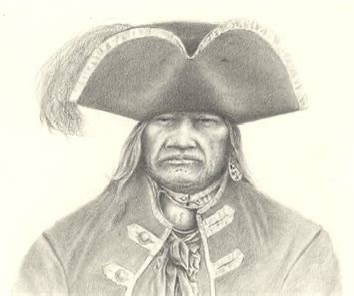
During the war, the Lenape spiritual leader Neolin — remembered as the “Delaware Prophet” — preached that Native peoples must turn away from the corrupting influences of Europeans. He urged rejection of British goods, including firearms, a return to traditional lifeways, and above all, the abandonment of alcohol, which he denounced as poison brought to weaken and destroy Native nations. His message was stark: Native peoples had lost their way and could only survive by returning to the path of their ancestors. Neolin’s teachings resonated widely, spreading beyond the Lenape and deep into Ottawa country.
Ottawa chief Pontiac did not fully embrace Neolin’s vision. He knew Native resistance to the British could not succeed without firearms. But he agreed with Neolin on one crucial point: rum was poison. And with Amherst already denying Native nations powder, lead, and other essential supplies, the damage was evident. Neolin gave voice to despair; Pontiac sought to turn that despair into action.
Maybe the British thought the war was over and were thus unprepared. A young king had ascended in 1760, and neither he nor his ministers relished the inheritance of war. In the spring and summer of 1763, forts across the interior rapidly toppled, falling like dominoes. Fort Sandusky was the first to go in May. By June, St. Joseph, Miami, Ouiatenon, and Michilimackinac had been overrun, the latter falling as part of a ruse involving King George III’s impending birthday. Soon after, Venango and Le Boeuf were destroyed, and Presque Isle surrendered after a two-day siege. By July, nine British posts had been wiped from the map. Only three targeted western forts remained in British hands—Detroit, Niagara, and Pitt—while along Forbes Road, Ligonier (and Bedford) endured repeated attacks but never surrendered.
Biological Warfare
“Could it not be contrived to send the smallpox among these disaffected tribes of Indians? We must, on this occasion, use every strategem in our power to reduce them.” General Amherst to Colonel Bouquet[6]
It’s one of those historical “facts” that sounds too sensational to be real: British officers plotting biological warfare at what is now Pittsburgh. For years, I assumed the story was apocryphal. I’d skimmed something once that dismissed it as a rumor, and left it at that. But I was wrong. Passive learning can be misleading — the evidence is there in the documents. Amid the siege of Fort Pitt in 1763, General Amherst suggested in a letter to Colonel Henry Bouquet that they supply the Natives with smallpox ridden blankets. Bouquet replied that he would attempt it. It happened — most secondary sources just get the details wrong.
Captain Simeon Ecuyer, the officer in command of Fort Pitt during the siege, along with trader William Trent, carried out the infamous act: giving Native envoys blankets from the smallpox hospital.[7] Trent recorded it in his journal. Smallpox had been a recurring issue for some time. Amherst and Bouquet corresponded on the idea in July, weeks after Trent and Ecuyer had already put it into practice — the war crime in all but name. The timeline is uncanny. On June 24, 1763, Ecuyer and trader William Trent handed Native envoys blankets from the smallpox hospital at Fort Pitt.
When Amherst and Bouquet began discussing the idea on paper weeks later, the deed was already done. Coincidence? Parallel desperation? Or were there other voices, unrecorded, passing the notion around the frontier? The documents go silent, and we’re left to guess. Much ink has been spilled over whether Amherst or Bouquet was ultimately “responsible” for the spread of smallpox at Fort Pitt in 1763, but that debate misses the larger point. What matters is that Amherst suggested it in writing, and Trent and Ecuyer had already tried it weeks earlier. This was not an isolated thought — British officers clearly regarded biological warfare as possible, perhaps because they had heard past rumors or even seen confirmed cases. Native peoples were already enduring wave after wave of epidemic disease, making it nearly impossible to know how or where infection spread.
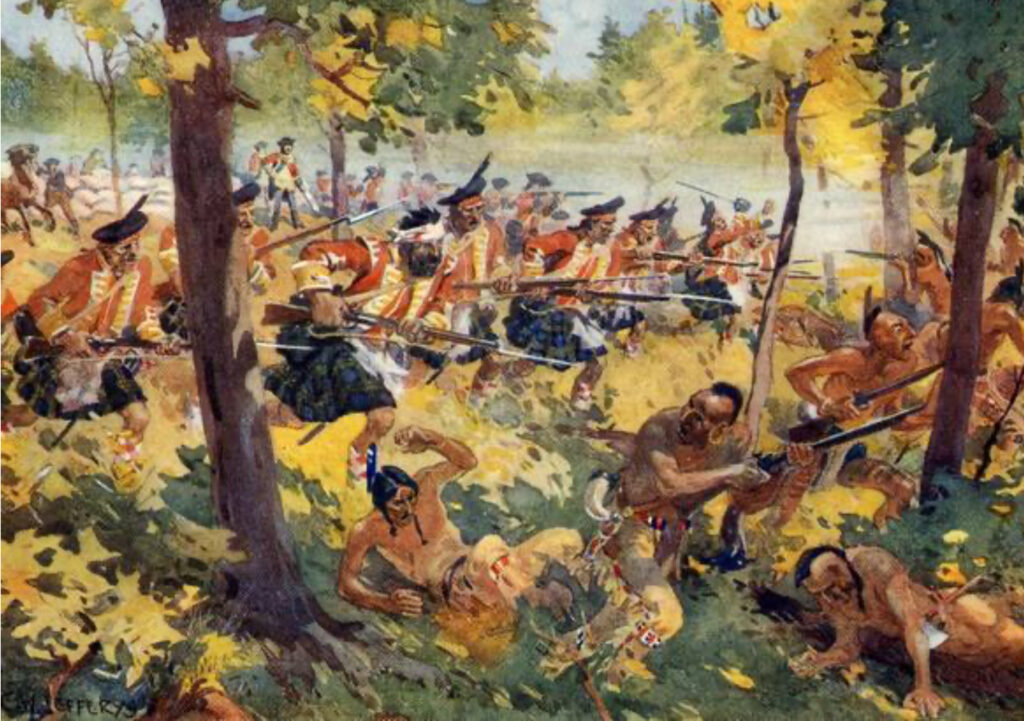
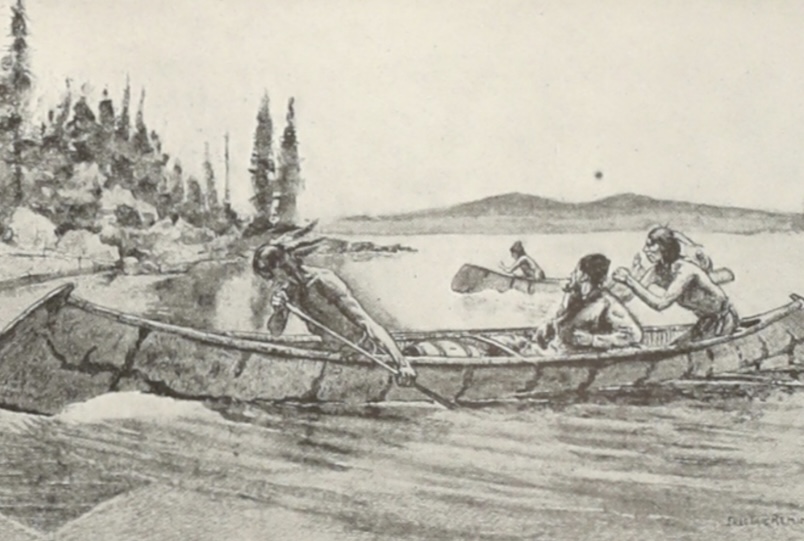
Romantic primitivism was baked into early 20th-century historical illustration.
August 1763, Bouquet Breaks the Siege of Fort Pitt
Unlike at Detroit, where Pontiac was clearly directing the siege, Fort Pitt’s attackers didn’t have a single commanding figure. Historians generally agree that the Lenape had the most prominent role, since the fort sat within their sphere of influence and they had the strongest grievances against British settlement and Amherst’s withdrawal of gifts. Yet they were not alone: Shawnee and Wyandot warriors joined them in pressing the attack in addition to the Seneca. The Seneca—alone among the Six Nations—took the field against the British. They had earlier accepted their fellow Six Nations’ desire to support the British, but never without reservations.
The little army that departed Carlisle with Bouquet in the summer of 1763 was a patchwork column: scarlet-coated regulars, 60th Royal Americans with dark blue facings, provincial rangers in coarse green linen hunting shirts, and Highlanders in tartan — all trailed by civilian teamsters, packhorse men, and camp followers. It was nothing like the uniform mass we imagine when we think of “British redcoats.”
The Highlanders formed a striking part of Bouquet’s force. The 42nd Royal Highland Regiment, better known as the Black Watch, marched in the dark plaid unique to their regiment: deep green and navy blue bars crossed with narrow black lines. In the dim light of the Pennsylvania forest, the pattern looked nearly black, which is how the regiment earned its name. Whether worn as belted plaids, tailored kilts, or trews, no other Highland regiment carried this tartan in the same way — it was their signature.[9]
But it was a weakened host. In his letters to General Amherst, Bouquet admitted that his men were “much reduced by sickness.” The Highland regiments were in especially poor condition, having just returned from the grueling 1762 Caribbean campaign that closed the Seven Years’ War. Disease had ravaged their ranks, and so many were unfit for the march that wagons trailed behind the column, carrying those too ill to keep pace. Bouquet had requested Pennsylvania provincials to join his force, but the Assembly spent weeks debating funding and principle. The colony’s political culture—dominated by Quaker pacifism and disputes over taxation—meant that any military response was halting and inadequate, leaving Pennsylvania largely incapable of organizing effective forces throughout the crisis and beyond.
An attack force struck hard as Bouquet’s weary column neared the water source at Bushy Run. Ambushed in the thick Pennsylvania woods, casualties mounted quickly. Bouquet pulled them into a defensive perimeter atop a rise known as Edge Hill to steady his men. It was a desperate position. Ammunition and supplies were low, the wounded were piling up, and water was scarce. A prolonged fight would mean certain destruction.
Bouquet knew he could not simply hold on. Instead, he gambled. On the morning of August 6, he ordered two light infantry companies to feign a retreat—an invitation his attackers could not resist. Believing the British line was finally breaking, Native warriors surged forward to exploit the collapse. At that instant, Bouquet’s hidden reserves wheeled around and delivered a devastating flank volley. The feigned withdrawal snapped shut like a trap.
The shock broke the momentum of the attackers. What had been a steady tightening noose around Bouquet’s column turned into chaos and retreat. Despite heavy losses, Bouquet forced open the road. On August 7, his battered column staggered into Fort Pitt, and the siege was broken.
Conclusion
Pontiac’s Rebellion primarily unfolded to the north, beyond the immediate scope of this narrative. But in the southern Upper Ohio Valley and along Virginia’s frontier, one Shawnee leader’s name began to echo louder than any other: Cornstalk. For settlers, he embodied their anxieties — imagined behind every raid, ambush, and burning cabin. Whether true or not, Cornstalk became the specter of Native resistance, the figure through which frontier families explained their deepest fears. His story — and that of the children caught between Native and settler worlds — will be the subject of the next post.
Notes and Citations
[1] Scarouady, speech to Pennsylvania commissioners at Carlisle, October 3, 1753, Colonial Records of Pennsylvania, vol. 5 (Harrisburg: State Printer, 1852), 676.
[2] Kevin M. Sweeney, “The Very Model of a Modern Major General,” Amherst Magazine (Fall 2008), accessed August 26, 2025, https://www.amherst.edu/news/magazine/issue-archive/2008fall/lordjeff.
[3] King, James C. “Indian Credit as a Source of Friction in the Colonial Fur Trade.” Western Pennsylvania Historical Magazine 49 (January 1966): 61. https://journals.psu.edu/wph/article/view/2783/2615
[4] Francis Parkman, The Conspiracy of Pontiac and the Indian War after the Conquest of Canada, vol. 1 (Boston: Little, Brown, 1851), 74.
[5] National Park Service, “The French and Indian War 1754–1763: Biography Cards—Unit 7,” Fort Necessity National Battlefield, last modified June 10, 2022, accessed September 5, 2025, National Park Service, https://www.nps.gov/teachers/classrooms/the-french-and-indian-war-biography-cards.htm.
[6] David R. Farrell, “‘To Keep Them in Proper Subjection’: Jeffrey Amherst and the Indians,” Man and Nature / L’homme et la nature 4 (1985): 155–169, accessed August 20, 2025, https://doi.org/10.7202/1011843ar.
[7] Never trust a historical work that (A) doesn’t cite its sources, or (B) is written by someone posing as the expert while covering too broad a canvas to corroborate the details. That’s when rumors get repeated as fact. If you’re interested in what really happened at Fort Pitt in 1763, see the work of Elizabeth Fenn of the University of Colorado Boulder — her study is a thorough, source-driven analysis.
Elizabeth A. Fenn, “Biological Warfare in Eighteenth-Century North America: Beyond Jeffery Amherst,” The Journal of American History 86, no. 4 (March 2000): 1552–1580, https://doi.org/10.2307/2567577.
[8] Charles William Jefferys, The Battle of Bushy Run, c. 1915, public domain, Wikimedia Commons, accessed September 5, 2025, https://commons.wikimedia.org/wiki/File:The_Battle_of_Bushy_Run.jpg.
[9] Before 1768, when the Royal Warrant of Clothing imposed army-wide standards, regimental commanders had broad discretion over uniforms. Colors, facings, lace, and accoutrements varied from regiment to regiment. Highland regiments were also in transition: by the 1750s, the tailored kilt (feileadh beag) had begun replacing the older belted plaid (feileadh mòr), though both garments (and trews) still appeared on campaign. Thus, at Bushy Run, the 42nd’s distinctive tartan would have been worn in more than one form, adding to the patchwork appearance of Bouquet’s column. The kilt had begun the decades-long replacement of the belted plaid in 1750. Additionally, until 1768, when the Uniform Standardization warrant took effect, commanders on the ground had a lot of leeway in colors, facings, lace patterns, and distinctions from regiment to regiment.
[10] Ralph Henry Gabriel ed. The Pageant of America: A Pictorial History of the United States. Vol. 2, “The Lure of the Frontier.” New Haven: Yale University Press, 1929. Engraving after Frederic Remington, “Rival Traders Racing to the Indian,” p. 17.
For readers who wish to follow ongoing research, subscription is available in the footer.