If the beaver was the coin of the frontier, then traders and interpreters were the ones who kept it flowing. Behind the ledgers and pelts were men whose names became bound up with the Ohio River Valley’s story. Among them were John Gibson and the Butler brothers, figures who stood at the crossroads of commerce and conflict. Gibson, once a captured provincial soldier, became a trusted interpreter with deep ties to the Shawnee. The Butlers, Dublin born gunsmiths turned traders, would rise from the banks of the Ohio to the ranks of the Continental Army. Their stories reveal how individual lives were entangled with the volatile economy that bound Native nations, settlers, and empires together.
John Gibson: an introduction
John Gibson’s life on the frontier began not with commerce but with conflict. His route west came by way of marching with General Forbes’s army. Taken by the Lenape during the upheavals of the 1750s, he was spared execution, but not the burdened responsibility of watching the terrible executions of others. In 1764 Gibson was amongst those held captive that were freed by Henry Bouquet following breaking the siege on Fort Pitt. Rather than returning east to Lancaster, he opted to stay and commence trade out of Pittsburgh.
He was nicknamed “Horse Face” by his Native community because of his long, narrow face and strong jaw. Note, that the label is from later recollection, not a verifiable ledger line. Unlike many traders who hovered at the edges of Native villages, Gibson felt at home within them, absorbing customs that made him a credible intermediary. His later marriage to a Shawnee woman deepened those bonds, ensuring his place in Native society rested on more than commerce alone. By the late 1760s, Gibson appears in the Fort Pitt ledgers as a trader and an interpreter—a man trusted to carry words and meaning across the cultural divide. These early experiences, forged in captivity and kinship, would shape his role for decades to come, as he moved between trade, diplomacy, and eventually politics. In 1773 be is mentioned as residing in Newcomers Town with a Lenape wife.
The Butlers: From Dublin to the Frontier — Before They Were Fighting Butlers
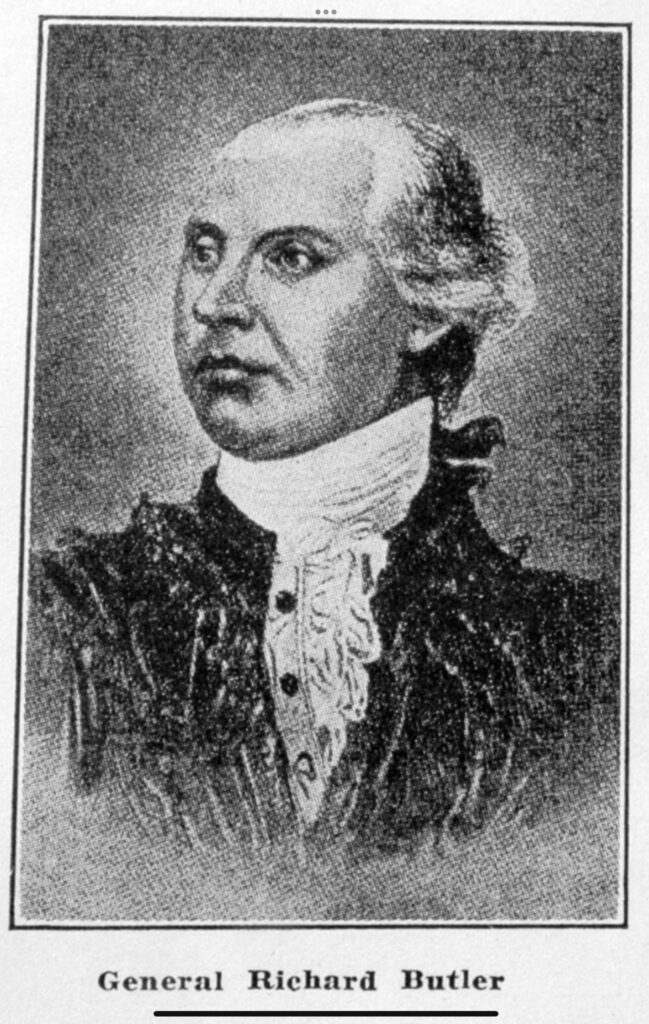
The Butler family emigrated from Dublin to Pennsylvania in the mid-eighteenth century, settling first in Lancaster and then Carlisle. Their father, Thomas Butler, was an accomplished gunsmith, and the sons carried on the trade, supplying firearms and repairs on the Pennsylvania frontier. Within a decade, all five Butler brothers were officers in the Continental Army, a family service record so striking that they became known as “the Fighting Butlers.”
The brothers seemed to have set their eyes beyond gunsmithing early. In 1764, a newspaper notice from York Town reported two Irish born teenagers named Thomas and William Butler detained as suspected runaway indentured servants.[1] Both were described as wearing buckskin breeches, the garb of the frontier, not what genteel apprentices or town youths would usually wear. It is possible these were two the Butler brothers, though absolute confirmation is lacking. Were it them, had their father not stepped forward within thirty days, the two Butler boys would have been sold at auction to pay for their jail fee. For free born Irish immigrants in colonial Pennsylvania, the line between liberty and servitude could be frighteningly thin.
By the late 1760s, brothers Richard and William Butler had moved westward toward Fort Pitt, where they combined their gunsmithing skills with the Indian trade. Their experience as armorers gave them an edge in frontier commerce, firearms and powder were among the most sought after items in exchange for pelts. Before they became famous as Revolutionary officers, the Butler brothers were already well known in the Upper Ohio River Valley as traders who operated in Shawnee country and maintained close ties to George Croghan’s network at Fort Pitt.
By the early 1770s Butler brothers Richard and William had established themselves as some of the leading traders in Fort Pitt. Baynton, Wharton & Morgan Papers, mentioned in depth in the previous post had overextended themselves by attempting to dominate trade in and out of the Illinois country and were thus eclipsed. Despite needing to compete with fellow traders John Gibson, George Croghan, and the Lowrys the Butlers rose to be the dominant traders in Pittsburgh by 1774. [2]
The Fort Pitt ledgers record the “Grenadier Squaw,” remembered in oral tradition as a sister of Cornstalk. Some nineteenth-century accounts went further, claiming she was married to Richard Butler, though no contemporary evidence supports it. What can be said with certainty is that she was a woman of influence, moving goods in quantities that marked her as a significant participant in the Ohio Valley trade.
John Gibson: The “Last” Resident of Logstown
Butler’s rumored relationship with the Grenadier Squaw is a reminder of the mercurial nature of ties between traders and Native women. Although it is important to note that nineteenth century county histories popularized the relationship claim without contemporary documentation. Such unions could cement trade networks and trust, but they were also informal, ending when either party no longer wished to continue them. These relationships were not sealed in the binding contracts of colonial law but in mutual need. John Gibson’s own experience illustrates the point: his marriage to the Shawnee woman listed as “Gibson’s Shawnee Wife” in Baynton, Wharton, and Morgan’s records eventually dissolved, showing how such partnerships could shift as quickly as the politics and fortunes of the frontier itself. Some traditions hold that the couple had a son who remained among the Shawnee, though the records are silent on his life. Unlike George Croghan’s daughter Catharine, whose kinship ties are well documented, Gibson’s Native descendants surface only in fragments of oral memory.
Gibson appears in the Baynton, Wharton & Morgan ledgers not as an employee but as one of dozens of contractors who drew goods on credit. Like Croghan or the Butlers, he operated at his own risk, carrying Philadelphia’s merchandise into Shawnee country and returning with pelts or promises. It was the standard model of the frontier trade — independence balanced on the edge of debt.
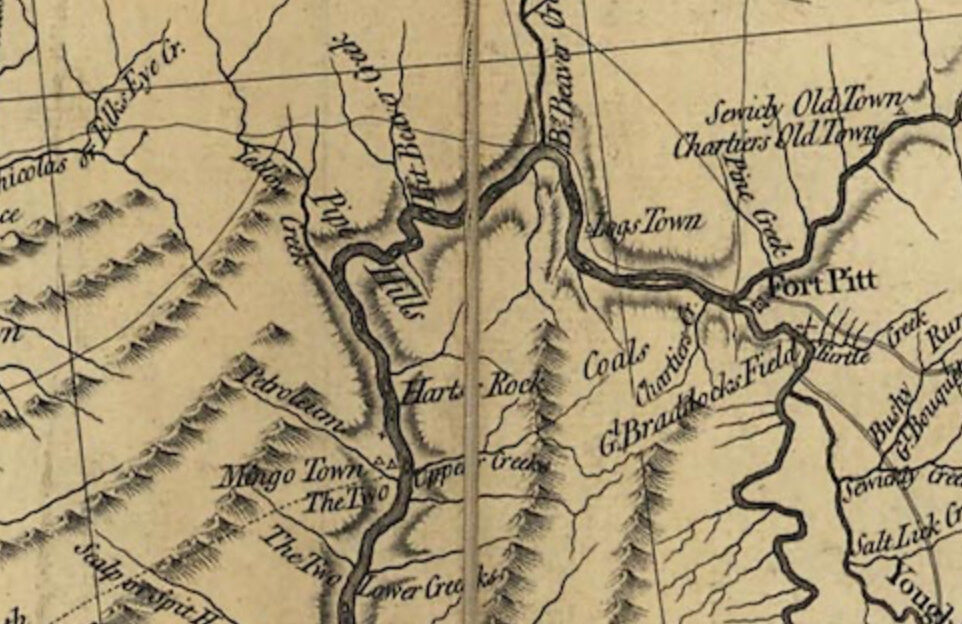
Gibson has often been remembered as the ‘last resident’ of Logstown, though by then the site was a ghost of its former self. By then the site was far from the bustling trading post it had been a generation earlier, its houses mostly abandoned and its people dispersed. Just downriver, at the mouth of Beaver Creek, stood Loganstown, the settlement of the Mingo leader James Logan. One surviving account places George Girty present when Logan, angered by reports that Gibson had supplied alcohol to a Native man who drowned in the river, was waiting for the trader outside his home. Gibson, fearing for his safety, withdrew to Fort Pitt. To ease the tension, Guyasuta and White Eyes visited Logan to diffuse the situation.[4]
Pennsylvania vs. Virginia Merchants
“In the matter of land speculation Virginia led the way, Maryland followed, while Pennsylvania seemed to divide its interest fairly equally between the fur trade and land.” [5] Clarence W. Alvord, The Illinois Country, 1673–1818, 1920.
Not all traders came from the same mold. Those tied to Pennsylvania’s capital — like the Butlers, Croghan, and Gibson — depended on credit, Atlantic markets, and often wove themselves into Native communities through marriage and language. Virginia’s men — like John Connolly, William Crawford, and George Washington — blended trade with speculation, eyeing Native lands as prizes to be parceled out. The clash between these two systems sharpened tensions in the Ohio Valley and shaped the road to Dunmore’s War.
By the late 1760s, two distinct colonial visions for the Ohio Valley were colliding. Pennsylvania’s Illinois Land Company, launched in 1767, was the creation of Philadelphia merchants: Samuel Wharton, George Morgan, Joseph Wharton, and others from Baynton, Wharton & Morgan’s circle. Their strategy leaned on trade and treaties. They poured goods into Fort Pitt, courted Native leaders at councils, and looked to secure vast tracts of Illinois Country land on paper before settlers ever arrived.
Virginia’s Ohio Company, by contrast, dated back to the 1740s and was dominated by Tidewater grandees like Lawrence and George Washington, Thomas Lee, and George Mason. Their model was land first, trade second. They dreamed of survey lines, townships, and plantations carved out south of the Ohio River. Where Pennsylvanians saw profit in pelts and credit, Virginians saw profit in surveys and settlement.
Native nations did not see the Anglo-European colonists as a single people. Just as they marked differences among their own tribal neighbors, they noticed distinctions between Pennsylvanians and Virginians. Pennsylvania traders had long been part of the Ohio economy, tied in by webs of kinship, credit, and language. Virginians, by contrast, were increasingly identified as land-hungry speculators, men with surveyor’s chains and militia swords. In times of conflict, these reputations mattered. Shawnee and Mingo raiders might strike down Virginia traders while sparing Pennsylvanians in the same village, judging them by the same logic they applied to rival tribes. To Native eyes, the Virginians had earned their name: the “Long Knives,” men whose ambitions reached past trade into Native land itself.
By 1774, these rivalries, among traders, colonies, and nations, would erupt into violence. The killing ground would not be in distant Illinois, the Ohio Valley would soon erupt.
Notes and Citations
[1] The Pennsylvania Gazette, “ York Town February 6, 1774.,”February 23, 1764, p. 4, image 39396504, Newspapers.com.
[2] The Pennsylvania Gazette, “Philadelphia, July 6.,” July 6, 1774, p. 2, image 39408709, Newspapers.com.
[3] Across a New Nation,” in Mapping a New Nation: Abel Buell’s Map of the United States, 1784, Library of Congress Exhibitions, accessed September 15, 2025, https://www.loc.gov/exhibits/mapping-a-new-nation/special-presentation/newnation.html.
[4] Consul W. Butterfield, History of the Girtys: A Concise Account of the Girty Brothers, (Harrisburg, PA: Harrisburg Publishing Co., 1890), 338.
[5] Clarence W. Alvord, The Illinois Country, 1673–1818 (Illinois Centennial Commission, 1920),226.
For readers who wish to follow ongoing research, subscription is available in the footer.