Fort Pitt was never just a fort. Built on the ruins of Duquesne, it became the crossroads of empire and dispossession, where British officers, land-hungry traders, and Lenape leaders met in wary alliance. For traders it was a gateway to western lands; for Native communities it was the hub of Anglo-European exchange. Deals were struck in one breath and broken in the next, with rum fueling diplomacy as often as it poisoned it. Schemes born here promised futures as ambitious as they were fragile. The world that took shape at Fort Pitt—partnership and betrayal bound tightly together—set the stage for the bloodletting soon to follow down the Ohio.
Community on the Borderland
Fort Pitt was erected on the ruins of Fort Duquesne at the confluence of the Allegheny and Monongahela Rivers, the site now preserved as Point State Park in downtown Pittsburgh. In 1760, the year the new fort opened, the adjoining settlement consisted of roughly two hundred domiciles for the garrison and about 150 civilian inhabitants.[1] In these early years, Pittsburgh remained wholly a military town: every house and outbuilding required permission from the commandant to be built, and property could not be sold without military approval.
Traders who were found guilty of selling guns, powder, or alcohol to Native Americans risked banishment and the destruction of their cabin. An incident that occured in the late 1750s speaks to the state of alcohol availability prior Bouquets assumption of authority. One night while drinking, George Croghan and Lenape leader Teedyuscung—whom colonial communities styled the “King of the Delawares”—came to blows at Fort Pitt, leaving Croghan with a black eye. A wagonmaster claimed to have seen the two men “boxing.” Even as drunken brawls played out, officials tried to regulate the trade in liquor by restricting rum to non-Natives. Yet Tamaqua, the Lenape chief known as Beaver King, spoke up for those who resented being denied access, insisting that his people should be free to purchase it like anyone else. [2]
Colonial sources often speak of the “Delaware tribes” as if they were ten or more separate nations, but this reflects the language and misunderstanding of British record-keepers rather than Indigenous reality. What colonial officials called “tribes” were usually local bands, village communities, or clan-based divisions within a single cultural nation: the Lenape (Lenni Lena.[3] By the mid-eighteenth century, the Lenape had been forced west from their homelands along the Delaware River and were living in scattered towns across Pennsylvania and the Ohio Valley. Each community had its own chiefs—men like Beaver, Shingas, Delaware George, Killbuck, and Teedyuscung—so outsiders sometimes mistook these divisions for separate “tribes.” Teedyuscung, for example, was a Munsee Lenape leader whom the British and Haudenosaunee (Iroquois) styled as “King of the Delawares,” but his authority never extended over all Lenape bands. What appears in colonial records as a patchwork of “tribes” was in fact one people, dispersed and politically fractured under pressure from war and displacement.
The Lenape were integral to the frontier community at Fort Pitt, yet their presence exposed deep cultural tensions. Elders admitted that it was often their own young men who stole horses or caused disturbances, but such behavior could not be stamped out by decree. In Lenape political culture, leaders guided by persuasion rather than coercion, and every man’s independence was respected. To colonial eyes this looked like weakness; to the Lenape, it was the natural balance of a society built on autonomy and consensus. The British garrison, however, saw matters differently. Colonel Henry Bouquet had Major Edward Ward, George Croghan’s brother, send out word for the local Native leaders to gather at the fort. Per Ward, in the meeting, Bouquet announced “that if they did not prevent their young people from stealing our horses in the future, the killing of a man or two would not be the end of it.”[4]
Ordering that any Natives caught stealing horses be killed on sight — a striking decision in a moment when Native nations were divided between alliance with or opposition to the Crown. The policy risked alienating even friendly groups, since a horse thief might just as easily be a relative or ally. Yet to the garrison, horses were indispensable for military supply and survival, too valuable to lose no matter the diplomatic cost.
An Outsider Between Worlds
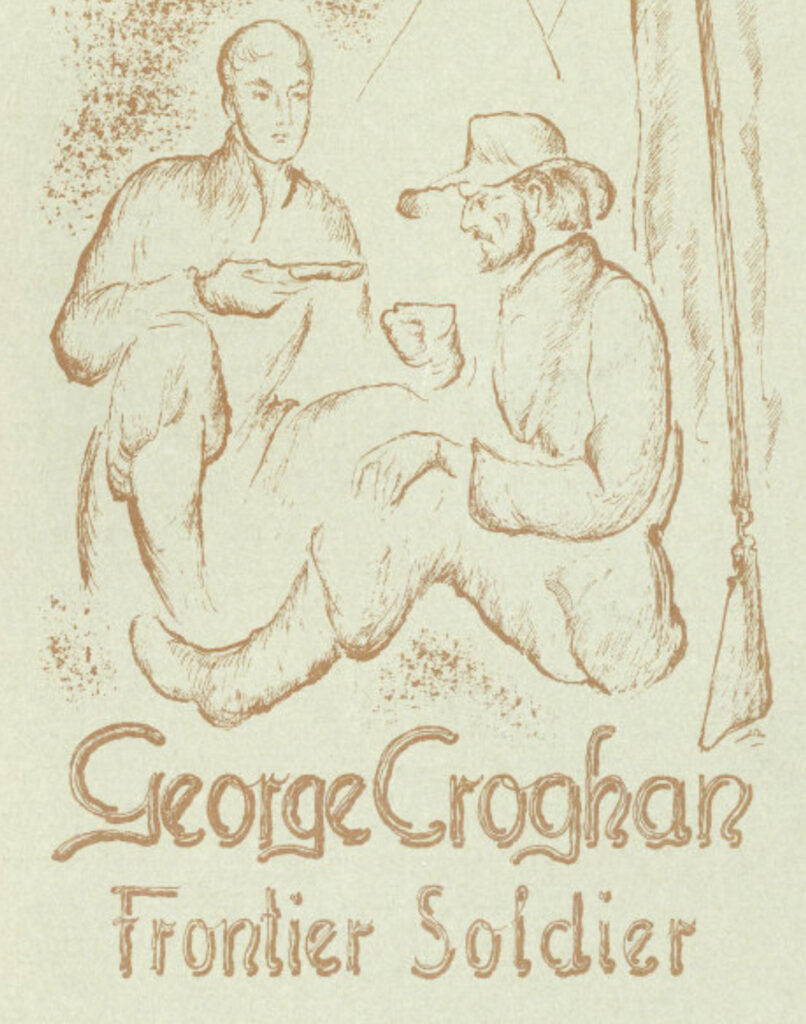
George Croghan was a man who inspired strong opinions, most of them unflattering. Contemporary descriptions of him were vivid: scoundrel, rogue, villain, swindler, corrupt agent, unscrupulous dealer, and opportunist. Some of this was rooted in his own conduct — his habit of blurring trade and diplomacy, his deep entanglement in debt and speculation — but much of it also reflected prejudice. As an Irish outsider in a colony dominated by Quakers, Presbyterians, and Anglicans, Croghan was the target of ethnic and religious slurs: Papist, Romanist, designing Irishman, bog-trotter. To many on the Pennsylvania frontier, he was both indispensable and suspect — a man too close to Native allies, too ambitious in land schemes, and too foreign in background to be trusted.
Croghan, an experienced Ohio Valley trader, was appointed Deputy Indian Agent in 1756 under Sir William Johnson, the Crown’s Superintendent of Indian Affairs for the Northern Department. Johnson himself was deeply embedded in the world of the Six Nations: married into Mohawk kinship networks, fluent in Iroquois diplomacy, and formally recognized by Britain as the essential broker of Haudenosaunee relations. Trusting Croghan’s long experience with the Ohio Valley tribes, Johnson made him his deputy for Pennsylvania and the west. Through Johnson’s authority, Croghan managed diplomacy and trade with the Shawnee, Lenape, and other Native peoples of the Ohio Country.
Croghan often seemed more at home in Native country than among the Anglo-Pennsylvania elite. An Irish immigrant and outsider in colonial society, he built his fortune on trade and diplomacy with Native communities outside of the colonies. This closeness often spilled into open disputes with provincial officials. In James Kenny’s 1761 journal, Croghan defended Native traders against Pennsylvania’s commissioners, accusing them of undervaluing Native peltry while inflating the cost of imported goods. He insisted he had the authority to set prices, even when they diverged from official tables.[5] His stance was hardly selfless—his wealth depended on Native alliances—but it reflected how much of his identity and influence came from standing between cultures, closer in outlook to his Native partners than to the colonial gentlemen in Philadelphia.
Croghan himself often seemed to embody the fragility of the frontier world he helped hold together. Kenny’s journal and Baynton, Wharton, and Morgan’s correspondence show him frequently “not well,” sidelined by bouts of illness or weariness that kept him from councils and trade. Life between cultures took its toll: constant travel, exposure, debt, and heavy drinking left him chronically under the weather. Bad attacks of gout left his hands and feet swollen, which often made him unable to walk or write. His condition mirrored the community around Fort Pitt—indispensable yet precarious, held together by fragile bodies caught in an uncomfortable balance and uneasy bargains.
Vandalia Scheming
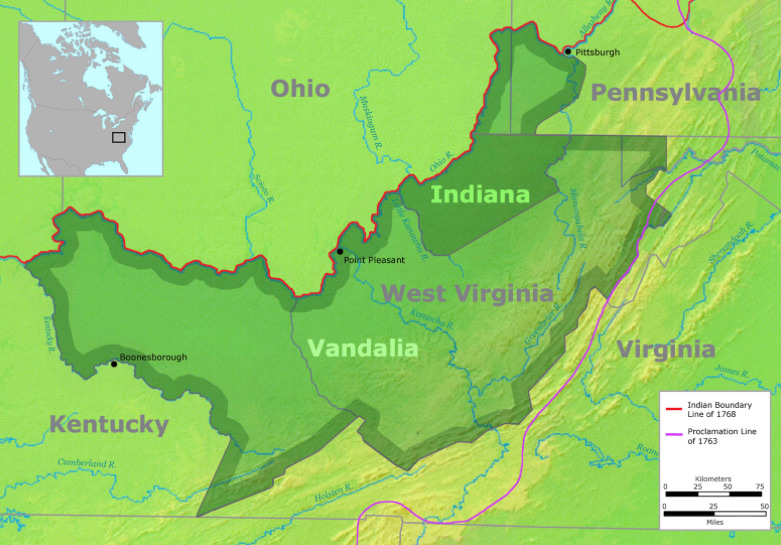
By the early 1770s George Croghan was thinking far beyond Fort Pitt. No longer just a go-between in the fur trade, he was using his connections with Native leaders and Philadelphia merchants to stitch together the outlines of a brand new colony in the Ohio Valley: Vandalia. The project promised to carve a fourteenth colony out of western lands stretching through the Ohio River basin, an answer to the endless jurisdictional quarrels between Pennsylvania and Virginia.
To sell the idea, Croghan leaned on the same firms that financed his trade—Levy & Franks, Baynton, Wharton & Morgan—who now shifted their credit into land speculation. He also courted men of stature who could give Vandalia political weight, among them George Washington, whose appetite for western acreage was well known. Washington heard Croghan out but kept himself carefully detached, watching the schemes unfold without tying his name or fortune to them.
Yet Croghan did not just dream on paper; he gambled on politics. As Pennsylvania and Virginia both laid claim to Pittsburgh, Croghan’s sympathies tilted toward Virginia, where Governor John Murray, the Fourth Earl of Dunmore proved more willing to back large-scale western ventures. Croghan’s land schemes and Virginia’s ambitions in the Ohio Valley overlapped, and his family tie to a man named Dr. John Connolly helped link the two.
When Lord Dunmore appointed Connolly to act as Commandant of Fort Pitt in 1773, Croghan almost certainly lent quiet support. He was already drifting away from Pennsylvania’s authorities, and Connolly’s position offered a way to keep influence in the region alive. Dunmore, as governor of Virgnia, was officially declaring his colony’s ownership of Fort Pitt/Pittsburgh and surrounding territories.Connolly leaned on Croghan’s networks and experience, but he was also very much Dunmore’s man. The result was a tangle of interests — Croghan’s speculation, Virginia’s expansion, and Connolly’s local authority — that pulled Fort Pitt into the heart of the Pennsylvania-Virginia dispute.
George Croghan’s grand designs in the Ohio Valley repeatedly brought him into conflict with George Washington. I will cover more on how Croghan’s Vandalia scheme put him in direct conflict with George Washington further on in part II, but know that both men were eager land speculators, and their claims often overlapped or cut across one another. Washington, who prized orderly surveys and secure patents, dismissed Croghan’s vast purchases made through Native diplomacy and merchant credit as “fraudulent and oppressive” to both settlers and Indigenous peoples.[6] Croghan, for his part, tied himself to Pennsylvania merchants while also aligning with Virginia interests and this role in the Vandalia scheme, which put him squarely in competition with Washington’s Virginian land ambitions.
While Washington never called him a “nemesis” outright, historians such as Alfred P. James and Francis Jennings have cast Croghan in that role: a rival speculator whose fragile frontier empire threatened to obstruct Washington’s carefully cultivated claims.[7] To Washington, Croghan was less a colleague than a cautionary tale—proof that empire built on unsanctioned speculation could collapse as quickly as it rose. But Washington’s resentment ran deeper than land. In July 1754, at only twenty-two years old, he stood at Great Meadows as colonel of the Virginia Regiment, leader of a mixed force of militia and Native allies that had just bloodied the French. Scanning the horizon, he waited for the contracted supplies that never came. Instead, hunger and exhaustion set in, the French closed around him, and Washington was forced to sign a humiliating surrender that would blacken his name. The man responsible for that absence, the contract agent who failed to deliver, was George Croghan.[8]
Conclusion
Much has been written about Croghan’s “betrayal” of Pennsylvania in his pursuit of Vandalia, casting him as an opportunist who shifted allegiance toward Virginia and London speculators. But the deeper betrayal was not of Pennsylvania’s proprietors—it was of the Native peoples who had sustained him. For decades Croghan had lived among Lenape, Shawnee, and Haudenosaunee communities, trading, negotiating, and presenting himself as their broker. Yet Vandalia, like every land scheme before it, rested on the presumption that those very communities would be pushed aside. The colony Croghan envisioned would not have secured Native homelands but erased them, forcing his partners further west along the same trail of displacement that had shadowed them since the Delaware Valley.
The world that first formed at Fort Pitt—of traders, soldiers, and Lenape leaders negotiating side by side—was always fragile. It rested on uneasy bargains, fleeting trust, and the constant threat of violence. From horse thefts punished with death to disputes over rum and trade, the community at the Forks of the Ohio embodied both mingling and mistrust. When it drifted down the river, reappearing in taverns and trading posts where figures like Guyasuta and Killbuck emerged again, it carried those same contradictions with it. The arc of this series, traced through Parts I to III bends toward this collision known as the Yellow Creek Massacre of 1774. The massacre was not a sudden break but the endgame of a failing experiment in coexistence. What had begun as a tenuous partnership at Fort Pitt ended in betrayal and blood, erasing a community that might have carried the region toward another future.
Epilogue
Croghan never recovered from the collapse of Vandalia. The colony that was supposed to crown his career instead ruined it, leaving him buried in debt and stripped of influence. Pennsylvania officials, weary of his endless lawsuits and suspect dealings, barred him from living west of the Alleghenies — exiled from the very frontier he had built his life upon. It was the metaphorical black eye to match the one Teedyuscung had given him years before at Fort Pitt: a bruised reputation that never healed, the mark of a man who schemed too broadly and fell too hard.
Notes and Citations
[1] Leland D. Baldwin, Pittsburgh: The Story of a City (Pittsburgh: University of Pittsburgh Press, 1937), 9.
[2] James Kenny and John W. Jordan, ed. “Journal to Ye West-Ward, 1758-59.” The Pennsylvania Magazine of History and Biography 37, no. 4 (1913): 429 & 438, https://www.jstor.org/stable/20086139.
[3] Kenny and Jordan, ed. “Journal to Ye West-Ward, 1758-59. refers to Teedyuscung as chief of the “Lenni Lenapi and nine other Delaware Indian tribes,” but this reflects colonial mislabeling. In fact, all “Delaware” were Lenape communities scattered into separate towns and bands. See C. A. Weslager, The Delaware Indians: A History (New Brunswick, NJ: Rutgers University Press, 1972), 181–90.
[4] Margaret Pearson Bothwell. “Edward Ward: Trail Blazing Pioneer.” Western Pennsylvania Historical Magazine, vol. 43, no. 2 (June 1960), 110.
[5] Kenny and Jordan, ed. “Journal to Ye West-Ward, 1758-59. 225.
[6] George Washington to William Crawford, September 21, 1767, in The Papers of George Washington, Colonial Series, vol. 8, ed. W.W. Abbot (Charlottesville: University Press of Virginia, 1993), 360.
[7] Alfred P. James, George Croghan, Wilderness Diplomat (Pittsburgh: University of Pittsburgh Press, 1937), 289–95; Francis Jennings, Empire of Fortune: Crowns, Colonies, and Tribes in the Seven Years War in America (New York: Norton, 1988), 446–48.
[8] That was at least Washington’s point of view. In defense, Croghan’s half brother Edward Ward is quoted as saying that the force”would not have had ammunition to make the least defence that day” had it not been provided by contractors such as Croghan. Carlyle, John. Letter to George Washington, June 17, 1754, The Papers of George Washington, Series 2, vol. 1. Founders Online, National Archives. https://founders.archives.gov/documents/Washington/02-01-02-0067. Bothwell, “Edward Ward: Trail Blazing Pioneer.” 105.
For readers who wish to follow ongoing research, subscription is available in the footer.