In the first days of January 1774, as ice sealed the Delaware River, and far to the west the Allegheny and Monongahela had likewise frozen fast. their joined waters forming an Ohio clogged with slow moving floes that ground against each other well past the ghost of Logstown.[1] A group of men on horseback, ice gripping their thick wool greatcoats, rode into Pittsburgh. Those years were remembered for their bitter cold; the period wasn’t called the Little Ice Age for nothing. During that period North American winters bit harder than Europe’s, but the group’s leader knew no different. This son of the British Empire had been born in York… a county in Pennsylvania, not England.
Frontier Outpost City
The inhabitants of this place are very dissipated. They seem to feel themselves beyond the arm of government, & freed from the restraining influence of religion. It is the resort of Indian traders, & many here have escaped from Justice & from Creditors, in the old settlements. – David McClure on Ft. Pitt. [2]
In 1772, the British Empire withdrew its regular troops from former Seven Years’ War outposts like Fort Pitt. The expectation was that the colonies would now handle their own security. But at this point, none of the colonies maintained a standing army. Instead, defense relied on local militias, ordinary men who only mustered when needed. This is why, when reading colonial history, you might come across a ordinary (ie tavern) keeper or farmer suddenly referred to as “Captain.” It was common for men to carry their militia rank into civilian life as a marker of status.
Militias, however, were raised and overseen by individual colonies, and Fort Pitt sat in a contested borderland zone outside any single colony’s authority.
Pennsylvania authorities dispatched their Berlin Rangers militia to patrol the region, but resources were scarce. Their reach rarely extended far beyond the settled edges of Westmoreland County. Further south and west, in the tangled borderlands near Wheeling, Virginia, and the Ohio River, even that thin semblance of authority disappeared. Here, settlers operated in a gray zone, outside colonial law.
Shifting Allegiances
Major Edward Ward had been charged with the defense of Fort Pitt since the 1772. He began his military career as an ensign in the Virginia militia, tasked with constructing a small stockade known as Trent’s Fort at the Forks of the Ohio. In a strange full circle, that very stockade was seized by the French, who replaced it with Fort Duquesne, and now Fort Pitt stood upon Duquesne’s ruins. By 1759, Colonel Henry Bouquet referrenced him as a Major, marking his rise through Pennsylvania’s frontier militia.[4] In this narrative, we last saw Ward in part II when William Crawford accused him of stirring up the squatters who overran Washington’s Miller’s Run property.
Who, then, did Edward Ward truly serve—Virginia or Pennsylvania? The mountain barriers that isolated western Pennsylvania in the eighteenth century lent Virginia’s claims a veneer of natural right. Fort Pitt, cut off by rugged ridges and unreliable east–west routes, maintained closer physical and commercial ties to Virginia and Maryland than to Philadelphia. Local settlers might have thought of themselves as residents of Pennsylvania’s Westmoreland County, but many among their leading men were swayed by the capital and patronage that Virginia poured into the region.
The record offers no simple answer. His commissions and loyalties shifted with the jurisdiction at the Forks of the Ohio, a place claimed by both colonies but governed by neither. Ward began as a Virginia ensign under Captain William Trent in 1754, but by the 1760s was serving as a Pennsylvania militia officer and local defender of Fort Pitt. In truth, his allegiance followed the post, not the province.
For men like Ward, colonial identity was fluid, not fixed. In a world where most settlers were first- or second-generation immigrants, loyalty to a particular colony mattered less than survival, opportunity, or whoever could supply powder and pay the bills. As historian Fred Anderson argues in Crucible of War: The Seven Years’ War and the Fate of Empire in British North America, 1754–1766, the frontier made colonials less British, Virginian, or Philadelphian long before it made them American. Yet events were already in motion that would soon force Ward, and everyone else at the Forks, to choose a side.
On the frontier, local networks were a matter of life or death, and family was the strongest of all. Ward’s half-brother, George Croghan, has featured extensively throughout this series. It was family that would make Ward pick a side in the coming conflict—but not his brother. In January 1774, his brother-in-law, Dr. John Connolly, arrived, having already chosen his own.
John Connolly: Charisma Meets Ambition
“Thursday 22. Stayed in Pittsburg all day. Invited the Officers & some other Gentlemen to dinner with me at Samples—among which was one Doctr. Connelly (nephew to Colo. Croghan) a very sensible, intelligent man who had travelled over a good deal of this western Country both by Land & War” George Washington, November 1770 [5]
George Washington met John Connolly during his 1770 backcountry exploratory mission. Connolly was a Seven Years War veteran who championed a military system that hybridized European military tradition with Native American practices.[6] He was a well connected man to get to know. Aside from any relationship to Croghan and Ward, his maternal uncle, Gordon Howard, was an Irish-born “Indian trader,” a relationship well-documented in colonial records.
The men shared an interest in speculation and the promises of the Northwestern landscape. In 1772, Connolly sent Washington a mastodon tooth from today’s Big Bone Lick State Park, south of Cincinnati. Collecting fossilized teeth of giant creatures was a common interest among many Western explorers and founding fathers. Christopher Gist, who had accompanied Washington on his first trip west, claimed to have a tooth that weighed fourteen pounds. [7] During his lifetime, Washington would proudly display the tooth in his Mount Vernon mansion.
In their correspondence, Connolly expressed surprise that Virginia’s Tidewater elites had not yet taken advantage of the fertile Trans-Appalachian frontier, especially along the Ohio River. He suggested that Virginians could make great profits by settling and cultivating tobacco there using enslaved labor, and expressed frustration that he couldn’t personally pursue the venture himself. Washington clearly agreed. Acting on Connolly’s “sensible” encouragement, he converted speculation into strategy, commissioning James Wood in 1773 to explore and locate valuable lands under the jurisdiction of West Florida, a bureaucratic label for the Mississippi–Ohio frontier where he intended to establish a managed plantation estate.[8] Washington instructed Wood to confer with Nathaniel, son of the Ohio Company’s explorer Christopher Gist, along with other experienced frontiersmen whose regional knowledge could guide his selections.
Connolly comes off as one of those magnetic, dangerous frontier personalities who pulled men into his orbit—even someone as calculating as Washington. While many of his contemporaries in the colonies were European-born and fixed their ambitions on the Atlantic seaboard, Connolly was a Pennsylvanian by birth whose gaze turned relentlessly westward. Where others saw wilderness and risk, he saw corridors of power and profit stretching through the Ohio and down the Mississippi. Washington, for his part, was still a far from the sanctified figure later whose birthday would be celebrated each February on a national scale; at this stage, he was an ambitious planter veteran searching for advantage. Fortunately for Connolly, he had drawn the attention, and eventually the favor, of much more powerful men within the colonies.
Lord Dunmore:The OG British Villain
Lord John Murray, Fourth Earl of Dunmore, had been perfectly content as the crown-appointed governor of New York. So when London abruptly reassigned him to Virginia in early 1771, he was far from pleased. It took him more than six months to obey orders and make the journey south to Williamsburg. Yet once there, Dunmore clearly found reasons to embrace his new post, he would soon begin maneuvering for a share of Virginia’s western lands.
While veterans like George Washington jockeyed for massive land grants beyond the Alleghenies, Dunmore was explicitly forbidden from granting property in areas still considered “Indian country.” That didn’t stop squatters from attempting to seize land on their own initiative. But where settlers squatted and claimed with their rifles, colonial elites worked more delicately—petitioning the governor and leveraging influence in Williamsburg. The elites were acutely aware that they were competing with the squatters on the ground, but with the right support they maintained the belief they would come out on top.
For a crown governor, Virginia’s western claims offered more than geographic bragging rights. They promised prestige, patronage opportunities, and a steady stream of revenue. Every new land patent sent fees flowing back to Williamsburg—and into Dunmore’s own coffers. He had strong financial incentives to help eastern elites claim lands before the squatters did.
It’s worth clarifying a common myth: Dunmore did not attempt to reserve 100,000 acres for himself, despite claims to the contrary in later retellings. The image of a scheming British lord plotting to carve off a large swath of North America makes for good cinema—a predictable villain arc where you’re watching for the action, not the plot. He did, however, pursue land for his personal ownership and wasn’t shy about testing the limits of crown policy
What Lord Dunmore ultimately intended for the Forks of the Ohio and the western lands beyond its gateway is difficult to determine. American sources often portrayed him as the villain in any frontier narrative. The Ormsby family records suggest that Dunmore had every intention of resolving the Pittsburgh–Virginia border dispute and bringing the region firmly under Virginia’s jurisdiction. Lore holds that while lodging at John Ormsby’s Pittsburgh tavern, Dunmore made quiet inquiries about his willingness to serve as his man on the ground.[9] Ormsby was one of the principal early landholders in what became Pittsburgh, and much of the city’s later growth rested on acreage that had once been his property. If I were scheming to take the city, I would have started with him. However, Ormsby apparently refused to take part; his loyalty lay with Pennsylvania.
He found a much more willing ear in Connolly. A February 1774 letter Connolly wrote to George Washington reveals that the two had discussed, on earlier occasions, his disbelief that Virginia had not already exercised its “rightful” claim to the western frontier.[10] Perhaps they met at Sample’s Tavern—through George Croghan, William Trent, or a number of other intermediaries. Regardless, they met, and they recognized in each other men of like ambition. In December 1773, just weeks before his official appointment as Fort Pitt’s commandant, Dunmore awarded Connolly an under-the-table survey for a tract at the Falls of the Ohio—what would later become Louisville, Kentucky.[11] The Falls weren’t true waterfalls but a series of rapids and limestone ledges where boats had to portage, making it a natural hub for trade and settlement.
In later retellings, Lord Dunmore became the villain by consensus—the convenient British mastermind behind every spark that lit the frontier. County histories from Pennsylvania to Ohio laid the blame for Dunmore’s War at his feet, insisting that he had “riled up the Indians” to seize their lands or engineered a border crisis to distract from rebellion in the East. The charge endured precisely because it was useful. It spared frontier communities from having to examine their own complicity too closely. The same towns that condemned Dunmore for the bloodshed of 1774 often celebrated the very men who had stood at Wheeling or across from Yellow Creek in those tragic April days. The governor made an ideal scapegoat: distant, titled, and English—everything the frontier was learning to despise.
Pennsylvania vs. Virginia: the Migration of Loyalties
Connolly rode into Pittsburgh that bitter January day carrying a writ from Lord Dunmore, authorizing him to enforce Virginia’s jurisdiction at the Forks of the Ohio. He announced that Pittsburgh and the surrounding settlements belonged to Virginia and ordered the inhabitants to assemble a militia on the twenty-fifth. It was a bold move, but not an unwelcome one. Major Edward Ward, Connolly’s relation, did not contest his authority.
On the frontier, loyalties did not follow maps. Most settlers had stronger trade and travel ties southward, toward Williamsburg or Baltimore, than east to Philadelphia. Crossing the Alleghenies was difficult; crossing into Maryland or Virginia was not. And if a man’s land claims were more likely to be recognized under Virginia law, then siding with Virginia was less a political choice than an act of self-preservation. Ward was one such figure. His land surveys along Chartiers Creek overlapped with Washington’s own claims, illustrating both the jurisdictional confusion and the competition pushing ambitious men toward Virginia’s orbit.
Ward was hardly unique. Contrary to later accusations, this was no Croghan–Connolly conspiracy. , By 1774 Croghan’s influence had already evaporated. His creditors were on the verge of stripping him of Croghan Hall, when he would had retreat east.[13] His once far-reaching authority survived only through a few kinsmen and agents: Ward, Trent, Devereaux Smith. Connolly’s rise occurred not because Croghan engineered it, but because Croghan left a vacuum that ambitious men rushed to fill.
Pennsylvania, watching Pittsburgh’s drift toward Virginia, attempted to impose structure. In 1773 it created Westmoreland County, the first county west of the Alleghenies, and filled it with a slate of justices: William Crawford, Arthur St. Clair, Thomas Gist, Alexander McKee, and others.[14] This was Pennsylvania building government from scratch: issuing deeds, recording transfers, posting sheriffs, enforcing civil order.
But paperwork was not power on the frontier. Pennsylvania’s slow, Quaker-inspired bureaucracy clashed with a population that preferred decisive authority. Connolly’s waving of Dunmore’s writ exposed how hollow Pennsylvania’s commissions felt. Virginians offered clarity, courts, and faster decisions. Pennsylvania offered… process.
It is little surprise that many of Westmoreland’s leading men shifted their allegiance almost immediately. McKee and Gist accepted Virginia commissions; newley elevated justices of the peace Van Swearingen did the same. McKee would in a short time refuse to abandon his loyalty to Britain, but shifting allegiances between colonies was a different story. Crawford publicly upheld Pennsylvania’s authority while quietly collaborating with Washington and Virginia speculators. Their reasons were pragmatic: Virginia was closer, faster, more predictable, and more likely to validate the claims they staked their livelihoods upon.
For these men, allegiance was not ideology.
- It was geography.
- It was access.
- It was whose seal made a deed worth the paper it was written on.
Seen in this light, Dunmore’s “seizure” of Pittsburgh was less a coup than the final step in a long migration of loyalties. Authority in the region had already been shifting toward Virginia for years. Dunmore did not create that momentum—he simply arrived at the moment it could no longer be concealed. Like Pontiac before him, he became the name attached to forces that were already moving
Conclusion
The contest between Virginia and Pennsylvania had been simmering for decades. Even in 1758, at the height of the Seven Years’ War, George Washington opposed the construction of Forbes’s Road, seeing it as an unnecessary rival to Braddock’s Road.[15] Braddock’s route favored Virginia’s supply line into the frontier; until Forbes’s Road cut across the mountains from the east, Pennsylvania had little practical way to assert control over the western lands it claimed. By the 1770s, after years of quiet maneuvering for dominance, that contest finally broke into the open.
At Pittsburgh, Dr. John Connolly nailed Virginia’s writ to the door. Arthur St. Clair held to his Pennsylvania oath, setting the stage for a clash between magistrates and militias at the Forks of the Ohio. On January 24, 1774, St. Clair had Connolly arrested for sedition under Pennsylvania authority—the day before Connolly’s new militia was to muster. With so many settlers already leaning toward Virginia, the situation edged toward open violence. Pennsylvania officials, wary of provoking a wider confrontation, released Connolly on the condition that he return for trial.
He did not.
Instead, Connolly doubled down. He began recruiting for the Virginia Partisans, a militia loyal to Lord Dunmore, and issued a fresh proclamation in Dunmore’s name, reaffirming Virginia’s claim and renaming Fort Pitt as Fort Dunmore. With a growing local base that saw Virginia as the more responsive patron, Connolly became Dunmore’s enforcer on the Ohio River.
Fort Pitt, or Fort Dunmore—the name hardly mattered now. The fuse was lit. Settlers and speculators, loyalists and rebels, Virginians and Pennsylvanians were about to collide in a frontier firestorm that neither Dunmore nor his man at the Forks could truly control.
The escalation around Pittsburgh is essential to any path that leads to Yellow Creek, Logan’s grief, and Dunmore’s War, because it exposes how fragile the world at the Forks had become. This was the same community where traders sparred with commissioners, where Croghan argued with Teedyuscung, and where Lenape leaders like Beaver, Shingas, and Killbuck debated rum, peltry, and survival. For a time, Irish adventurers, Quaker merchants, and Native diplomats shared streets, rivers, and rumors in an uneasy partnership held together by trade and necessity.
By 1774, that experiment was collapsing. The hunger for land had outgrown the habits of coexistence. The Yellow Creek Massacre did not come out of nowhere; it marked the brutal culmination of years in which mistrust, racism, and opportunism had seeped into every exchange along the river. What began as a shared space of trade and diplomacy ended in betrayal and blood.
Frontier histories have often framed this moment as the beginning of an “American” West, glossing over how many communities were displaced in the process. The mixed population that once shared the Ohio River Valley did not endure. As land pressure mounted and colonial systems tightened, the social world that had taken shape around the Forks unraveled. By 1774, a different order was emerging—one defined less by negotiation than by force, and one in which the earlier, fragile balance could no longer survive.
Notes & Citations
[1] “Pennsylvania Weather Records, 1644-1835.” The Pennsylvania Magazine of History and Biography 15, no. 1 (1891): 109–21. http://www.jstor.org/stable/20083411.
[2] Diary of David McClure, Doctor of Divinity, 1748–1820. Accessed July 3, 2025. https://archive.org/stream/diaryofdavidmccl00mclu/diaryofdavidmccl00mclu_djvu.txt.d
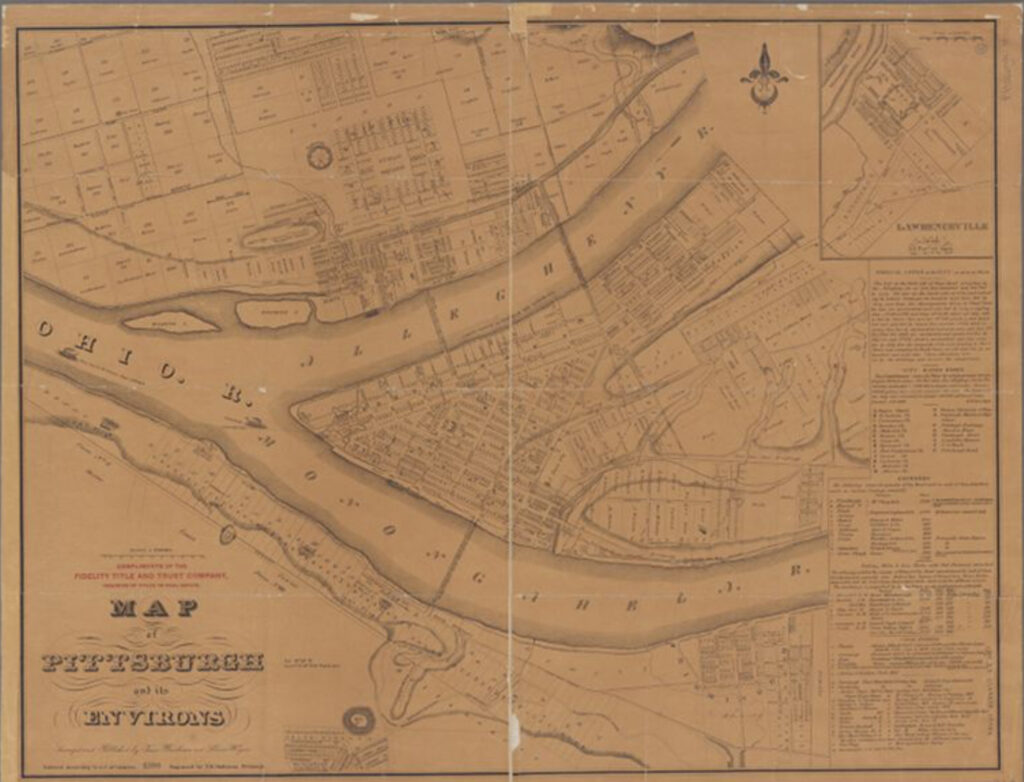
[3] Lionel Pincus and Princess Firyal Map Division, The New York Public Library. “Map of Pittsburgh and its environs ” New York Public Library Digital Collections. Accessed July 6, 2025. https://digitalcollections.nypl.org/items/36c3ab00-57aa-0136-8f4f-08990f217bc9
[4] Margaret Pearson Bothwell. “Edward Ward: Trail Blazing Pioneer.” Western Pennsylvania Historical Magazine, vol. 43, no. 2 (June 1960), 105-107
[5] Washington’s spelling of “Pittsburg” reflected the eighteenth-century convention. The name Pittsburgh was initially given by General John Forbes in 1758, in honor of William Pitt the Elder, but spellings varied widely in colonial and early national usage. In 1890 Pittsburg became the government mandated spelling, but in the early twentieth century the silent “h” was restored due to popular demand.
Additionally, Dr. John Connolly was undoubtedly related to George Croghan by marriage. Connolly married Susannah Sample, the sister of Hannah Sample, who was the wife of Edward Ward, Croghan’s half-brother. However, Connolly was popularly known as George Croghan’s nephew. William Henry Egle, Pennsylvania’s late-nineteenth-century State Librarian and editor of Notes and Queries, Historical, Biographical and Genealogical, Relating Chiefly to Interior Pennsylvania, a dogged collector of early frontier records, observed that “George Croghan was probably his father’s brother-in-law.”
Remark & Occurs. in Novr. [1770],” Founders Online, National Archives, https://founders.archives.gov/documents/Washington/01-02-02-0005-0031. [Original source: The Diaries of George Washington, vol. 2, 14 January 1766 – 31 December 1770, ed. Donald Jackson. Charlottesville: University Press of Virginia, 1976, pp. 321–324.], Egle, William Henry, ed. Notes and Queries, Historical, Biographical and Genealogical, Chiefly Relating to Interior Pennsylvania. 2nd series. Vol. 2. Harrisburg: Harrisburg Publishing Company, [1895]. Digitized by Google. HathiTrust. https://babel.hathitrust.org/cgi/pt?id=pst.000004688846&seq=98
[6] John Connolly. “A Narrative of the Transactions, Imprisonment, and Sufferings of John Connolly, an American Loyalist and Lieut. Col. in His Majesty’s Service.” The Pennsylvania Magazine of History and Biography 12, no. 3 (1888): http://www.jstor.org/stable/20083271. 2.
[7] “John Connolly to George Washington, 18 September 1772,” Founders Online, National Archives, https://founders.archives.gov/documents/Washington/02-09-02-0074. [Original source: The Papers of George Washington, Colonial Series, vol. 9, 8 January 1772 – 18 March 1774, ed. W. W. Abbot and Dorothy Twohig. Charlottesville: University Press of Virginia, 1994, pp. 95–99.]
Mount Vernon Ladies’ Association. “George Washington’s Mastodon Tooth.” George Washington’s Mount Vernon Digital Encyclopedia. Accessed October 10, 2025. https://www.mountvernon.org/library/digitalhistory/digital-encyclopedia/article/george-washingtons-mastodon-tooth.
[8] “George Washington to James Wood, 30 March 1773,” Founders Online, National Archives, https://founders.archives.gov/documents/Washington/02-09-02-0156. [Original source: The Papers of George Washington, Colonial Series, vol. 9, 8 January 1772 – 18 March 1774, ed. W. W. Abbot and Dorothy Twohig. Charlottesville: University Press of Virginia, 1994, pp. 205–207.]
[9] Walter T. Kamprad, “John Ormsby, Pittsburgh’s Original Citizen,” Western Pennsylvania History (Pennsylvania State University), accessed October 10, 2025, https://journals.psu.edu/wph/article/download/2173/2006/
[10] “John Connolly to George Washington, 1 February 1774,” Founders Online, National Archives, https://founders.archives.gov/documents/Washington/02-09-02-0346. [Original source: The Papers of George Washington, Colonial Series, vol. 9, 8 January 1772 – 18 March 1774, ed. W. W. Abbot and Dorothy Twohig. Charlottesville: University Press of Virginia, 1994, pp. 464–466.]
[11] Sarah S. Hughes, Surveyors and Statesmen: Land Measuring in Colonial Virginia (Richmond: Virginia Surveyors Foundation and Virginia Association of Surveyors, 1979), 102.
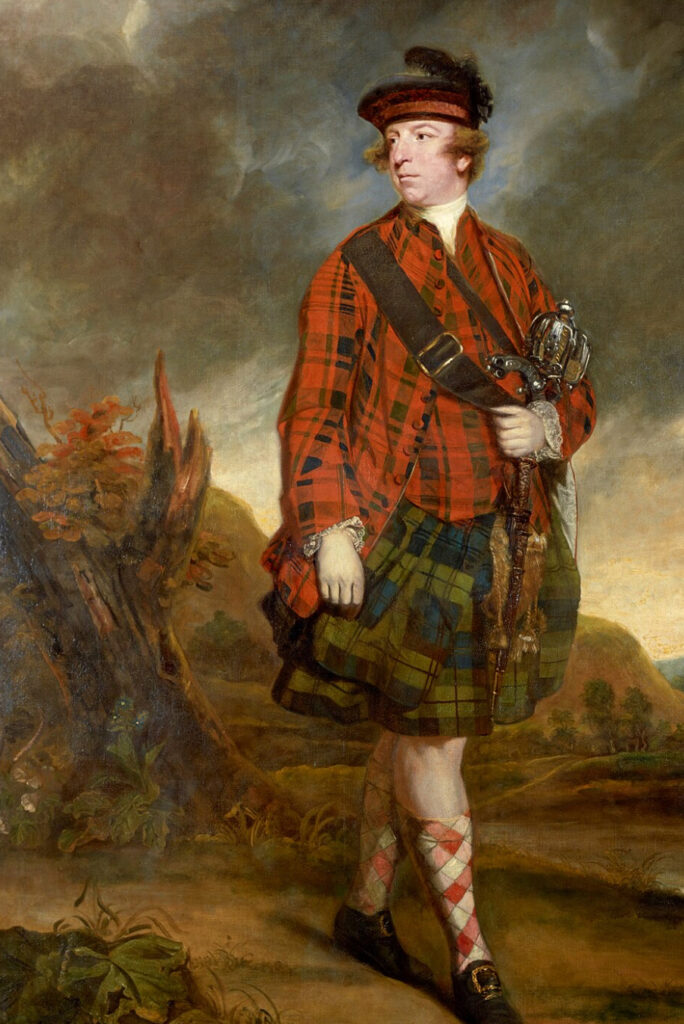
[12] Joshua Reynolds. John Murray, 4th Earl of Dunmore. 1765. Oil on canvas. Scottish National Portrait Gallery, Edinburgh.
[13] Writers like Albert T. Volwiler and his contemporary Frederick Jackson Turner cast westward expansion as the natural spread of an “Anglo-Saxon race,” framing figures such as Croghan as civilizing agents who carried British institutions and bloodlines into a supposed wilderness. In that worldview, the success of the Western frontier became synonymous with the success of the white race. It was not academia’s finest era.
The sciences, at least institutionally, have been able to reframe or repudiate their racist pasts by appealing to progress and self-correction — we were wrong then, but now the data is better. History, which deals as much with memory and myth as with “facts,” doesn’t get that grace. To say the past was racist in science is considered a mature reflection; to say it was in history is branded as revisionism. History will never be respected in the same way as other academic fields until it is accessible to everyone. John Connolly to George Washington, February 1, 1774, in Letters to Washington and Accompanying Papers, ed. Stanislaus Murray Hamilton (Philadelphia: Society of the Colonial Dames of America, 1899–1902), vol. 4, 76–78, https://www.loc.gov/resource/mgw4.033_0076_0078. Albert T. Volwiler, George Croghan and the Westward Movement, 1741–1782. Cleveland: Arthur H. Clark Company, 1926.
[14] John B. Linn and William H. Egle, eds. Pennsylvania Archives, 2nd series, vol. 9. Published under the direction of Matthew S. Quay, Secretary of the Commonwealth. Harrisburg: Lane S. Hart, State Printer, 1878. https://babel.hathitrust.org/cgi/pt?id=uiug.30112049418053&seq=814
[15] “George Washington to Henry Bouquet, 24 July 1758,” Founders Online, National Archives, https://founders.archives.gov/documents/Washington/02-05-02-0259. [Original source: The Papers of George Washington, Colonial Series, vol. 5, 5 October 1757–3 September 1758, ed. W. W. Abbot. Charlottesville: University Press of Virginia, 1988, pp. 318–319.]
[16] L. Prang & Co., Great horned owl. Bubo virginianus bon (1874). Lithograph, Popular Graphic Arts Collection, Prints & Photographs Division, Library of Congress. Accessed via Library of Congress, digital file PGA 12063
For readers who wish to follow ongoing research, subscription is available in the footer.