Decades after Grave, Pipe, and Captina Creeks became synonymous with Michael Cresap and the Anglo-American mob that he, if not leading, was forever bound to, another man recounted his part in the events that set the frontier aflame. Seven decades later, In his final years, Michael Myers recalled the moment he believed had begun it all. Myers was in the canoe with Cresap as sharpshooters on the bank murdered the Butler brothers’ Native employees, according to W.H. Hunter’s Pathfinders of Jefferson County. The episode Myers reflected on in his final years, however, preceded George Roger’s Clark and his fellow settlers’ conflict with the Shawnee on the Scioto and Cresap’s succeeding role as impermanent leader.
It is no small feat, even today, to live 107 years on this earth, and that is precisely what Myers did. He lived long enough to see the lands he once knew as wilderness divided into states, to witness a nation first declared and then defined. He lived as a citizen of the United Stateds for nearly a third of the future nation’s existence. By the time he gave his account, Michael Myers, nicknamed “Auver” for a speech impediment, was an old man haunted by a past that, in his memory, bore little resemblance to the myths that survived him.
What’s more, he believed he had helped ignite the chain of violence that ultimately led to the Yellow Creek Massacre. Speaking to historian Lyman C. Draper in 1850, Myers offered an account steeped in guilt and frontier paranoia. The same man who scouted for William Crawford before the Battle of Sandusky to the latter’s tragic capture, a frontiersman who sailed up and down the Mississippi along the nation’s breadth, and who is credited with owning the land that became Toronto, Ohio, had one more story to tell.
Trespass
“He did not hesitate long, but raised his rifle, fired, and the largest of the savages fell into the spring. The others hotly pursued the ‘pale face,’ but Myers had calculated the difference of speed, and the distance to be run.”
— History of Belmont and Jefferson Counties by John Alexander Caldwell, 1880[1]
Caldwell’s language reflects the frontier’s moral economy as much as Myers’ actions, violence rendered acceptable through dehumanization.
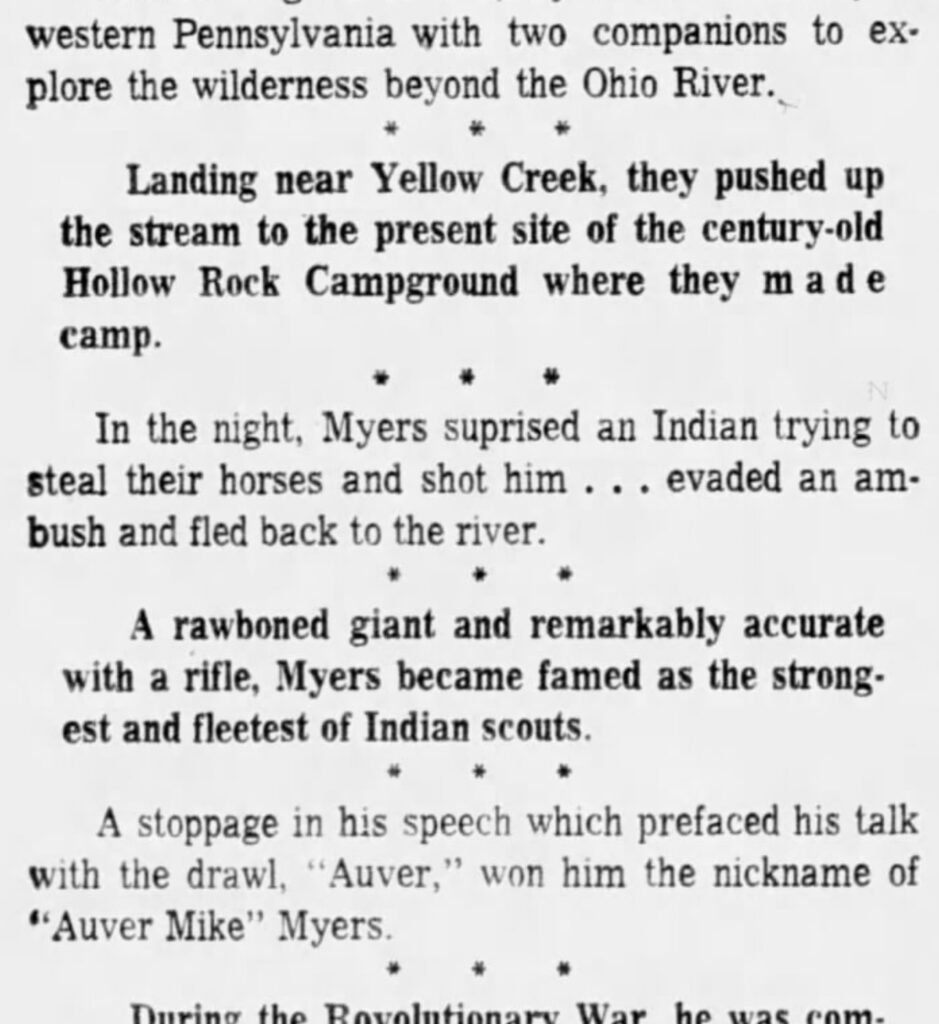
Auver Myers was an “Indian fighter”—the kind of man frontier legend revered simply for killing Native people because they were there. At least, that is how the surviving accounts of his life portray him. The eighteenth century celebrated such figures, offering men like Myers every incentive to become what Caldwell later called an “Indian hater.” He is always described as tall, strong, and an above-average marksman, a man who dressed in Native style but fought against them all the same.
He was precisely the kind of man who drew others to him, especially co-occupiers seeking backup before trespassing onto Native ground.
In April 1774, Myers agreed to guide two men west across the Ohio River into Indigenous territory, to a spring known as Hollow Rock, so they could inspect and possibly stake out land. That night, while they encamped, the sound of their horses’ bells stirred the night. Investigating, Myers encountered a Native man attempting to steal their horse. He, by his own account, shot and killed the man. A second would-be horse thief fled, possibly wounded; Myers never knew for sure. By dawn, Myers and his companions had hurried back across the Ohio.
Taverns on the Edge of “Civilization”
The next day, a small party of Native men visited Joshua Baker’s tavern, seeking information about the killings. About thirty men were gathered at Baker’s that day. Myers claimed that Daniel Greathouse instructed those present the Native investigators nothing.[3]
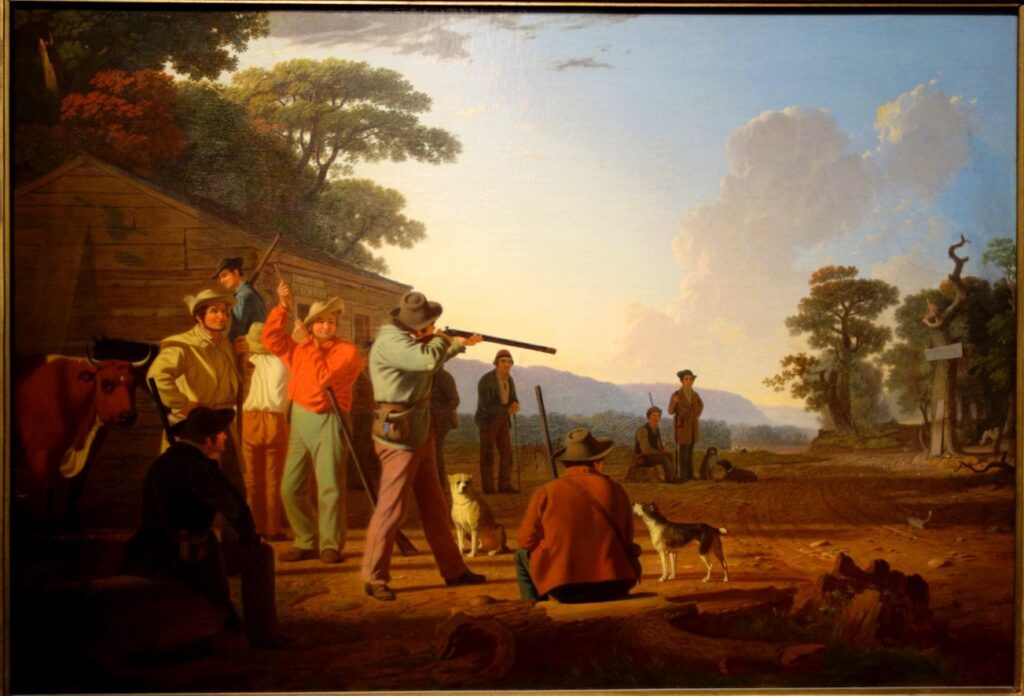
On the 1774 frontier, a tavern was never just a tavern, it was an outpost where the rituals of western civilization were performed: doubling as post stop, meeting hall, rumor mill, and, at times, fortress. Hite’s Tavern in early Augusta County and Pringle’s Tavern near the Monongahela are both cited in county records as temporary venues for local court proceedings, though in 1774 such meetings were far more informal, lacking any legal authority.
Unlike John Holliday’s later establishment at Holliday Cove—a larger ordinary with lodging, meals, and a blockhouse—Baker’s was little more than a cabin of rough-hewn logs. Yet it served as tavern, meeting hall, and fortress in miniature: a place where settlers spread news and fear in equal measure. Holliday’s tavern, built on land first claimed by Harmon Greathouse, would not open until around 1776. In 1774, Baker’s cabin served that role in miniature.
The rum barrels alluded to in many accounts of Baker’s tavern reflect a lingering colonial trade world still tied to Britain and its Caribbean sugar islands, not yet the grain-to-glass economy of the post-Revolutionary American frontier where whiskey was king.
What kind of authority did Daniel Greathouse, a young man in his early twenties who had already amassed a small fortune, hold in this setting? That is something one can only speculate about. He had no legal standing. Yet multiple accounts —Myers’s, Connolly’s correspondence, and later recollections — suggest that people deferred to him. On an unregulated frontier built on kinship, charisma, and fear, informal leaders emerged whose authority was as absolute as any commission or elected office. Such authority did not restrain violence. it organized it.
Myers would later recollect that by Greathouse’s command, armed settlers were stationed along the riverbank to ambush and kill the Native delegation investigating the attack on the Ohio River’s western shore as they canoed past.[4] IIf Myers’ recollections are accurate, this act of premeditated violence marked a chilling escalation of frontier violence: murder not out of fear, but as a calculated show of dominance.
Violence in a Crowded Borderland
Myers’ account leaves unresolved both who was killed and to which nation the victims belonged in in his western shore shootings and Greathouse’s ordered ambush. Contemporary frontier sources do not explicitly identify the dead as Shawnee or Lenape, but those nations were far from the only Indigenous peoples present along the upper Ohio in 1774.
The Ohio Haudenosaunee,often labeled “Mingo” in colonial records, would soon take the lead in calls for vengeance for their peoples murdered that savage spring, yet they were not alone in the region. Wyandot members also participated in Lord Dunmore’s War, and their people moved regularly through the Ohio Valley as hunters, traders, and diplomats. Smaller and more fragmented nations—including Saponi and Tutelo remnants, Piscataway, Nanticoke, and others displaced by earlier wars—likewise maintained a presence along the river corridors.
It is also possible that the victims belonged to a Métis trading band, composed of people of mixed Indigenous and European descent, a common but poorly documented population along the Ohio. Such groups, often multilingual and mobile, fit the profile of traders moving through contested territory, and were especially vulnerable to settler violence that made no distinction between nationality, kinship, or political alignment.
In the absence of clear identification, what matters most is not the precise tribal label affixed after the fact, but the broader reality: Greathouse’s ambush struck people who were neither warriors nor participants in any declared conflict, and its consequences would be felt across multiple Native communities. Kinship, marriage, and obligation crossed national lines, and violence against one group often compelled response from others. Whether Lenape, Mingo, Wyandot, or Métis, the dead did not belong to a single people, and neither did the responsibility to answer their deaths.
Claiming Lands West of the Ohio
Why was Myers’ party on the western side of the river? The land west of the Ohio River was Native territory in 1774, but if obedience to boundaries set by the British court had actually deterred squatters, it would have been the exception, not the rule. It is undeniable that settler incursions occurred on the west side of the Ohio River well before the United States government extended settlement with the passage of the Northwest Ordinance in 1787.
When did first-wave settlers begin to push west in defiance of treaties? It is, in a way, a question as old as the frontier itself—what came first, the boundary or the boundary breaker? Jacob Walker, whom I mentioned earlier in Part III regarding his purchase of 400 acres from a “Mr. Greathouse,” likely Daniel Greathouse’s father Harman, for 16 cents an acre was amongst the first. [5] At the same time Walker acquired land on from Greathouse on the eastern bank he made a concurrent tomahawk claim on the site of present-day Steubenville, Ohio. He wasn’t the only squatter on Indigenous lands though.
In 1779, Colonel Daniel Brodhead wrote to George Washington reporting that George Cox and his in-laws had illegally crossed the Ohio River to build cabins and “make improvements” on lands still firmly under Indigenous control.[6] Yet evidence suggests the Cox family had been pushing into the West Bank years before the Yellow Creek killings. In 1801, a witness testified that back in 1773 he had seen a cabin at Mingo Bottom, near the Mingo Path, which he believed belonged to the Coxes. “Mingo Bottom” is often used to describe the site on the western shore near modern Mingo Junction, earlier references make clear that this cabin stood on the Indigenous side of the river—across from the OldMingo Bottom on the eastern bank. The mention of the Mingo Path, a well-known Native thoroughfare, confirms that the structure sat in Native country. Land sales deepen the picture: John Decker purchased acreage from the Cox family on the west side of the river, and Fort Decker later rose within what is now Follansbee, Ohio. Taken together, these fragments reveal a settler presence that predated legal authority and quietly crept into territory Native leaders had never ceded.
Walker’s family remained east of the river on the land purchased from Greathouse, but he maintained his claim west of the river for years, despite it remaining in indigenous territory and thus illegal. Later, after Fort Decker was built in late 1774, Walker would work his western fields under the protection of the stationed soldiers.[8] The site on which his claim lay was eventually named Steubenville after Fort Steuben.
This pattern suggests that the Greathouses, Tomlinsons, and their allies were not simply fearful settlers defending hearth and home. They were part of an emergent settler class, men who saw opportunity in the contested borderlands and were willing to use violence to secure it.
Kentucke
Jacob Greathouse, Daniel’s elder brother, left little trace of involvement in the lands surrounding Wheeling. From the outset, his ambitions were directed farther west into Kentucky, bypassing the eastern shore of the Upper Ohio River altogether. In 1774, he had only recently returned from a winter spent hunting and trapping near the mouth of the Big Sandy River.[10] In the territory still known as Kentucke, Jacob had worked alongside Simon Kenton and Samuel Cartwright, part of the loose fraternity of long hunters who roamed the trans-Appalachian frontier. At the end of that winter, provided their pelts were not seized by hostile parties, as happened to Daniel Boon, the men would have taken their haul to market, before returning to their families.
Their migration underscores a critical truth about these men: they were not permanent settlers defending homesteads that they would one day leave to descendents, but speculators and frontiersmen, their gaze fixed on new opportunities beyond the Ohio River. By the time the Yellow Creek killings resurfaced in the national memory, decades later, during Thomas Jefferson’s vice presidency, the Bakers, John Sappington, and likely many of the unnamed participants of the Yellow Creek mob had long since moved on, pressing farther west into Kentucky, Indiana, and beyond. They had pulled up stakes from the Ohio riverbank and drifted deeper into the frontier. Each step in the march of progress left bloodshed that mattered only to the past. Had the speculators turned back to face the ground they had crossed, they might have seen the blood along their path—but their eyes, always, remained fixed westward. Yellow Creek was not the endpoint of their frontier story; it was a violent episode along the way.
A Conflict Closer to Home
By late April 1774, as the settlers massed at Wheeling braced for reprisals from a conflict simmering far downriver at the mouth of the Scioto, the Greathouses and their allies were already gripped by fears of retaliation for Native deaths much closer to home, for men like these, defense and conquest blurred until preemptive violence felt like survival.
Benjamin Tomlinson’s report of the murdered traders he aided in burying only intensified the anxiety. The kin networks pulsed with urgency: gather, arm, and prepare to strike before the frontier struck first. Then, just as the frontiersman were searching for signs of impeding Native attack, a “Mingo” encampment appeared on the other side of the Ohio River from Baker’s tavern, at the mouth of Yellow Creek.
In 1799, Judge Harry Innes of Kentucky received a certification from Charles Polke, then of Shelby County, attesting that in April 1774 a mob assembled at Polke’s Virginia home before marching en masse to Baker’s Bottom. This gathering occurred just days after Michael Cresap returned from the called-off raid on Yellow Creek before he departed upriver for Redstone by way of Catfish Camp. According to Polke, the group’s endeavor arose from rising anxiety about impending Native attacks, an anxiety that was quickly metastasizing into a call for preemptive violence.[11]
Yellow Creek enters the Ohio River about fifty miles downriver from Pittsburgh. Across the Ohio River from its mouth stood the cabin of Joshua Baker, his family, and their tavern. Benjamin Tomlinson, in his nineteenth-century account, recalled that John Sappington arrived at Baker’s on April 30th at dawn with men from Buffalo Creek.[12] The creeks of Cross, Buffalo, and Harman lie in succession along the eastern shore between Wheeling and Baker’s Bottom. That the party gathered at Polke’s home on Cross Creek, sixteen miles from Baker’s, suggests coordination among settlers from multiple creek valleys. Buffalo Creek, which runs thirty miles inland across the modern West Virginia panhandle into Pennsylvania, may have served as a conduit for drawing men toward Baker’s from the inland environs that spring.
Historian J.T. Scharf suggested that men were brought from the inland reaches of Buffalo Creek because the implications of a prospective ‘Indian war’ on the shores of the Ohio did not incite the same fear in them as it did in immediate locals whose families would bear the brunt of any conflict escalated with the Native nations.[13] The idea that Yellow Creek served as a casus belli, a calculated provocation to ensure war, is not implausible. The call for reinforcements from far-flung creeks suggests deliberate coordination. Settlers stationed at Baker’s Tavern knew the Ohio Haudenosaunee, i.e., the Mingo, delegation would cross the river on April 30th. Despite the sanitized versions spread after the fact by apologists, they knew the visitors were coming because they had been invited.
Conclusion
Michael Myers lived long enough to remember what the frontier later chose to forget. In his telling, the violence did not begin with a massacre, nor with a declaration of war, but with shots fired in trespass. What he described was not chaos, but a process, one in which private fear became community action, and unpunished killing hardened into call for action.
The killings that followed along the Ohio River were not committed in ignorance of consequence. They were committed in confidence that consequences could be controlled. Land could be taken faster than law could follow, memory could be reshaped faster than truth could settle, and responsibility could be dissolved by movement—downriver, westward, always forward.
In that sense, Yellow Creek was not an aberration but a culmination. It was the moment when trespass, rumor, kinship, and ambition converged into certainty: that violence worked.
Myers remembered because he stayed still long enough to look back. Most did not. Their eyes remained fixed west, and history, faithful to motion, not restraint, followed their gaze.
Notes & Citations
[1] J. A. Caldwell, History of Belmont and Jefferson Counties, Ohio, and Incidentally Historical Collections Pertaining to Border Warfare and the Early Settlement of the Adjacent Portion of the Ohio Valley (Wheeling, WV: The Historical Publishing Co., 1880), 485.
[2] “Michael ‘Auver Mike’ Myers,” The Newark Advocate (Newark, OH), September 19, 1964, 4. https://www.newspapers.com/image/287426217.
[3] Reuben Gold Thwaites and Louise Phelps Kellogg, eds. Documentary history of Dunmore’s war: 1774 ; compiled from the Draper manuscripts. Historical Society: Wisconsin, 1905. 18-19.
[4] Thwaites and Kellogg, eds. Documentary history of Dunmore’s war: 1774 ; compiled from the Draper manuscripts. 19.
[5] W.H. Hunter, “The Pathfinders of Jefferson County.” Ohio Archealogical and Historical Quarterly VI, no. 2–3 (April 1898),119.
[6] Charles A. Hanna. Historical collections of Harrison County, in the State of Ohio: With lists of the first land. –Owners, early marriages (to 1841), will record. Privately Printed, 1900. 47.
[7] Lyman Chalkley. Chronicles of Scotch-Irish Settlement in Virginia. Vol. II. Rosslyn, VA: Mary S. Lockwood, 1912. 100. https://babel.hathitrust.org/cgi/pt
[8] W.H. Hunter. Ohio Archaeological and Historical Publications. Vol. 6. Columbus: Published for the Society by J.L. Trauger, 1900. 119.
[9] George Caleb Bingham, Shooting for the Beef, 1850, oil on canvas, Brooklyn Museum, accessed July 6, 2025, https://www.brooklynmuseum.org/opencollection/objects/1171.
[10] “Floyd County Sesquicentennial 1800-1950.” Core.ac.uk. Accessed July 8, 2025. https://core.ac.uk/download/pdf/217262718.pdf.
[11] Jefferson, Thomas. Notes on the State of Virginia with an Appendix. 9th American ed. Boston, MA: H. Sprague, 1802. 345
[12] J. Thomas Scharf, J. History of Western Maryland, vol. 1: From the early settlers to the Civil War. Thomas Scharf. Altenmünster: Jazzybee Verlag, 2020.
[13] Scharf. History of Western Maryland Vol. 1: From the Early Settlers to the Civil War.
For readers who wish to follow ongoing research, subscription is available in the footer.