The well-trodden ground of American history, including the Tea Act of May 1773, the lockdown of Boston Harbor, the formation of the Continental Congress, and the raising of the Minutemen, is well-documented with primary sources to support the history. But the further west you go, the murkier the facts become. What survives is a collage: rumor, recollection, and ambition preserved through property records stitched together into something that resembles history. The record is fragmented, the sources contradict each other, and the versions that endure are shaped as much by memory and myth as by evidence.
Why History Feels Dead: How Racial Romanticization Hollowed the American Narrative
“At an infinite expense of toil and blood, this widely extended continent had been cultivated and defended: when the hardy adventurers justly expected that they and their descendants should peaceably have enjoyed the harvest of those fields which they had sown, and the fruit of those vineyards which they had planted.” Delivered by Dr. Joseph Warren in the aftermath of the Boston Massacre, 6 March 1775 [1]
Warren’s words capture the moral vocabulary that would define the American story: suffering transfigured into virtue, conquest rendered as inheritance. Even before independence, the language of destiny and sacrifice was already at work, preparing a people to see expansion as divine reward. I was drawn to the quote because, behind the rhetoric, were real people—farmers, laborers, and artisans—whose endurance laid the foundations of the republic long before narrative gave it language. Their toil built the roads, the farms, and the small towns that held the country together. The tragedy is not that they worked or struggled, but that their struggle was later used to sanctify conquest and erase others from the story.
A “surprising” number of Americans don’t like history. I don’t blame them. Most of us were introduced to it by someone who didn’t like it either. In my school classes growing up, history was what coaches taught when they weren’t on the field, or what the creepy driver’s ed teacher fulfilled his in-classroom requirement with. For them, it was a box to check before the real work began. It’s no wonder so many people grew up thinking history is a lifeless list of dates, generals, and battles. The past was presented like a trophy case: polished, selectively curated, untouchable. The messy parts, the contradictions, the losses, the uncomfortable truths, were either omitted or delivered as moral afterthoughts.
However, for many Americans, the problem was never just what happened. It was why people told the story the way they did, and who benefited from those versions. That’s where the real damage of Frederick Jackson Turner and Albert T. Volwiler comes in. Their work helped transform westward expansion from theft into destiny.
In their narratives, the frontier became a proving ground for the white race:
- white heroes conquering a supposedly empty land,
- white virtue tested and confirmed,
- white triumph presented as the natural outcome of history.
I repeat “white” deliberately, because that repetition was the point of their scholarship too, only they buried it under academic language. This is the foundation on which American frontier mythology was built. Not analysis. Not objectivity. But a racial ideology masquerading as history. Few readers today, of any background, want to spend time with those old texts. They survive mainly as evidence of how deeply prejudice shaped the field. Historians read them now the way archaeologists pick through ruins: carefully, extracting whatever fragments of fact might be salvageable from the debris of myth.
Turner’s Frontier theory is a subset of American historical mythmaking that frames the settlement of the frontier as a story of courageous white pioneers taming the wilderness, spreading civilization, and embodying the essence of American identity. Turner systematized and popularized this narrative in his 1893 Frontier Thesis, turning conquest into character and erasure into progress. Turner presented his thesis before the American Historical Association (AHA) in 1893. Today, the AHA doesn’t cancel Turner so much as curate him. His thesis still anchors syllabi and textbooks—not as gospel, but as a ghost, an idea that continues to shape a nation’s self-image long after its foundations have decayed. Rather than reject Turner outright, historians treat him as a cautionary landmark: a reminder that scholarship, when left unexamined, can harden into ideology.
But long before Turner, romanticized portrayals of white settlers had already taken root in American literature, folklore, and popular memory. Alexander Scott Withers’ 1831, Chronicles of Border Warfare, which I had to consult often while writing this series, codified a moral universe in which settler violence was framed as necessity and Native violence as evil. His work didn’t merely record events—it helped produce the frontier myth that legitimized westward expansion. Chapter Seven, titled “Chronicles of Border Warfare, or, A History of the Settlement by the Whites, of North-Western Virginia, and of the Indian Wars and Massacres in That Section of the State,” makes no pretense of objectivity. Withers wasn’t shy about his bias; in his era, he didn’t need to be.
These early narratives cast the frontier as a stage for courage, hardship, and destiny—offering a vision of history that was comforting, heroic, and selectively remembered. The collective fascination with the frontier, the amorphous entity born from a society’s desires and self-justifying myths, became a power of its own. In the works of Henry Wadsworth Longfellow and Walt Whitman, that power was distilled into verse and vision, giving the frontier a cultural afterlife that still shapes American thought.
Driving along I-68—part of the National Pike, itself laid over sections of Braddock’s Road—you see valley towns carved from rock, the products of generations of endurance and communal pride. Cumberland, MD in particular radiates a kind of American perseverance. But landscapes have a way of seducing us into thinking the past was simpler than it was. When we teach romanticized syntheses of history as truth, we rob the past of its oxygen. It stops arguing back. It stops breathing.
The real frontier isn’t the one Turner wrote about—it’s the space between memory and myth, between the stories we inherited and the evidence that refuses to fit them. That’s where history really is. History lives in what a community chooses to remember—and what it works hardest to forget.
The Birth of a Community
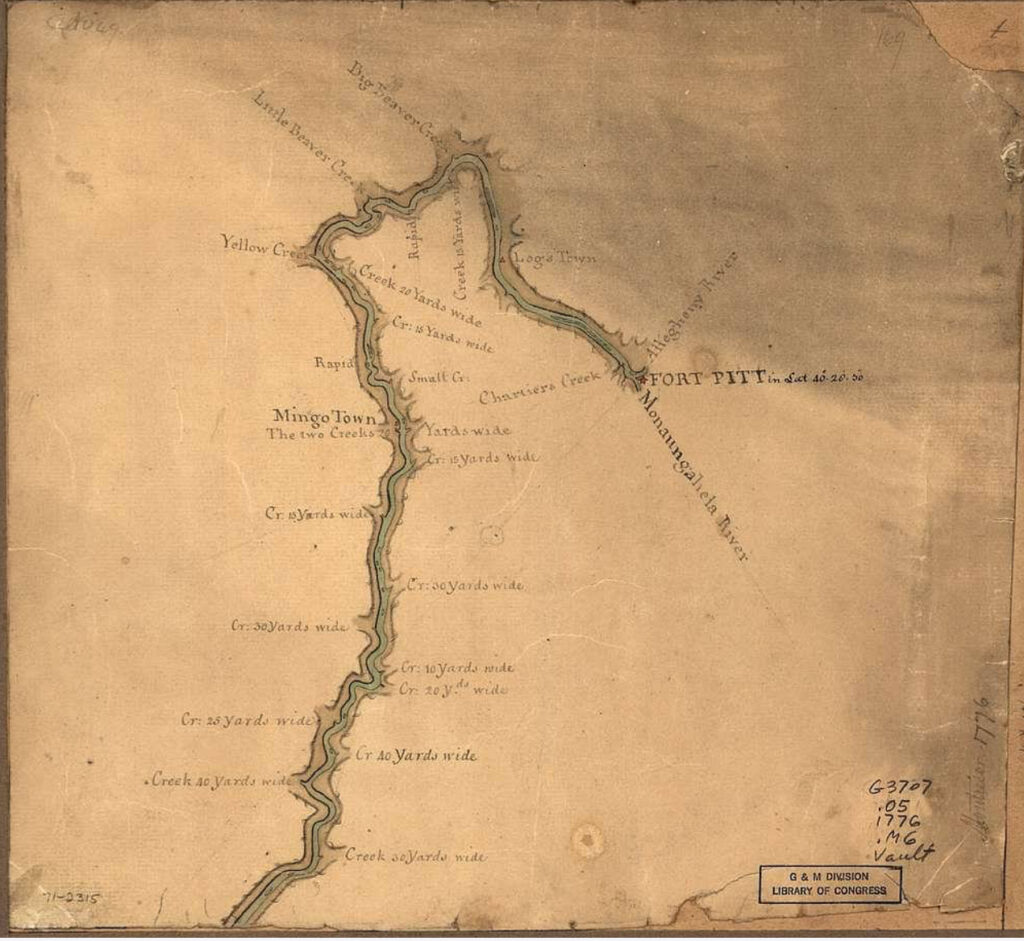
The Ohio River Valley lacked large, permanent settlements in the years immediately following the Seven Years’ War. Logstown, once a key hub for Indigenous and colonial trade, had been abandoned by the early 1760s. Mingo Town was more accurately a seasonal or semi-permanent village with a fluctuating population, and Grapevine Town served primarily as a hunting camp. The closest permanent settlements to what is now Wheeling, Redstone Fort and Pittsburgh both lie roughly sixty miles away as the crow flies. About thirty-five miles east of Wheeling, a site known as Catfish Camp, named for a Lenape leader, served as a midpoint between the latter and Redstone.[3]
The founding of Wheeling is attributed to the brothers Ebenezer, Silas, and Jonathan Zane around 1769, though the exact date is difficult to pin down with precision. There appears to be no surviving evidence that the Zanes interacted with George Washington during his 1770 survey down the Ohio; still, he was aware of their presence.[4] His trip was about assessing future land prospects, not meeting competitors. It’s equally likely he encountered no one at all. Another brother and sister would eventually join the Zanes. A fifth brother had been taken as a child and adopted amongst the Wyandotte. He would soon be on the other side of the war to come. Later, after the Revolution, Isaac Zane contributed to frontier diplomacy by serving as an interpreter between the United States government and Native nations.[5]
Local legend holds that Ebenezer Zane was the first to construct a cabin in the area on his claim that encompassed the mouth of Wheeling Creek adjacent to triangular Zane Island. Today, that one island, now known as Wheeling Island, is home to thousands of people. The brothers then returned east to the South Branch of the Potomac to gather up their families. Alongside the Zanes came many of their neighbors, including the Wetzel, Bonnet, and Mercer families, each inspired by Zane, who laid their own claim to lands around what would eventually become Wheeling.
The group journeyed together to Redstone Fort. Then on the final leg, legend has it that John Wetzel was riding ahead as the group neared the Ohio River and their future when his saddle’s girth broke. In the time it took for him to fix it, Silas Zane moved ahead and achieved the privilege of picking the choicest claim he found for himself. However, other narratives have the three Zane brothers making their claims before turning back east, hence why they had the best land claims. The specifics, as I said earlier, are murky, but what is positive is that on the frontier, the quickest got the prize. [6] Regardless, Wetzel laid claim to enviable bottomland over ten miles south of Wheeling Creek and doubtlessly never needed to curse his saddle.
Wetzel and his wife, Mary, brought their five children with them, all of whom were between the ages of four and twelve. Two more would be born along the Ohio. At the time, John Wetzel’s sons were still young boys, blending play with chores as they adjusted to the raw, ungoverned Ohio frontier. Four of the five would one day be known as Indian fighters. Was that fate already sealed, or did the events of 1774 shape their path? We’ll never know for sure.
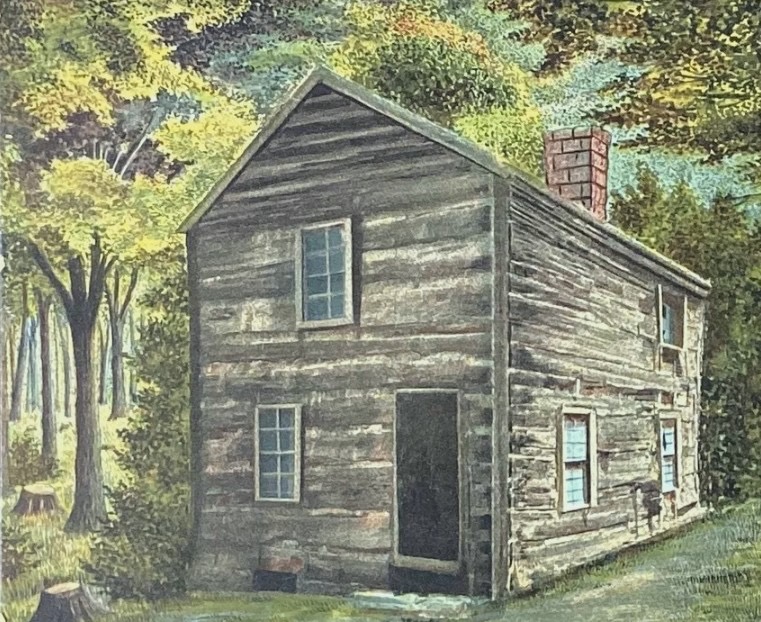
Others soon followed David Shepherd, and Andrew Swearingen arrived as part of a westward wave disseminating from Mecklenburg, now known as Shepherdstown, WV, in 1770. Both were the sons of rival Potomac ferry operations. I noted in a previous post that the latter’s brother, Van Swearingen, would later transfer his allegiance from Pennsylvania to Virginia after Dr. Connolly arrived with Lord Dunmore’s Declaration.
The Record Gap
Here we reach a gap in the historical record. While the Zanes, Wetzels, and other white families achieved prominence, the record is virtually devoid of the laborers who accompanied them, people who crossed the mountains into contested land not primarily as free agents, but under compulsion. They were present at the frontier’s beginning, but absent from its memory.
Some of these laborers may have been indentured servants. Family histories claim that John Wetzel’s father arrived in the colonies as an indentured servant from the German Palatinate, though this remains unverified. Indentured servants labored under contracts binding them for a fixed term to repay debts, finance passage from Europe, or earn wages they could not yet command as free men or women. Many families celebrated in frontier history descended from earlier generations who arrived as indentured servants, particularly among Scots-Irish and German Palatine migrants, but those origins rarely survived into the written record once land, whiteness, and legal standing had been secured. Their proportion declined with each generation as more colonists were born in the colonies.
Others arrived enslaved, bound permanently by race and violence rather than by time-limited contract. These systems, indentured and enslavement, operated in fundamentally different moral and social spheres and produced profoundly different lives. Yet both were present on the early frontier, and both performed labor essential to the process of claiming land. People of African ancestry were among the first families on the frontier in fact, but not in memory. You will find no romantic blurbs celebrating their pioneering spirit.
Speculators and wealthy landholders, George Washington among them, often required enclosed boundary walls as proof of required “improvements.” The mortarless stone walls still found across the former frontier were more than fences; they functioned as affidavits of ownership, laid by Scots-Irish laborers, many once bound by indenture, whose toil converted wilderness into property and speculation into wealth.
As indentured servitude declined, slavery became the dominant form of uncompensated labor. West Virginia, like Virginia and Maryland, from which many settlers originated, was a slaveholding society. When David Shepherd died, he bequeathed two adult enslaved people and their children to his wife. According to a 2016 article in Wheeling’s The Intelligencer, the Zanes also brought enslaved people with them, including one known as Daddy Sam.[7]
Archibald Woods, a speculator who moved to the Forks of Wheeling Creek in the 1770s, provides a clearer paper trail. In 1785, he purchased two enslaved children, a boy named Littleton and a girl named “Pink.” In 1789, he bought two women, Phetis and Lila.[8] After their sale, these individuals fade from view—reduced in subsequent records to property, even when traded alongside land. Woods’ surviving documents also note slave dealings involving the nephew of Michael Cresap and a son of John Wetzel. These fragments, when assembled, reveal a larger reality: enslaved labor was not anomalous, but routine in and around Wheeling.
By 1800, the U.S. census recorded 257 enslaved people in Ohio County, the modern West Virginia jurisdiction that encompasses Wheeling. Before Ohio County’s creation in 1788, the region existed within Virginia’s vast and loosely administered western claims, boundaries far less stable than later census tables suggest.[9] This Savage Spring narrative unfolds across what is now West Virginia’s northern panhandle, today divided into Brooke, Hancock, Marshall, and Ohio Counties, administrative units that did not yet exist when slavery was already embedded in the region. While precise enslaved counts for the full territory covered in this narrative remain elusive beyond Ohio County in surviving transcriptions, the historical record leaves no doubt: slavery operated throughout all four counties.
Along the Monongahela River in Pennsylvania, Fayette County recorded 282 enslaved people in 1790, alongside forty-four free African Americans.[10] Pennsylvania’s Gradual Abolition Act of 1780 declared that children born to enslaved mothers after that date would serve as indentured servants until age twenty-eight, after which they would be freed. Enforcement, however, proved uneven in border regions still disputed by Virginia, such as Westmoreland County, where overlapping land claims and divided loyalties blurred jurisdictional authority. By 1780, Wheeling lay securely within Virginia’s Ohio County, where slavery remained legal.
It bears remembering that in 1774, nearly all of what is now southwestern Pennsylvania and northern West Virginia fell under either Westmoreland County or Augusta County, depending on whose survey one recognized. The county lines later used to organize census data bear little resemblance to the tangled geography of the early 1770s. I introduce this complexity because it exposes the fallacy at the heart of Turner’s vision: the myth of a frontier tamed by white, self-sufficient labor. The record instead reveals a world built by many hands, free and enslaved, Indigenous and immigrant, whose work sustained the frontier even as their stories were written out of it.
Accounts of Joseph Tomlinson Jr.’s plantations at Grave Creek and William’s Station demonstrate that slavery persisted west of the Alleghenies well into the nineteenth century, with enslaved laborers transported up and down the Ohio River between farms. Ownership figures alone obscure this reality. While relatively few settlers “owned” enslaved people outright, many more rented their labor, explaining why the region appears less slaveholding on paper than it was in practice.
Given standard assumptions about population growth, one might expect fewer enslaved people in the region during the 1770s. Yet during the initial period of settlement, it is possible that more enslaved African Americans lived and labored in the backcountry than later, once landholdings stabilized. George Washington himself leased or dispatched enslaved workers to frontier tracts to improve property and generate income, as his partnership with Gilbert Simpson Jr. demonstrates.[11]
Turner imagined a baptism by frontier in which Anglo-European settlers were remade into democratic individualists. In doing so, he sidelined the labor of free and enslaved African Americans and erased most women’s work, regardless of race. That distortion survived in part because historians leaned heavily on written records—records produced almost exclusively by those with the power to create them. People do not dislike history because it is dull, though its polished moralizing versions often are, but because it is incomplete, narrated by those who inherited the record while countless others were denied both name and memory.
Readers raised on frontier mythology may be tempted to read this evidence as an indictment of all settlers, or to dismiss it by pointing to incomplete numbers and shifting boundaries. Both responses miss the point. This is not a story of villains and victims neatly divided, but of how labor, land, and memory interacted to produce a usable past—one that elevated certain narratives while quietly erasing others. The frontier was not built by isolated white yeomen alone, whatever Turner imagined, but by overlapping systems of free, coerced, and enslaved labor whose traces rarely survived into celebration.
Conclusion
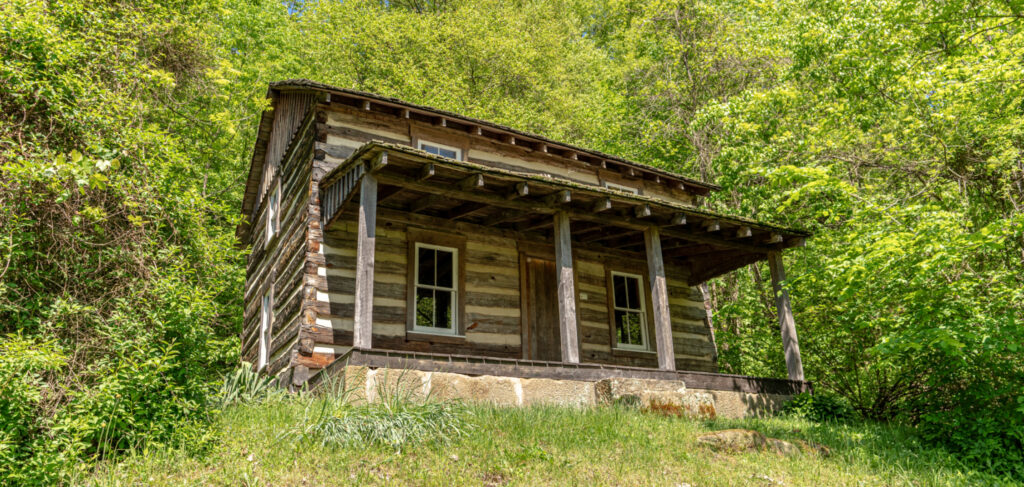
The Revolution left paper trails. The frontier left shadows, and those shadows became scripture. What’s left in the record, ledger entries and censuses—reminds us that the frontier was never just a landscape of heroism or hardship. It was a place of labor, coercion, and survival. If history feels hollow, it’s because the scaffolding of the American story was built on selective memory. What settlers called “founding” was, in truth, a rearranging, building within the footprints of older paths, gardens, and clearings. Yet those same footprints rarely left room for everyone whose hands and memories had shaped them—Native nations, enslaved laborers, and the unseen workers who sustained the frontier’s promise.

Notes & Citations
[1] Joseph Warren, “Warren’s 1775 Boston Massacre Oration in Full Text: ‘Our Country Is in Danger — But Not to be Despaired Of’,” DrJosephWarren.com, March 6, 2015, accessed October 20, 2025, https://www.drjosephwarren.com/2015/03/warren%E2%80%99s-1775-boston-massacre-oration-in-full-text-our-country-is-in-danger-but-not-to-be-despaired-of/.
[2] Map of the Ohio River from Fort Pitt. Accessed June 27, 2025. https://loc.getarchive.net/media/map-of-the-ohio-river-from-fort-pitt.
[3] The Department of State, Journal of Mason and Dixon: The Manuscript Journal of Charles Mason and Jeremiah Dixon with Historical Prelude to their Survey (1763), “Journal of Mason and Dixon: The Department of State,” Internet Archive, accessed October 20, 2025, https://archive.org/details/JournalOfMasonAndDixon/page/n171/mode/2up?q=Catfish.
[4] “Diary entry: 23 October 1770],” Founders Online, National Archives, https://founders.archives.gov/documents/Washington/01-02-02-0005-0029-0019. [Original source: The Diaries of George Washington, vol. 2, 14 January 1766 – 31 December 1770, ed. Donald Jackson. Charlottesville: University Press of Virginia, 1976, p. 297.
[5] Treaty with the Wyandot, etc., 1795 (Aug. 3, 1795). Tribal Treaties Database, Oklahoma State University Library. Accessed October 20, 2025. https://treaties.okstate.edu/treaties/treaty-with-the-wyandot-etc-1795-0039. And Treaty with the Shawnee, 1786 (Jan. 31, 1786). Tribal Treaties Database, Oklahoma State University Library. Accessed October 20, 2025. https://treaties.okstate.edu/treaties/treaty-with-the-shawnee-1786-0016.
[6] A History of Marshall County, West Virginia, comp. W. Hunter Wilson. William J. Clarke Printing Company for The Marshall County Board of Education, 1925. PDF. Accessed October 21, 2025. https://www.wvgw.net/marshall/1925powellbook.pdf. 9.
[7] “Wheeling Historian Explores ‘Awfulness’ of Enslavement,” The Intelligencer, February 14, 2016, accessed October 21, 2025, https://www.theintelligencer.net/life/features/2016/02/wheeling-historian-explores-awfulness-of-enslavement/.“History of Monument Place at Elm Grove, West Virginia,” Ohio County WVGenWeb, accessed October 21, 2025, https://www.wvgw.net/ohio/monument.htm.
[8] Archibald Woods Papers, Special Collections Research Center, Swem Library, College of William & Mary, Williamsburg, VA. Available at: https://scrcguides.libraries.wm.edu/repositories/2/resources/8977. Accessed October 12, 2025.
[9] “Tomlinson Family of Marshall County, West Virginia,” WVGenWeb Archives, accessed October 21, 2025, https://www.wvgw.net/marshall/tomfam.htm.
[10] G. D. Dixon, 1790 Fayette County, Pa. Census – Head of Households with Free Persons of Color and Slaves(transcription), Fayette County PAGenWeb, accessed October 22, 2025, https://pagenweb.org/~fayette/slave_records/1790fpoc.pdf
[11] George Washington, “Having found it indispensably necessary to visit my landed property west of the Apalacheon Mountains…” (September 1784), in George Washington Papers, Series 4: Diaries, 1748–1799, The Papers of George Washington, ed. W. W. Abbot et al. (Charlottesville: University of Virginia Press), Founders Online, National Archives, https://founders.archives.gov/documents/Washington/01-04-02-0001-0001 (accessed October 21, 2025).
For readers who wish to follow ongoing research, subscription is available in the footer.