More is known about the men who carried out the Yellow Creek Massacre than about the victims they killed. Names like Daniel and Jacob Greathouse, Nathaniel Tomlinson, and John Sappington have survived, not by accident, but because the systems they lived within kept track of men like them. They signed land petitions, left estates, and witnessed deeds. Their descendants have pieced together family genealogies. Meanwhile, their victims left little behind that the colonial systems valued.
Much of what we know about early frontier families comes from the careful work of genealogists who have preserved land records, wills, and migration trails across generations. Without such family-held materials, parts of this history would remain inaccessible. The presence of these records should not be read as a moral inheritance. As with all genealogies, preservation reflects circumstance and access rather than virtue, shaping the archive independently of ethical judgment.
Historical interpretation doesn’t always flatter its subjects. The same records, which document settlement and kinship, reveal patterns of speculation, dispossession, and violence. We all have ancestors who did things now considered reprehensible. After 250 years, there are worse burdens than an honest accounting of the past.
Details of land and money dominate 60–70% of this post, but frontier land dealings aren’t just bookkeeping—they’re the blueprint for how a family could rise on the edge of empire.
A Land Deal Rooted in Deception
Harman Greathouse’s grandfather, Harmon Groethausen, immigrated from a patchwork of states within the Holy Roman Empire that we now call Germany in the early 1700s. Even fifty-plus years later, the long shadow of the Thirty Years’ War had left the German Palatinate fractured and insecure.
Groethausen acquired land in Springfield Township directly from the Penn family. That land was part of the infamous Walking Purchase, a 1737 swindle in which the Penns promised to claim only as much land as a man could walk in a day—but sent trained runners down a pre-cleared path, ultimately seizing more than twice the territory the Lenape understood to be on offer.
Three men stood at the center of this scheme: James Logan, secretary to the Penn family; Shikellamy, a trusted Haudenosaunee (Six Nations) diplomat who served as Logan’s intermediary; and Conrad Weiser, the colony’s primary cultural and political go-between. Shikellamy’s precise role in the swindle has been debated, but his proximity to Logan is indisputable. He named two of his sons James and John Logan—a testament to the depth of their relationship. (I explored Shikellamy and his family more fully in Part I.)
Harman Greathouse’s Frontier Footprint
Harman Greathouse didn’t inherit much—when his father died in 1745, he left six acres to his widow and no land to any of his ten children. Harman, a blacksmith by trade, built his fortune differently: through land.
From 1749 to 1755, he and his wife, Mary Magdalena Stull, held a 50-acre tract called ChestnutSprings near Antietam Creek in what was then Frederick County, Maryland.
Greathouse wasn’t content to stay put. By 1753, he had pushed west into the rugged hills of what’s now Hampshire County, West Virginia, staking his claim in a region that was still more Native hunting ground than settled farmland. Over the next two years, he added at least two more tracts, a 275-acre parcel and a neighboring 249-acre survey, slowly assembling the kind of holdings that turned squatters into speculators.
In 1760, the restless Greathouse circled back east, securing 10 acres in what is now Carroll County, Maryland, where he opened a tavern, a gathering place for travelers, traders, and the occasional land agent. By 1765, he had acquired additional land in Baltimore County, but his eyes were still fixed on the opportunities west, beyond the mountains.[2]
In 1772, Greathouse sold part of his Hampshire County holdings to Michael Cresap—yes, that Michael Cresap. [3]
Greathouse didn’t just buy and sell land; he worked the frontier networks that made such dealings possible. As a chain carrier for several surveyors, he trudged through rough terrain, helping measure land that others would claim. Unlike some who inherited their position, Harman earned his through trade, sweat, and connections, a settler class that built its fortune on constant movement.
Harman and Mary had twelve children, of whom Jacob and Daniel were the eldest surviving. Around 1771, the Greathouses undertook the pioneer path west to the Ohio River. Harman claimed land on Harmon Creek and his son Daniel claimed land near Old Mingo Bottom, just upriver from the mouth of Yellow Creek. Despite acquiring multiple tracts over his lifetime, Harman sold or traded his land rather than holding onto land to pass down to his descendants. His children had to carve out their own claims, often settling nearby but not as potential heirs.[4] By 1774, Daniel Greathouse moved his family to a tract off nearby King’s Creek. Land off Big Sandy Creek was also credited to him.
Frontier Flipping
A sense of entitlement fueled a settler class that built its fortune on constant movement, leaving behind a trail of speculation, dispossession, and conflict. It took a particular kind of person, determined, audacious, and often ruthless, to bring their family west and seize opportunity before anyone else. To call them anything less than salt-of-the-earth frontiersmen might seem revisionist to some, but I would be remiss not to add: history always has two sides. In the shadows of those brave stories lie other narratives that wouldn’t have sounded so inspiring in an early American primer reader.
The first wave of settlers, like the Greathouses, didn’t just homestead—they speculated. They arrived early, staked out as much land as they could hold, sometimes more than they could work, and then profited by selling excess claims to later arrivals who lacked the muscle or firepower to carve out ground for themselves.
Jacob Walker’s great-grandson later recalled that Walker bought 400 acres from a “Mr. Greathouse,” likely Harman, for just 16 cents an acre.[6] That price wasn’t unusual on the raw frontier, though the original payment would have been in pounds, shillings, and pence, not dollars and cents. Under Virginia’s post-1778 land system, settlers who could prove prior residence and improvement were later allowed to secure patents directly from the government at rates equivalent to roughly $2.25 per 100 acres.[7] On paper, this was far cheaper than what Walker and others paid. In practice, however, frontier supply and demand ruled: second-wave settlers typically had to purchase claims from earlier occupants before they could perfect title with the state.
For men like the Greathouses, the strategy was simple: move in early, clear enough land to make a claim, and sell it when demand rose. If lucky, they could claim 400 acres, sell it at 15–25 cents per acre, and move ten miles downriver to do it again. It wasn’t farming—it was frontier flipping. And it paid. What distinguished this behavior was not its illegality, but its scale: land ceased to be a means of subsistence and became a repeatable instrument of profit.
By 1799, George Washington’s will estimated his own Ohio River Valley holdings at $10 an acre. In just two decades, what had been an “empty” frontier in the 1760s and early 1770s became prime real estate—thanks to formal surveys, military protection, and the slow advance of colonial governments.[8]
Daniel Greathouse’s will, following his 1777 death, reveals that his estate was valued at £398, 10 shillings, and 8 pence—roughly $1,815 in the post-Revolutionary dollar-and-cents system.[9] To put that in perspective, the Lindert-Williamson income estimates for 1759–1774 indicate that the average colonial household earned £78 per year, and only the top 10 percent exceeded £100 annually.[10] At just 25 years old, Daniel had already climbed into that elite bracket.
Daniel’s 400-acre tract at Old Mingo Bottom was sold the same year he died. If his brother John sold it for anything close to the 16 cents an acre their father reportedly accepted from Jacob Walker, the sale would have brought only about $64, hardly enough to explain Daniel’s wealth. This suggests Daniel wasn’t just sitting on land; he was likely speculating, farming, and leveraging enslaved labor to grow his fortune.
So long as claims could be maintained long enough to sell, first-wave settlers stood to profit handsomely. Men like the Greathouses weren’t just rugged pioneers—they were entrepreneurs and opportunists, operating in a volatile world where land, violence, and ambition intertwined. Maintaining such claims required the credible ability to defend them—against Native resistance, rival settlers, and later arrivals—which meant that landholding and armed presence were inseparable on the Ohio front
By the spring of 1774, land, arms, and expectation had accumulated. On the Ohio frontier, no such convergence remained inert for long.
Conclusion
To describe the economic mechanics of frontier landholding is not to condemn ambition itself, nor to claim that settler behavior was aberrant by eighteenth-century standards. It is to acknowledge that frontier capitalism operated with its own incentives, and that violence, exclusion, and dispossession were not aberrations within that system but predictable outcomes of it.
The story of Harman and Daniel Greathouse is more than an account of acreage and speculation—it’s a case study in how ordinary ambition, multiplied across families, transformed the Ohio frontier. What began as a means of survival became an opportunity; what started as a settlement became a possession. Squatter claims ringed the Ohio River like a string of advance outposts, and their neighbors shared the same hunger for expansion. Systems that recorded successes on the frontier rarely recorded the cost. When the spark finally came in the spring of 1774, it found men who had already learned that fortune and violence could coexist on the same tract of ground.

Notes & Citations:
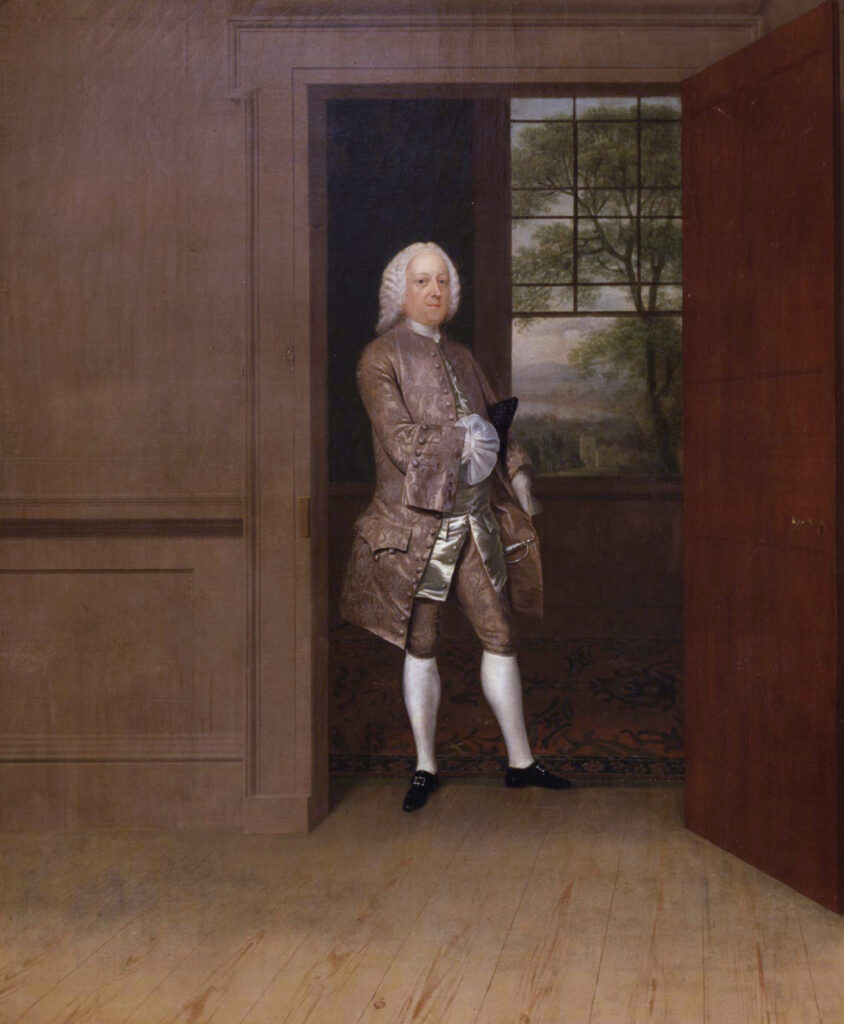
[1] Arthur Devis, Portrait of the Right Honourable Thomas Penn, 1752, oil on canvas, Philadelphia Museum of Art.
[2] Helen S. Stull, The Stulls of “Millsborough”: A Genealogical History of John Stull “the Miller,” Pioneer of Western Maryland, Vol. 1. Descendants of (Col.) John Stull of Hagerstown, Mary (Stull) Greathouse, and Margaret (Stull) White (Akron, OH: Sumner Press, 1952). 241-242 https://www.familysearch.org/library/books/records/item/420731-redirect.
[3] Stull, The Stulls of “Millsborough”: a genealogical history of John Stull “the miller”, pioneer of western Maryland, Vol. 1. Descendants of (Col.) John Stull of Hagerstown, Mary (Stull) Greathouse, and Margaret (Stull) White, 242.
[4] Reminder, I’m referencing the Mingo Bottom in WV as Old Mingo Bottom.
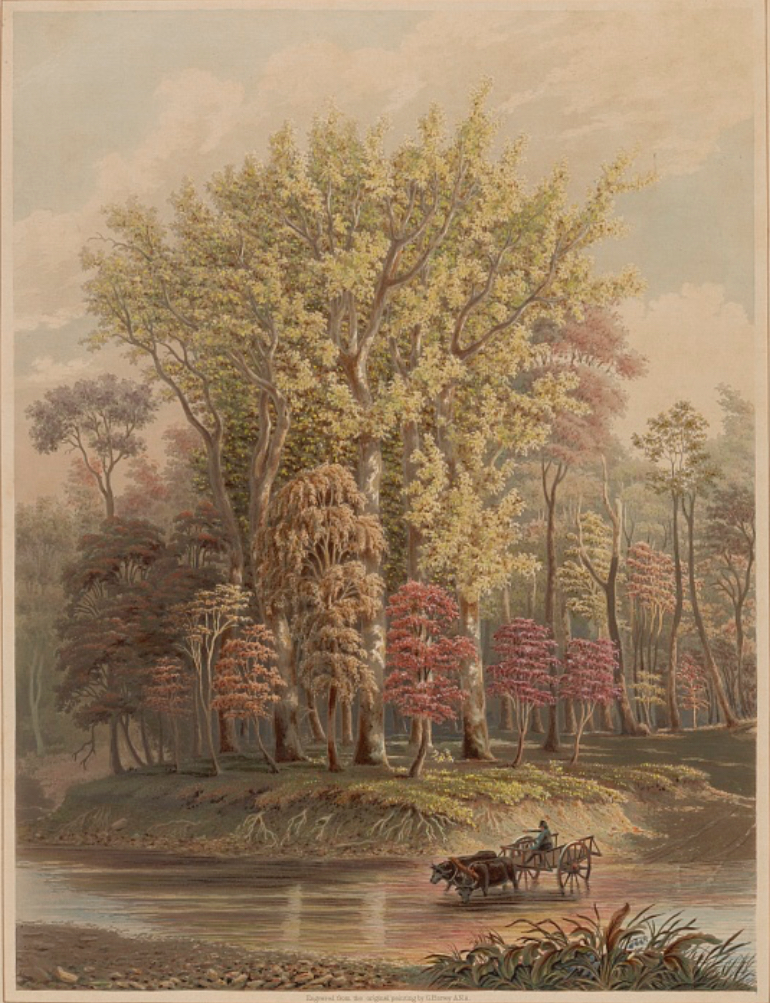
[5] W. J. (William James) Bennett, engraver, and George Harvey, artist. Autumn. No. 4. Gigantic Sycamores. An Ox Team Crossing the Ford. Owl Creek, Ohio. Engraved from the original painting by G. Harvey, A.N.A. New York: George Harvey, ca. 1840. Library of Congress. Accessed July 5, 2025. https://www.loc.gov/item/2003674125/.
[6] W.H. Hunter, “The Pathfinders of Jefferson County.” Ohio Archealogical and Historical Quarterly VI, no. 2–3 (April 1898),119.
[7] Amelia Clewley Ford, Colonial Precedents of Our National Land System as It Existed in 1800 (Madison: University of Wisconsin, 131.
[8] Prussing, Eugene E. The estate of George Washington, Deceased. Boston, Mass: Little, Brown, and Company, 1927. 78.
[9] “1799 – Paris District Court: Chancery Case # 3166, Gabriel Greathouse vs Andrew McCreery, Mary McCreery, Richard Morris and Others.” Greathouse Point. http://greathousepoint.com/archives/usa/ky/bourbon/1799-dep-greathouse-gabriel.htm. Shannon Selin. “Currency, Exchange Rates & Costs in the 19th Century.” Currency, Exchange Rates & Costs in the 19th Century, December 15, 2021. https://shannonselin.com/2021/06/currency-exchange-rates-costs-19th-century/.
[10] Peter H. Lindert and Jeffrey G. Williamson. “American Incomes before and after the Revolution.” The Journal of Economic History 73, no. 3 (August 9, 2013): 757-758. https://doi.org/10.1017/s0022050713000594.
For readers who wish to follow ongoing research, subscription is available in the footer.