No family represents the epitome of the 1770s frontier network more than the Tomlinson family. Joseph, Samuel, and James Tomlinson were amongst the first-wave settlers who swarmed to the area around Wheeling in 1769-1771. Their brothers, Nathaniel and Benjamin Tomlinson, were both at Baker’s Tavern on the day Logan’s family was ambushed. Only Nathaniel, however, was present during the actual murders.
The Tomlinsons weren’t just neighbors to the Greathouses—they were kin and business partners, deeply entwined in the networks of land claims and intermarriages that defined life on the Ohio frontier. Their familial ties to nearby settler families ran deep:
- Sister, Lucy, married Joshua Baker, the tavern keeper.
- Benjamin Tomlinson lived with the Bakers while unmarried until marrying Rachel Greathouse in 1777.
- Their maternal aunts Ruth and Drusilla Swearingen married Michael Cresap’s brothers, Daniel and Thomas, respectively.
- Their paternal aunt Susannah Tomlinson was the mother of George Cox and his siblings.
The Tomlinsons knew firsthand the cost of frontier violence. Their uncle had been killed in a Native attack near Redstone in 1762.
“An express came yesterday from Redstone Creek, with account that one Tumblestone [Tomlinson] & another white man that settled above Redstone was kill’d (one shot, ye other tomhoek’d in ye head) by ye Indians, being lying dead in their house.” James Kenny, 1762 [2]
Another sister, Rebecca, was widowed at sixteen when Shawnee killed her husband, a trader, on the Hocking River. He had been attacked alongside another uncle for their role as Virginia traders; Pennsylvania traders working nearby were spared. In the same way that colonial writers later characterized certain Native nations as “more warlike,” indigenous communities assigned reputations to settler populations as well. Virginians, shaped by militia culture and recurrent land conflict, were widely perceived as quicker to rely on armed force, a reputation that carried practical consequences.
Land, Legacy, and Lawsuits
Joseph Tomlinson Jr. and his brothers, Samuel and James, laid claim to land at Grave Creek in their father, Joseph Sr’s, name. The brothers would also later be involved in a legal dispute involving George Washington and the heirs of Michael Cresap downriver over Round Bottom, a prime stretch of river bottomland.
The Tomlinsons had made improvements at Round Bottom to strengthen their claim. However, William Crawford, George Washington’s appointed land manager, ignored their claims and surveyed it for Washington anyway. Washington had expended a lot of time and energy to get Crawford appointed as a Virginia surveyor in the first place, because he could be counted on to put his, Washington’s, interests above those of others. Michael Cresap, too, staked a competing claim at Round Bottom in 1774.
The Round Bottom matter dragged on for decades, finally resolved in 1834, long after Washington’s death, the court ruled in favor of Washington’s heirs. An 1823 Court of Appeals judge noted that ruling against Washington’s estate would mean concluding that the Father of the Nation’s land claim was fraud, something Washington was not considered capable of.[3] This incident itself was an extenuating circumstance to the extreme. The judge’s ruling reveals the near-sacred aura surrounding Washington in the courts and across the nation. At one point, before the court’s decision to award all to Washington’s heirs, the Tomlinsons and Cresaps had proposed splitting Round Bottom between them, a compromise typical of frontier land disputes. But by the early 19th century, absentee owners in the East won these cases more often than not, leaving frontier families on the ground with little to show for their efforts.
It’s All in the Family
Nathaniel Tomlinson was no stranger to frontier maneuvering. In 1771, he made improvements at Grover, land that had been first claimed in 1770 by another man. The following year, he established a settlement at Harmon’s Run, selling it in 1773.[4]
Without special approval, no individual could legally hold more than 400 acres on the Virginia frontier. Experienced claimants often skirted this rule by filing claims in the names of wives, sisters, or other relatives. In 1773, Samuel and Joseph Tomlinson claimed 400 acres for their widowed sister Rebecca. Other families played the same game. John Sappington Sr. held 400 acres on Harmon’s Run, while his son John claimed land on Cross Creek. By the 19th century, the Cox family had amassed over 3,000 acres across six areas of Ohio County—including Buffalo Creek, Long Run, Koons Run, Pleasant Fork, and Castleman’s Run.[5]
Which Joseph Swearingen Was at Yellow Creek?
Of all the names tied to the Yellow Creek Massacre, few are as murky as Joseph Swearingen. No land patents, tax rolls, or estate files place a Joseph Swearingen in the Wheeling area in 1774. Yet Joseph Swearingen’s name lingers in accounts of the Yellow Creek Massacre because he effectively signed his name to a confession. Yet as aforementioned, unlike his co-conspirators, Joseph left no property records in the Wheeling area. That gap fuels confusion, especially since the Swearingen lines in the colonies all reused the same first names—Van, Joseph, and Benoni—repeatedly.
So which Joseph was it? The Tomlinsons, who were neighbors and kin to the Greathouses, descended on their mother Rebecca’s side from the Maryland Van Swearingen line. But another prominent branch lived just down the Potomac in Mecklenburg (now Shepherdstown, WV). That branch descended from Thomas Swearingen—the same Thomas who once beat George Washington for a seat in Virginia’s House of Burgesses, earning Washington’s lifelong disdain.[7] Thomas died in 1760, and his brother, “Maryland Van,” the Tomlinsons’ grandfather and the local regional sheriff, took over administration of the ferry and other properties while his nephews grew up.
Thomas’s son, Joseph Swearingen, inherited land from his father’s Lord Fairfax grant. In 1774, however, he was not yet twenty-one and therefore legally unable to hold property in his own name; the deed remained with his uncle and the Tomlinson’s grandfather, Maryland Van.
Was this Joseph, the one from Mecklenburg, the same Joseph Swearingen present in Joseph Baker’s cabin during the murders of Logan’s family? The evidence suggests he could have been.
Mecklenburg, as noted earlier,[8] sent many of its young men westward to Wheeling during this period, seeking opportunities and land. Joseph’s brother Van Swearingen eventually found his way to Wheeling as well, though not until the 1780s, when he purchased one of the Cox brothers’ holdings in Brooke County. Still, he was already active on the frontier by 1774, serving as a Justice of the Peace along the Monongahela in Westmoreland County, Pennsylvania before he switched sides after Connolly declared Pittsburgh and its surroundings part of Virginia.[9]
A faint but tempting thread connects this Joseph Swearigen to the conspirators even earlier. Antietam Creek, the site of the Greathouse family’s old property, empties near the Swearingen ferry, a small geographic overlap, but one that hints at shared routes and acquaintances. Yes, this borders on conjecture, but it illustrates just how intertwined these frontier circles could be.
Another brother, Andrew Swearingen, one of the first settlers near Wheeling, would claim that the Ohio River’s northeastern bank had already been evacuated before Yellow Creek “due to the menacing conduct of the Indians.”[10] Whether this was a sincere memory or a retrospective effort to shift blame away from his kin is hard to say. Withers, whose chronicle preserves the remark, was far from impartial; his work consistently frames Native resistance as “savage.” Even so, Andrew’s statement reinforces how this branch of the Swearingen family, however indirectly, was entangled in the events surrounding the massacre.
There is the matter of the documentation of Joseph Swearingen’s whereabouts in 1774. The local tithable list taken in the summer of 1774 lists him home with his mother, but a vast percentage of those who were west of the Alleghenies before the Yellow Creek Massacre would have been found east that summer.[11]
Then there is the Bellevue estate, now known as the Van Swearingen-Shepherd House. An adorned plaque credits its erection to Colonel Joseph Swearingen in 1773. The house’s 1773 date and “Colonel” title both reflect later embellishment. Swearingen would have been only nineteen that year and still in military service a decade later.[12] Architectural evidence and documentary records indicate that Bellevue was, in reality, erected in the 1790s, once he had returned home and achieved the standing that such a residence symbolized. Finally, Joseph’s youth may explain why no local land records around Wheeling bear his name. Too young to hold land outright, he may have intended to file a claim in his own name, as he later did in Kentucky, but his return east to serve in the Revolution dissolved those plans.
So who was this Joseph? It’s a theory, I do believe there were other Joseph Swearingens descended from Garrett Van Swearingen that posterity hasn’t been able to identify as well as they have for Garrett’s son Thomas’s line. The Swearingen family’s North American roots lie in the Dutch-influenced Delaware River Valley, part of the former colony of New Netherland, where Dutch identity and kin networks persisted long after English control replaced formal Dutch rule.
Was the Joseph Swearingen who was present at the Yellow Creek massacre a drifter drawn into the frontier’s chaos, or a younger son from an established family testing his fortune on the Ohio?
In the end, I am not accusing Joseph Swearingen of taking part in the murders at Yellow Creek; my intent is to show how the surviving clues, fragmentary though they are, reveal the reach of kinship, movement, and ambition that drew men like him into the same orbit as those at Baker’s Tavern that spring.
Conclusion
The image of the lone frontiersman carving a life from wilderness endures because it is comforting, not because it is accurate. Survival on the Ohio frontier required networks—families bound by blood, marriage, and necessity—who supplied labor, protection, legitimacy, and access to land. Over time, those same ties that sustained survival also concentrated power.
Kinship networks stabilized claims, navigated legal uncertainty, and enforced authority where courts could not. But they also narrowed the boundaries of belonging. As land accumulated and competition intensified, those outside the network, Native communities, rival claimants, late arrivals, encountered not individual settlers, but coordinated families defending shared interests. Violence, when it came, did not erupt from isolation or chaos; it emerged from systems that had already learned how to claim, protect, and profit together.
Historians have long framed the frontier as a proving ground for rugged individuals. The record here suggests a different reality. The frontier was not built by solitude. It was built by alliances, and at their most extreme, by the willingness of those alliances to enforce their claims.

Notes & Citations
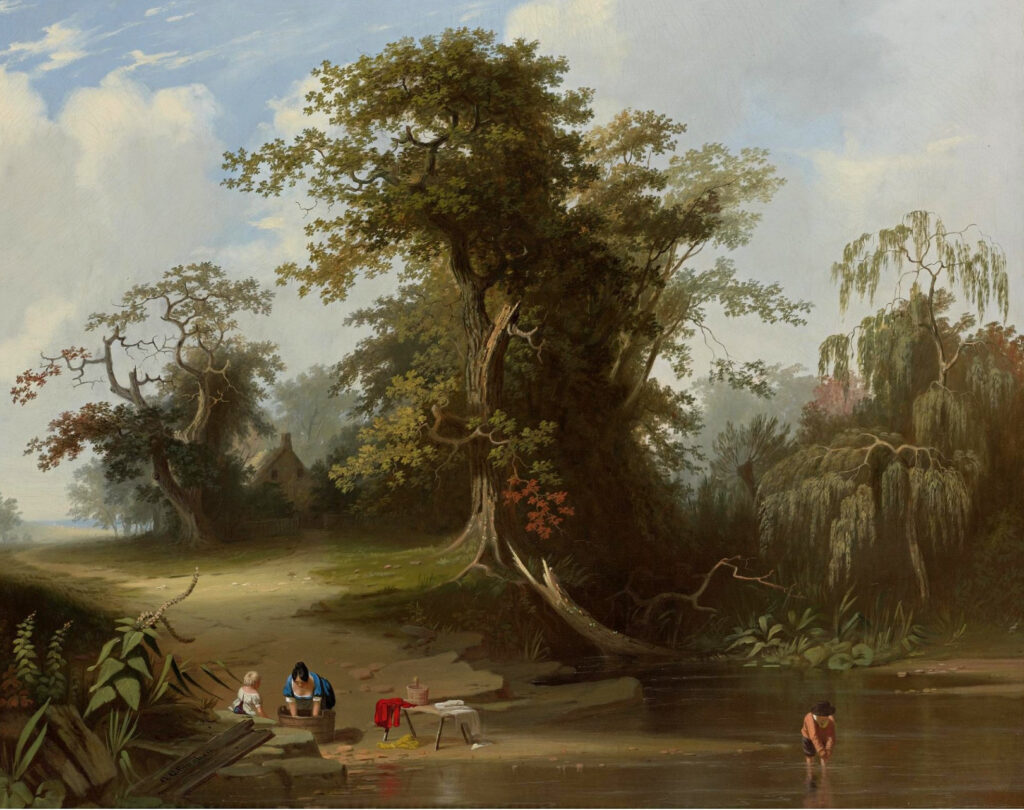
[1] In the process of writing this blog, I’ve become a big fan of George Caleb Bingham’s work. I’ve attempted to utilize his works as often as possible. George Caleb Bingham, Landscape: Rural Scenery, c. 1845, oil on canvas, The Metropolitan Museum of Art, New York. https://www.metmuseum.org/art/collection/search/642451.
[2] As noted in A.P. James’s edition of “Samuel Vaughn’s Journal, there was a tradition around Fort Redstone to call Tomlinson’s Tumblestones. Vaughn is referencing Jesse Tomlinson, who may have been the same person as Joseph Tomlinson Jr.’s youngest son. Historical Society of Pennsylvania. The Pennsylvania Magazine of History and Biography. Vol. 37, no. 3 (July 1913): 152. Available at https://upload.wikimedia.org/wikipedia/commons/7/7f/The_Pennsylvania_magazine_of_history_and_biography_%28IA_pennsylvaniamaga3719unse%29.pdf. A. P. James “Samuel Vaughan’s Journal.” Western Pennsylvania History, vol. 44, no. 1 (1961), pp. 1-38. Pennsylvania State University Press. PDF available at https://journals.psu.edu/wph/article/download/1897/1745.
[3] Scott Powell. History of Marshall County, from Forest to Field: A story of early settlement and development of Marshall County, W. Va. ; with incidents of early life and roster of soldiers of the several wars, with other matters of interest. Moundsville, West Virginia, 1925. 93-94. Prussing, Eugene E. The estate of George Washington, Deceased. Boston, Mass: Little, Brown, and Company, 1927. 334
[4] Lyman Chalkley. Chronicles of Scotch-Irish Settlement in Virginia. Vol. II. Rosslyn, VA: Mary S. Lockwood, 1912. 67. https://babel.hathitrust.org/cgi/pt?id=njp.32101076208097&seq=10. Chalkley. Chronicles of Scotch-Irish Settlement in Virginia. 72.
[5] Hildreth, Samuel P. Biographical and historical memoirs of the early pioneer settlers of Ohio: With narratives of incidents and occurrences in 1775. Cincinnati, Ohio: H.W. Derby & Co., 1852. 484. W Augusta County was divided in 1776 into counties that included Ohio, Brooke, and the now-defunct Yohogania County in what is now West Virginia. Mary F. Tessiatore. Sims index to land grants in West Virginia. Charleston, W. Va: State of West Virginia, 1992. 564.
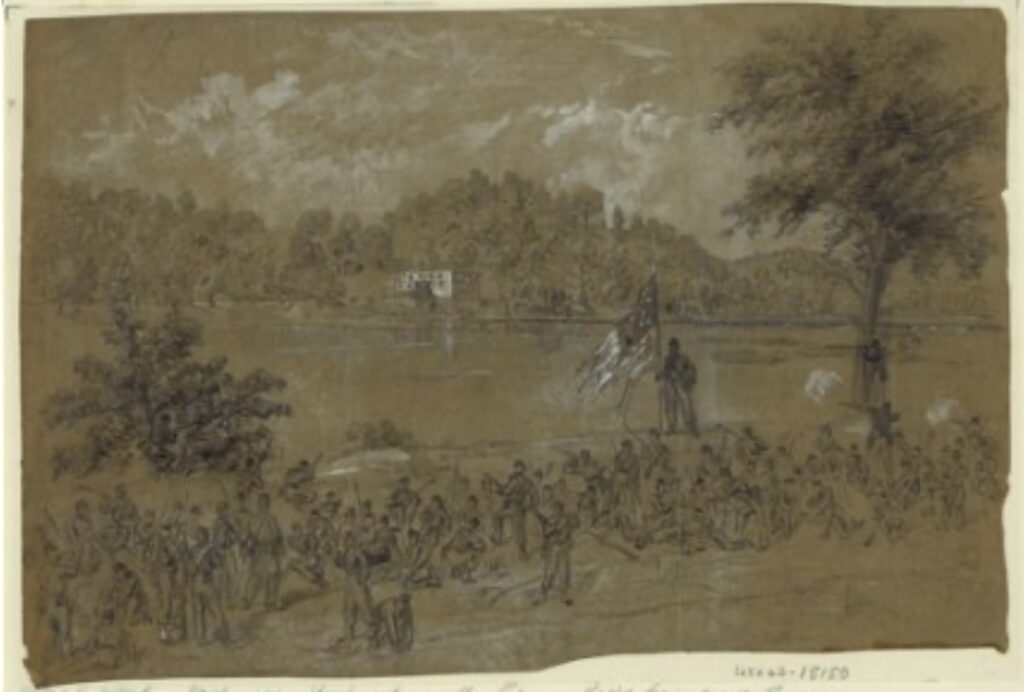
[6] Alfred R. Waud. Ford near Shepherdstown, on the Potomac. Pickets firing across the river. ca. 1862. Library of Congress, Prints and Photographs Division. https://www.loc.gov/item/2004660886/.
[7] “Founders Online: To George Washington from Adam Stephen, 23 December 1755.” National Archives and Records Administration. https://founders.archives.gov/documents/Washington/02-02-02-0229
[8] Mecklenburg wasn’t officially renamed Shepherdstown until near the turn of the century, but even in a 1761 letter to Van Swearingen, Washington references “Shepherds Town.”
[9] Like most of his fellow Justices of the Peace, Van Swearingen was not loyal to Pennsylvania during the border conflict with Virginia. McClure, James Patrick. “The Ends of the American Earth: Pittsburgh and the Upper Ohio Valley to 1795.” The Ends of the American Earth: Pittsburgh and the Upper Ohio Valley to 1795, 1983. 277-278, 280, & 283. Additional side note: The Greathouse’s sister married a Van Swearingen from one of the other three Swearingen family lines.
[10] Alexander Scott Withers. Chronicles of Border Warfare, Or, A History of the Settlement by the Whites, of North-western Virginia, and of the Indian Wars and Massacres in that Section of the State : with Reflections, Anecdotes. Edited by Reuben Gold Thwaites. Cincinnati, Ohio: The Robert Clarke Company, 1895.
[11] William H. Rice, ed., 1774 List of Tithables and Wheel Carriages in Berkeley County, Virginia (Parsons, WV: McClain Printing Company, 2006), 22.
[12] General Orders, 5 September 1779,” Founders Online, National Archives, https://founders.archives.gov/documents/Washington/03-22-02-0278. [Original source: The Papers of George Washington, Revolutionary War Series, vol. 22, 1 August–21 October 1779, ed. Benjamin L. Huggins. Charlottesville: University of Virginia Press, 2013, pp. 352–354.]
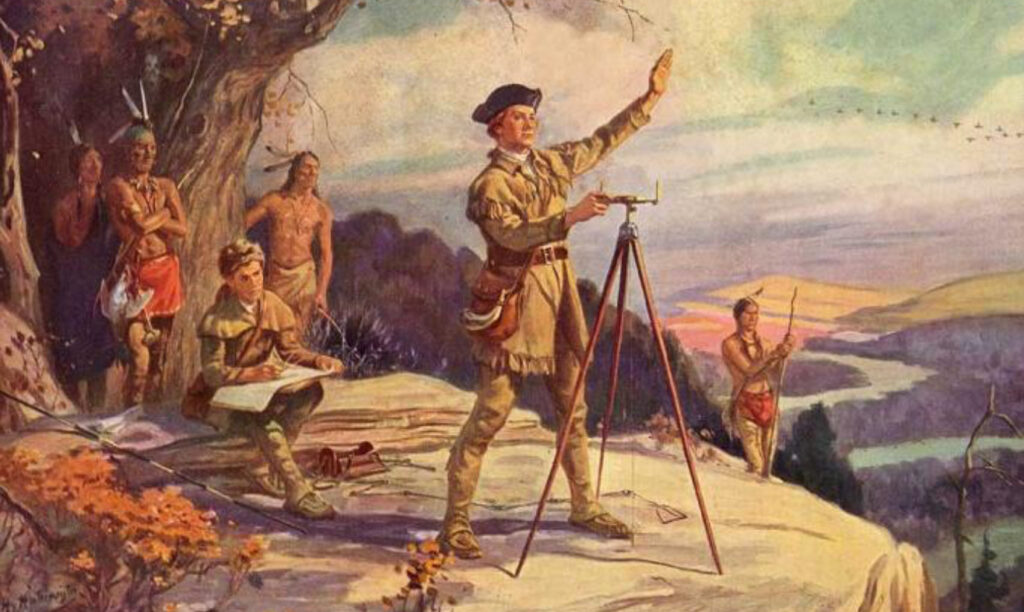
[13] Henry Hintermeister, George Washington, surveyor (1948), print, Wikimedia Commons, https://commons.wikimedia.org/wiki/File:George_Washington,_surveyor_by_Henry_Hintermeister.png
For readers who wish to follow ongoing research, subscription is available in the footer.