From Pontiac’s Rebellion until Lord Dunmore’s War, the colonial northwestern frontier was considered relatively peaceful, which contributed to the rapid pace of settlement. The greater Lenape and Shawnee communities begrudgingly honored the treaty of Fort Stanwix until 1774. However, a series of shocking murders belied the terrible events to come.
The Russell Massacre and a Shattered Peace
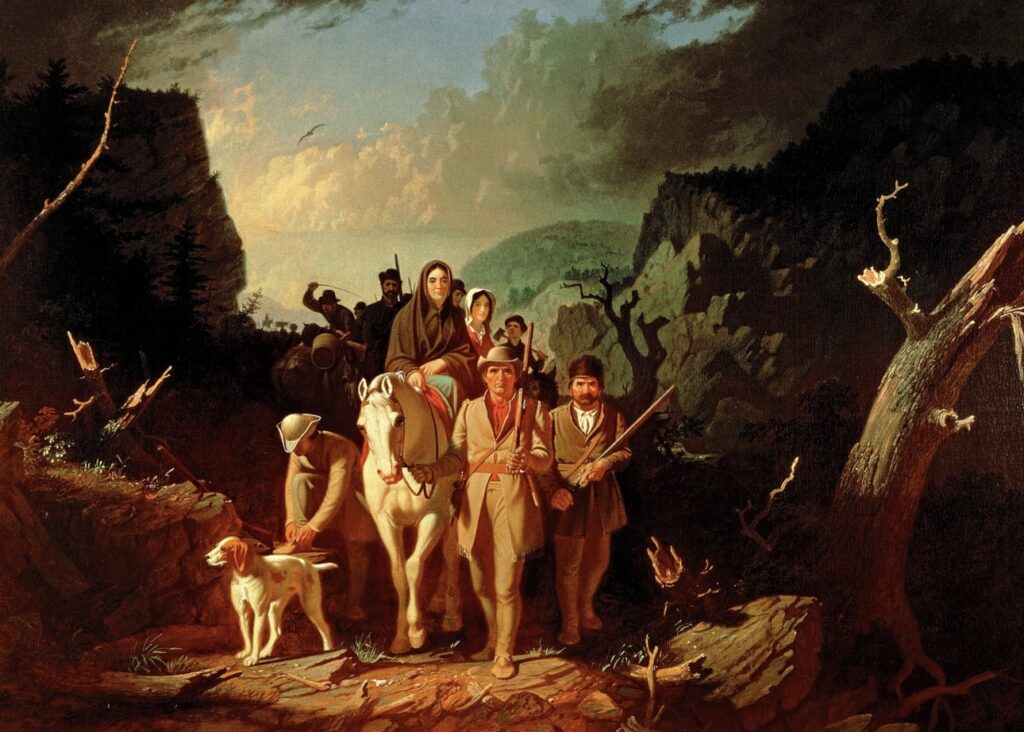
In September 1773, a frontier party led by Daniel Boone ventured west. Boone’s advance party moved along the newly blazed Wilderness Road, a route that followed an ancient native path. Just south of the Cumberland Gap, the Wilderness Route intersected with the Warrior’s Path. Both courses had long been used by the Shawnee, Cherokee, and other Indigenous nations. The Wilderness route cut through the Cumberland Gap, connecting the Ohio Valley to the Carolinas and beyond. These were not merely footpaths, but corridors of trade, diplomacy, and war. For settlers, the route west was a gateway to Kentucky and the promise of a future built on their own determination and hard work. For Native communities, this was sacred hunting ground and a vital artery linking their homelands.
Note – Interstate 81 (I‑81) roughly follows the path of the Great Indian Warpath (or Warrior’s Path) for much of its length through the Appalachian Valley.
South of the Cumberland Gap on Wallens Creek near the confluence of the Warriors Path, a rogue party of Native warriors ambushed a smaller trail party that included teenagers James Boone and Henry Russell.[1] Contemporaries believed the attackers were young men acting without sanction. Regardless, it was a terrible and brutal slaughter, born of seething hatred rather than military strategy. In the morning, frontiersman William Russell came upon the remains of his son and those of many of his party, including James Boone. The young men who had been youthful and eager to prove themselves the day prior had been mutilated.
Reports soon circulated that the boys had not only been killed but tortured. In a time when scalping, practiced by both settlers and Native warriors, was already a symbol of frontier brutality, the details of the torture inflicted struck a more resounding, visceral chord.
Word of the murders spread quickly through frontier settlements. Newspapers in Baltimore and Philadelphia carried the story, and frontier communities reacted with fear, outrage, and a rising demand for protection.
Bald Eagle
Around the time of the Boone–Russell party murders, a Lenape man was seen drifting alone down the Monongahela River in a canoe. At first glance, the scene appeared ordinary, just Chief Bald Eagle, a well-known figure in the region, floating downstream in his own craft. But it was not an ordinary sight.
The canoe came ashore near the mouth of George’s Creek, where a woman named Mrs. Province noticed immediately that something was wrong. Bald Eagle had been murdered, scalped, and propped upright in the canoe, his hat placed carefully back on his head to give the illusion of life. The staging was deliberate—a final act of mockery as much as mutilation. Local settlers, disturbed by what they found yet fearful of returning him to his people in such a state, buried Bald Eagle according to their own customs.[3]
Nineteenth-century historian Alexander Scott Withers later named the murderers as Jacob Scott, William Hacker, and Elijah Runner.[4] Yet Bald Eagle’s death, like Withers’s account of the Bulltown Massacre, rests on oral tradition rather than surviving primary documentation. Withers also attributed the Bulltown killings to Hacker, while other accounts place blame for Bald Eagle’s murder on a violent drifter named John Ryan. These conflicting attributions underscore the difficulty of assigning individual guilt in a frontier world where violence was frequent, records were sparse, and accountability was rare.
What is widely accepted, however, is the pattern. In late 1773 and early 1774, unprovoked attacks against Native individuals increased along the Monongahela and Ohio tributaries. Whether or not Scott, Hacker, and Runner were responsible for Bald Eagle’s death, the killing itself fits a broader landscape of targeted violence that rarely resulted in punishment.
According to Withers and Daniel Rupp, a suspect identified as William White was at one point arrested and taken to Winchester, Virginia, the principal jail for the western counties, to stand trial. Before proceedings could begin, a mob forced open the jail and freed him. Withers further notes an earlier incident in which a crowd of two hundred men similarly liberated individuals accused of murdering Native people.[5]
This was not an aberration. In examining the 1768 murder of ten Native people, two of them children and one an infant, by Frederick Stump and his associate John Ironcutter, historian G. S. Rowe demonstrated the same outcome: escape from meaningful punishment despite overwhelming evidence. Rowe concluded bluntly that “no white jury would convict one of their own of murdering an Indian,” a sentence that captures the racialized legal impunity of the backcountry with devastating precision.[6]
Native vs Settler – Preemptive Retaliation
Long before the Ohio River Valley erupted into open war, the frontier had already learned how to interpret violence.
Is it a coincidence that in July 1763, during Pontiac’s War, Native war parties attacked the homesteads of another William White along the Juniata River as well as that of Robert Campbell near the Tuscarora Path? Not an uncommon name even then, after all. Families occupied both cabins, and neighbors gathered to rest during the summer harvest. Few survived. Word spread quickly that other nearby cabins had also been targeted.
These weren’t isolated incidents; they were coordinated ambushes carried out in moments of everyday life. The attacks claimed the lives of men, women, and likely children. This phase of Pontiac’s War became marked by mutual violence, though contemporary accounts especially emphasized the dismemberment and murder of settler families. Some scholars interpret these raids as preemptive retaliation, acts of resistance against colonial expansion, and a response to British military policy following the French and Indian War. They were responses to the steady pressure of settlers crossing into Native lands, forcing Native communities to strike first or risk being overrun.[7]
But such explanations, however valid from a geopolitical lens, would have offered little consolation to the grieving settler families left behind. The logic of resistance rarely eases the sting of personal loss.
When you trace these stories to their source, it gets harder to tell who started what, but easier to understand why the violence continued.
The Jonesborough Murder
“lurked in the area where the race was run; and in the evening, seizing a fitting opportunity, attacked and killed one of the Indians — an act then considered ‘heroic’ in that era of barbarous habits, when the un-instructed white man knew no other guide for his actions than the approval or condemnation of common opinion and prejudice” [8]
Isaac Crabtree, one of only two survivors from the Russell massacre [9], escaped with his life but not his peace of mind. The following spring, at a treaty festival in Jonesborough, Tennessee (then part of North Carolina), Crabtree spotted a Cherokee man whom lore says he believed had taken part in the massacre. As the horse races went on nearby, he drew his weapon and shot the victim dead. The unprovoked murder threatened to plunge the frontier into war. The festival had been held in celebration of recent land negotiations with the Cherokee for land along the Watauga. To their credit, the Cherokee were able to restrain their community from retaliation, but tension on the frontier deepened.
In Crabtree’s shot at Jonesborough, the frontier’s cycle of vengeance found its most intimate expression — grief turned reflexively into retribution. Retribution, as usual, fell not on the guilty, but those who opportunity had placed in the assailant’s path. Did it matter who took the brunt of vengeance so long as it was delivered? Acts like Crabtree’s shooting at Jonesborough showed how quickly grief curdled into vigilantism. By the following spring, that impulse would erupt on the Ohio.
Jonesborough illustrated how, in spaces where courts were distant and memory was personal, violence became its own form of adjudication.
The Paxton Boys and Sanctified Violence
In the winter of 1763, frontier violence in Pennsylvania crossed a line that could not be quietly walked back.
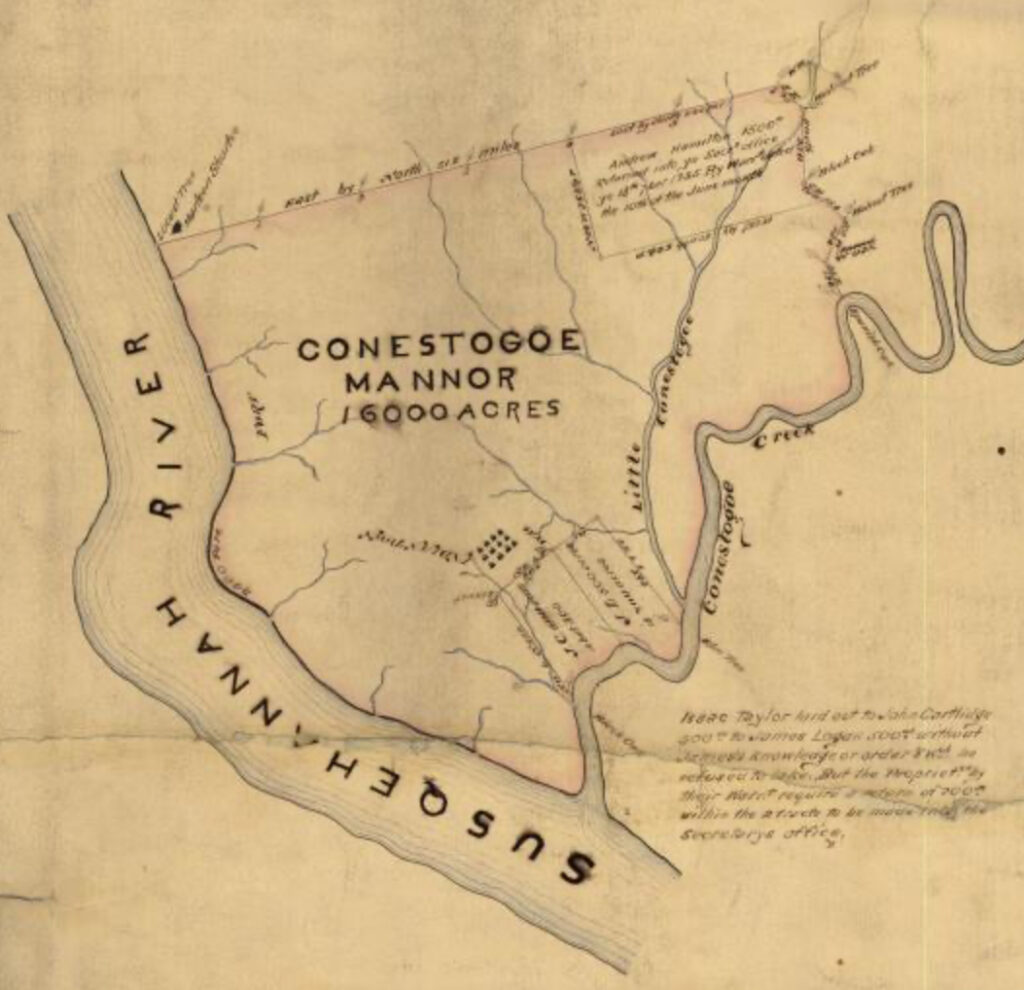
The Conestoga had no record of aggressive or defensive action against Anglo-European settlers. From the outset of Pennsylvania’s colonial project, they maintained peaceful relations, welcoming the Penn family and early settlers with gifts of food and trade. Assigned lands on Conestoga Manor, they lived under colonial protection as their population slowly ebbed—until only twenty remained.
Acting on rumors that the peaceful Conestoga were harboring and working with hostile Native fighters, more than fifty settlers from Paxton and Donegal townships stormed Conestoga Manor, murdering six in their beds before disfiguring the bodies and burning the community. The remaining fourteen members of the tribe had been away, selling their handmade wares to neighboring Anglo-American communities, at the time of the mob attack
Nearly two weeks later, a second mob of more than fifty men again assembled and stormed the Lancaster workhouse, where the remaining Conestoga had been placed for their own protection.
“When the poor wretches saw they had no protection nigh, nor could possibly escape, and being without the least weapon for defence, they divided into their little families—the children clinging to the parents. They fell on their knees, protested their innocence, declared their love to the English, and that, in their whole lives, they had never done them injury; and in this posture they all received the hatchet. Men, women, and little children—were every one inhumanly murdered—in cold blood.” Extract from pamphlet, Conduct of the Paxton-Men, Impartially Represented (Philadelphia, 1764) [11]
Those killed included Shehaes, the elder leader who had loyally served the Penns for decades; his daughter, Peggy, and her Cayuga husband, John Smith; their young toddler; the brothers George and Will Soc; Betty and her son; and others whose names survive only because Benjamin Franklin took the time to record them. In the space of minutes, an entire remnant community, one that had lived under colonial protection for generations, was erased.
The killings were not secret, nor were they followed by meaningful punishment. What followed was public debate, pamphlets, and marches that forced the colony to confront how far fear could stretch the boundaries of law. John Elder, a fiery Presbyterian minister known to preach with a firearm within arm’s reach, publicly defended the killings through sermons and pamphlets, framing them as defensive acts forced upon settlers by the failure of colonial authorities to provide protection. For many on the frontier, Quaker protection of Native peoples became evidence that the colony’s eastern leadership was willing to sacrifice its western Presbyterian subjects.[12]
Violence was not new to Pennsylvania’s frontier by 1763, but the Paxton Boys marked something different. Their killings were neither isolated nor hidden, neither spontaneous nor denied. They were carried out openly, defended publicly, and shielded from punishment by popular support. In that sense, Paxton stands as Pennsylvania’s first outrage—not because blood had never been spilled before, but because violence there crossed the line from transgression into justification.
Conclusion
Though separated by a decade, these incidents belonged to the same frontier world—one where law lagged behind settlement, rumor outran authority, and violence trained people how to think before it taught them how to fight. By the time blood was shed at Yellow Creek, both settlers and Native peoples understood that restraint would go unrewarded, and grievance would travel faster than justice.
Notes & Citations
[1] There are many versions of why the party was separated from the larger party and who discovered the remains. I chose to retell the version that was released in a newspaper of the period.
The Pennsylvania Gazette, January 4, 1774, p. 3. Historical Newspapers from 1700s–2000s. Newspapers.com. Accessed July 4, 2025. https://www.newspapers.com/image/39405965/
[2] George Caleb Bingham. Daniel Boone Escorting Settlers through the Cumberland Gap. 1851–52. Oil on canvas. Washington University Art Museum, St. Louis.
[3] I. Daniel Rupp, Early History of Western Pennsylvania: and of the West, and of Western Expeditions and Campaigns, from MDCCLIV to MDCCCXXXIII (Pittsburgh and Harrisburg, PA: D. W. Kaufman and W. O. Hickok, 1846), 182, Digital edition, University of Pittsburgh Library System, Darlington Digital Library.
[4] Alexander Scott Withers, Chronicles of Border Warfare, ed. Reuben Gold Thwaites (Cincinnati, OH: The Robert Clarke Company, 1895), 135.
[5]Withers, Chronicles of Border Warfare, 135-136. Rupp, Early History of Western Pennsylvania: and of the West, and of Western Expeditions and Campaigns, from MDCCLIV to MDCCCXXXIII. 180.
[6] G. S. Rowe, “The Frederick Stump Affair, 1768, and the Problem of Frontier Disorder,” Pennsylvania History 36, no. 4): 256.
[7] See Gregory Evans Dowd, War under Heaven: Pontiac, the Indian Nations, and the British Empire (Baltimore: Johns Hopkins University Press, 2002), especially Chapter 3, “Wider War.” Dowd argues that Native attacks during Pontiac’s War were not senseless outbreaks of savagery, but strategic efforts to push back against British fort-building, land surveys, and settler encroachment.
[8] John Haywood, The Civil and Political History of the State of Tennessee from Its Earliest Settlement up to the Year 1796 (Nashville: W.H. Haywood, 1891 [orig. 1823]), 56.
[9] The other survivor was an enslaved man called Adam, who, in some versions, was taken captive and later adopted into a Native community. The massacre of Boone and Russell’s sons, as well as those in their party, is often called either the Russell or Boone massacre. William Russell, Henry’s father, was a famed frontiersman and politician who was more well-known at the time than Daniel Boone.
[10] Map of Conestoga Manor, 1764. ExplorePAHistory. Accessed December 9, 2025. https://explorepahistory.com/displayimage.php
[11] “A Narrative of the Late Massacres, [30 January? 1764],” Founders Online, National Archives, https://founders.archives.gov/documents/Franklin/01-11-02-0012. [Original source: The Papers of Benjamin Franklin,vol. 11, January 1, through December 31, 1764, ed. Leonard W. Labaree. New Haven and London: Yale University Press, 1967, pp. 42–69.]
[12] “Paxton Boys, The Apology of the Paxton Volunteers of 1764, Am.283, reprinted in “Apology (edited),” HSP Digital Library, accessed December 9, 2025, https://hsp.org/sites/default/files/attachments/apology_edited.pdf.
For readers who wish to follow ongoing research, subscription is available in the footer.