Michael Cresap was born on the frontier, and had America’s war of rebellion not intervened, he would almost certainly have died there too. For more than 250 years, his name has echoed in the histories of the Ohio Valley—sometimes as a pioneer, sometimes as a villain.
During the 2025 American Historical Association Conference in New York City, I slipped away for a quiet detour to Trinity Church to visit his grave. The stone there is a replica—the original long removed to protect it from weather and curious hands. Gravestones are their own kind of primary source, records in stone meant to anchor memory in place. Trinity’s yard holds many such anchors: Hamilton rests here, and the church itself stood in the shadow of the World Trade Center on that terrible morning in 2001. Few places in America gather so many layers of history in a single square of ground.
Michael Cresap was not responsible for the Yellow Creek Massacre. I won’t be making that case here, not because it lacks intrigue, but because it lies outside the scope of my narrative. For readers interested in that line of inquiry, Robert Parkinson’s Heart of American Darkness: Bewilderment and Horror on the Early Frontier is a masterwork that traces the question in depth. While I often linger over the historiography of “historical facts,” for the rest of part III I intend only to dissect what occurred during those fractal days of late April 1774.
A Legacy of Frontier Violence
Michael Cresap was born into a frontier defined by bitter rivalries, violent skirmishes, and contested boundaries. His father, Thomas Cresap, had been a key figure in Maryland’s border dispute with Pennsylvania known as “Cresap’s War” (1730s). In a way, Michael Cresap inherited a world shaped by his father’s fights and grudges. Like the children of soldiers who follow their parents into service, Cresap came from a frontier class that passed down not only skills but a worldview. He also inherited the reality that their legacy was one of loss, his older brother Thomas was killed in 1756 during a attempted raid on a Native community near Fort Cumberland.
The year 1756 marked a particularly brutal phase of the Seven Years’ War in North America, when Pennsylvania’s colonial government actively promoted carrying the war into Native settlements. In January, Pennsylvania offered a reward of 700 pieces of eight for the heads of Shingas and Captain Jacob’s, Native leaders known for raiding colonial settlements. Pennsylvania. A few months later, Virginia began offering rewards for scalps as well as prisoners. The reward was payable to members of allied Native tribes and colonists alike. Records suggest that only eight scalps were purchased by Pennsylvania, and that Daniel Cresap, possibly Michael’s older brother of the same name, was paid for two scalps.[2]
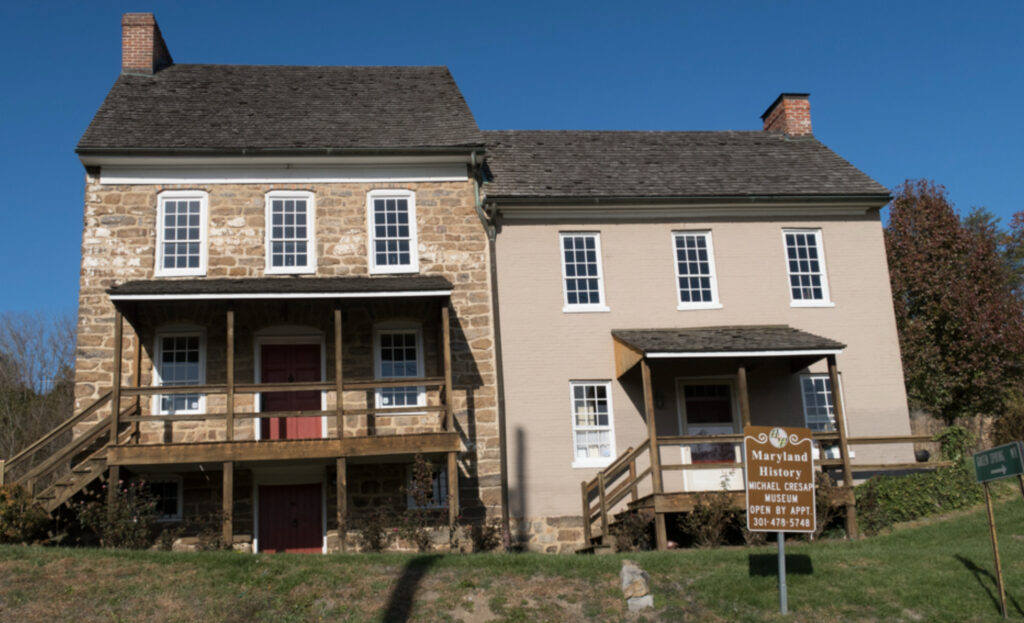
By 1774, Thomas Cresap was well established on the Potomac at Oldtown, Maryland, while Michael maintained a house nearby. As a child of the Seven Years’ War, Cresap had grown up amid conflict. However, despite the family’s reputation for frontier violence, Michael Cresap’s own life reflected the complex relationships of a borderland where Natives and settlers interacted daily. The Cresap family had long-standing ties to the Lenape Turtle Clan, specifically the Fish subclan of the Unami division, through their relationship with Chief Nemacolin.[3] Some family and Lenape-lineage sources claim that Lonacona (also called George Washington Cresap), a relation of Nemacolin, relocated his wife and children to live near the Cresaps’ due to his friendship with Daniel Cresap, and is buried in the family cemetery in Rawlings, Maryland
Far from the “Indian fighter” of later lore, the younger Cresap built his early reputation as a trader. By 1774, he had run stores in Oldtown and Redstone Fort. The problem he had was settlers kept buying on credit as they moved west, but were not returning east to pay their debts to him. Massively in debt, he turned his own attentions toward land speculation. [4] To achieve success in that endeavor, he would have to move farther west than any Cresap before him.
A Moment’s Counsel
A messenger was sent upriver, requesting that Michael Cresap support the would-be settlers who were still holding their position at the mouth of the Little Kanawha. The mouth of the Scioto River was on the Kentucky-bound group’s pre-chosen path, but no one in the party was as experienced with warfare against Native peoples as the speculator just fifteen miles away.
Cresap arrived to find the settlers restless, their tempers sharpened by fear and rumors. Many were eager to take immediate action in Shawnee country, convinced that preemptive action was their only hope. Cresap, though no stranger to frontier conflict, urged restraint.[6] If war hadn’t already begun, an attack on the Shawnee communities along the Scioto would surely ignite one. His words carried weight, not only as a trader and land speculator but as a son of the backcountry, and these frontier initiates gave him their respect. He advised that the settlers retrace their steps upriver and encamp at Wheeling for a period to see if Native tribes actually were intending to wage war.
As the group journeyed upriver toward Wheeling, Clark recorded that the party crossed paths with a small hunting party led by the Lenape Chief Killbuck. The group attempted to question the Lenape and the Shawnee’s intentions, but understandably, Killbuck could not provide them with the conclusive answers they desired. Michael Cresap remained on the other side of the river during the conversation with Killbuck. This fact would be presented as proof of his innocence of later charges that he set out to start a war from the get-go.
The Killbuck Cresap grew up hearing about was Captain Killbuck, or Bemino—the elder Lenape war leader who initially courted British alliance but later turned against colonial settlers as encroachment intensified. This was not the later William Henry Killbuck, the Christianized Lenape diplomat of the Revolutionary era, but his grandfather. Captain Killbuck (Bemino) had fought alongside the French during the Seven Years’ War and remained one of the most formidable Lenape figures of Cresap’s youth. Colonial records from the late 1750s routinely mention him within a circle of Lenape leaders grappling with the volatile politics of rum trading, land cessions, and frontier violence involving both the French and the British. His name still carried weight in the Ohio Valley when Cresap came of age—enough that young Michael Cresap inherited both the fear and hostility his father bore for the man.
Michael Cresap was open about the special enmity he held against Killbuck for the former’s past hostilities against his father. At one point in the younger Cresap’s childhood, Killbuck had sworn to kill Thomas Cresap and, according to frontier accounts, even camped near the Cresap home for days, waiting for the chance to carry out his threat. Frontier accounts suggest that had the two men finally met, Cresap might have felt compelled to strike first, given the long-standing hostility between them, thus he chose to stay on the other side of the river.
The Hero of the Moment, the Villain Forevermore
If you look closely, Michael Cresap should have been the hero of this story. From the testimony of George Rogers Clark, despite being given decades later, it’s clear that Cresap defused a situation that could have spiraled into all-out war. It was the right move, measured and prudent, aimed at avoiding unnecessary bloodshed. But neither fate nor history is fair. History is a poor steward of nuance. What a person prevents rarely enters the record, but what they are rumored to have done becomes the record.

A Dire Missive
The fledgling frontier town erupted with nervous energy when the settlers reached Wheeling. Rumors of attacks, reprisals, and open war swirled up and down the Ohio. According to George Rogers Clark’s 1798 letter to Samuel Brown, Dr. John Connolly sent word from Fort Pitt advising the settlers to stay put while he contacted local Native leaders, a sensible plan. Yet Clark claimed a second message soon followed, reporting that Connolly had received word back that war was “inevitable.”[7]
Neither Connolly’s May 1774 letter to George Washington, his journal, nor his 1783 memoir records any such warning. Connolly’s circular of April 20 warned that the Shawnee were “ill-disposed” and might cause “mischief,” even as it cautioned settlers not to mistreat peaceful Natives.[8] The contrast between Clark’s later recollection and Connolly’s surviving papers is striking. There is no evidence he ever sent a message declaring war inevitable—only Clark’s much later claim that he did.
If Connolly truly declared war inevitable in late April, it would mark an abrupt reversal from his attempts to calm tensions. His correspondence from both April and May describes unrest, but not a formal declaration of hostility. Clark’s 1798 account, written decades later, reflects the post-Revolutionary narrative that cast Dunmore and his agents as the architects of war. The documents we have show a man trying, however inconsistently, to hold the line: warning settlers against mistreating peaceful Native Americans while acknowledging growing unease along the river. The supposed “inevitable war” letter reads like a product of memory reshaped by the Revolution, when Connolly’s later loyalty to the Crown made him an easy target for blame.
The idea that Connolly suddenly sent a dire missive declaring war “inevitable” survives mainly because it fit a later American desire for villains. A British lord and a loyalist doctor made easy symbols of imperial deceit. It was a story too satisfying to question, a way to turn a chaotic border war into the deliberate design of empire.
What really happened that day remains uncertain. The simplest explanation is that Connolly’s circular of April 20, warning that the Shawnee were “ill-disposed” and urging settlers not to mistreat friendly Natives, finally reached Wheeling around April 26. The circular’s tone, urgent but not martial, could have been misinterpreted by anxious men waiting for direction.
Beyond that, there is no surviving evidence to explain why Cresap and the others abandoned caution. The river towns were on edge, rumors thick as the morning Ohio River fog, and fear often moves faster than orders. Whether sparked by misunderstanding, vengeance, or sheer panic, I suspect what actually led to the first shots on the Ohio that April will remain one of the many silences history refuses to fill.
Whatever the case, any attempts at peace were now elements of the past because just as word rang out that Native canoes were descending downriver towards Wheeling.
Conclusion
Cresap’s story captures a truth older than the Ohio frontier itself—that fear can undo reason faster than any bullet. He tried to hold back a current already moving, and when it swept past him, it carried his name downstream. Later generations would remember him as the man who initiated Dunmore’s War, but the truth is more modest and somber: he was one of the last to believe it could still be avoided.
Notes and Citations
[1] A lot of sources mistakenly credit Michael Cresap for Cresap’s War; kind of, he was so ambitious for battle that he started a war before the events on the Ohio, but he wasn’t even born yet… Throughout this research, I’ve repeatedly purchased or borrowed books from university libraries, only to find that they perpetuate the same false narratives. That’s been the dominant theme of this entire series. So question everything—especially me. I’m not special.
[2] Henry J. Young, “A Note on Scalp Bounties in Pennsylvania,” Pennsylvania History: A Journal of Mid-Atlantic Studies 28, no. 4 (October 1961): 380–384, https://journals.psu.edu/phj/article/download/22543/22312/22382. 209 & 211.
[3] The Lenape were organized into three divisions—Unami, Munsee, and Unalachtigo—and were further divided into clans, such as the Turtle, Wolf, and Turkey clans. The Fish clan represented a smaller kinship branch within the Turtle clan.
[4] Luther Martin to Thomas Jefferson, February 3, 1798, Founders Online, National Archives, https://founders.archives.gov/documents/Jefferson/01-30-02-0049.
[5] Pubdog. 2011. Michael Cresap House, Oldtown, Maryland, December 2011. Photograph. Wikimedia Commons. Public domain. Accessed July 5, 2025. https://commons.wikimedia.org/wiki/File:Michael_Cresap_House_Dec_11.jpg.

[6] Clark, George Rogers. George Rogers Clark Papers, 1771-1781. Ed. with introduction and notes by James Alton James. Edited by James Alton James. Springfield, Ill: Illinois State Historical Library. 6. https://archive.org/details/collections08illiuoft/page/n13/mode/2up
[7] Clark, George Rogers. George Rogers Clark Papers, 1771-1781. Ed. with introduction and notes by James Alton James. Edited by James Alton James. Springfield, Ill: Illinois State Historical Library. 7. https://archive.org/details/collections08illiuoft/page/n13/mode/2up
[8] John Connolly. “A Narrative of the Transactions, Imprisonment, and Sufferings of John Connolly, an American Loyalist and Lieut. Col. in His Majesty’s Service.” The Pennsylvania Magazine of History and Biography 12, no. 3 (1888): 310–24. http://www.jstor.org/stable/20083271. Connolly, John. “Journal of Captain John Connolly.” NYPL Digital Collections, April-May 1774. 2. https://digitalcollections.nypl.org/items/045855b0-3ca5-0134-558b-00505686a51c.
For readers who wish to follow ongoing research, subscription is available in the footer.