Word spread quickly that the levee of anger and unrest amongst the land’s Indigenous Nations had eroded, and all those who lay in the path of vengeance risked their lives and those of their family. Not everyone who had made the journey beyond the Alleghenies was like the Boones or Russells. These were not first families looking to tame the wilderness, no matter the cost. Many families had simply sought to move their families beyond the grasp of governing civilization with its laws, taxes, and other obligations. A livelihood of hunting, trapping, and living off the commons sounded better than living to enrich some eastern landlord. What’s more, they made the journey to secure a lineage, lands, and other assets, so their children and their children would have a chance at something lasting.
What they hadn’t signed up for was the possibility that a single raid could erase their family, most murdered, with the few left alive carried off into another world. Fear was not abstract; it tore at the fragile circles of belonging that families had built west of the mountains.
Fear on the Clinch
By May 7th, William Russell reported to Colonel William Preston that, upon returning from Williamsburg, he found the upper Clinch River plantations “totally” evacuated.[1] The panic had spread so quickly that he was forced to employ four runners to go from farm to farm, urging whoever remained to desist from leaving. In addition, the scouts were charged with assuring that everyone in the area knew not to trespass on or across the Louisa River into Cherokee territory. (The Louisa River, ie, the modern Kentucky river, was the boundary between the Cherokee and the Virginia Colony)
Russell’s correspondence makes clear that he considered the Clinch and Holston rivers under his protection. The exodus of settlers from these valleys was more than a local matter; it was a collapse of the frontier line.
Two days earlier, George Washington noted in his diary that frost had crept in and killed most of his garden, an inconvenience for a plantation owner on the Potomac’s lowlands.[2] But the Clinch and Holston settlements sat far higher in elevation, in narrow valleys and ridges where cold air pooled at night. A killing frost in tidewater Virginia meant an even sharper chill in the mountains. Families fleeing upriver slept in open boats or beneath makeshift lean-tos, the damp cutting through thin blankets. Large fires would only have drawn attention. What was for Washington an agricultural setback was, for the evacuating backcountry families, a night spent listening for war cries in the dark while their shivering children huddled beside them.
Within three weeks, Preston’s own orders would echo Russell’s concerns, issuing explicit instructions to his captains to keep settlers from leaving. “I shall… exert myself in keeping the people from abandoning their settlements,” Capt. Daniel Smith responded from Indian Creek, “and trying to make them punctually obey orders.” Yet Smith warned that a more basic danger loomed: “one half the people could not raise five charges of powder.”[3]

William Preston
Colonel William Preston emigrated from County Donegal, Ireland as a child. He was no Tidewater aristocrat but part of the Ulster Protestant migration that pressed through the Valley and over the mountains—people bound by clan ties, stubborn independence, and suspicion of distant authority. Kinship ties secured his first step onto the colonial stage in the early 1750s as secretary to Virginia’s treaty commissioners at Logstown, where he witnessed the uneasy mix of diplomacy, gift-giving, and territorial scheming that defined the Ohio Country. That education in frontier politics shaped his later career as a surveyor, militia officer, and political broker.
In the wake of the 1755 frontier crisis, including the Draper’s Meadow massacre, Governor Dinwiddie commissioned Preston as captain of the Augusta County Rangers. He rose to the rank of major and then colonel, commanding ranger detachments assigned to defend frontier forts and leading expeditions such as the Sandy Creek expedition. These roles cemented his place as a central figure in Virginia’s defensive posture.
By 1773, Preston had served successive terms in the House of Burgesses and emerged as both principal surveyor and county lieutenant of the newly formed Fincastle County.
For all the talk of guns and forts, the true instrument of power in the backcountry was the surveyor’s chain. William Crawford, whose position as surveyor came through George Washington’s politicking with the College of William and Mary, acted as Washington’s field agent in the Ohio Valley, staking out speculative tracts for his patron and fellow veterans. His plats advanced private ambition, but they lacked institutional weight. Preston, by contrast, held a formal commission as county surveyor, with jurisdiction that stretched across modern Virginia, West Virginia, and Kentucky. That office gave him the legal authority to turn wilderness into taxable parcels, to legitimize titles, and to fix Virginia’s sovereignty west of the mountains. Washington and men like him relied on Crawford to plant claims; they relied on Preston to make them stick.
Preston’s authority extended beyond surveys. As county lieutenant, he was technically the top militia officer, appointing captains and directing musters of every able-bodied man. But in a region where land titles were often uncertain and settlers came and went freely, enforcement was weak and desertion common. In 1774, authority on the frontier meant persuasion as much as command. The dream of Anglo-European civilization, and the freedom of land ownership, depended on men willing to stay and hold the line. Preston had to make that dream feel worth defending.
Forting In
“It is lamentable to see the multitudes of poor people that are hourly running down the country; such of them as stay, are building forts.” [4]
The settlers who remained while so many others fled lived in a precarious balance. Settlers heard that war parties were in the woods, but they did not yet see Logan as the singular threat he later became in popular memory. At the time, danger was understood as a collective Shawnee and Mingo response to Yellow Creek, not the calculated pursuit of one man. At the end of May, Chief White Eyes of the Lenape returned from his peace-seeking mission to the Shawnee. He assured colonial leaders his people would stand by their alliance with the British. However, he counseled, some among the Shawnee were set on the path to war. Colonial records note that Shawnee from Woakatameka were engaged in hostilities by May 1774. [5]
By summer, as the colonies buzzed with talk of the Boston Tea Party, several new forts rose along Virginia’s southwestern frontier. Fort Culbertson, following Preston’s orders for “a small stockade fort. Further north at Wheeling, the colony built Fort Henry (then called Fort Fincastle) to guard the Ohio crossing, while in the Clinch River region, Elk Garden Fort served as a rallying point for settlers in the upper valley. In total, Dunmore ordered the construction of at least seven forts that year, several along the lower Clinch under Capt. William Russell’s command, each serving as both a deterrent and a refuge, as the frontier braced for war.
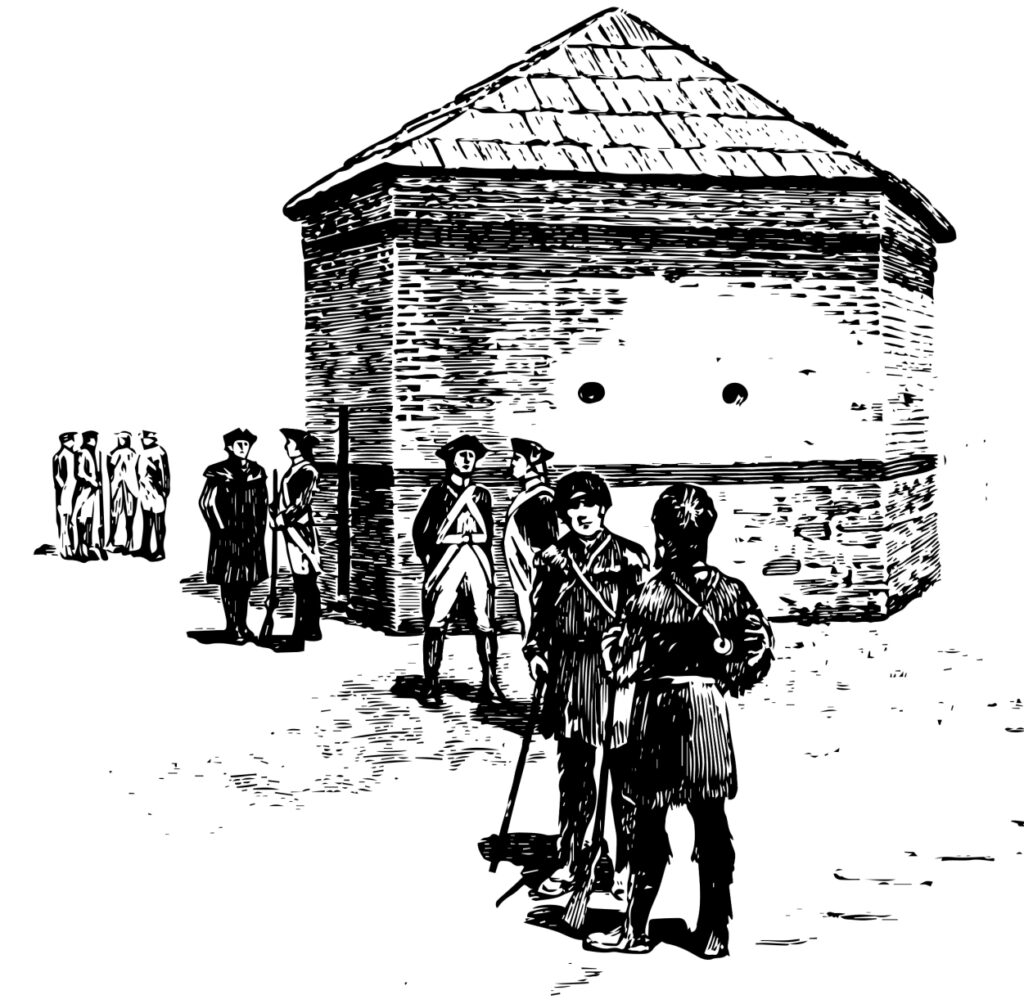
Alongside these official works were numerous private blockhouses, fortified cabins built by extended families or tight-knit neighbors. Such privately built fortifications were, in many ways, more traditional on the frontier than militia-constructed forts. Whether fort or blockhouse, these were almost always made of logs with wooden-shingle roofs. In 1756, Fort Granville’s defenses were undone when attackers set fire to its roof, but this was the exception rather than the rule. Fire was a known risk, yet it was not the dominant strategy used against settlers who had shut themselves up in these wooden strongholds.
The Rev. Joseph Doddridge, who grew up on the Virginia–Pennsylvania frontier, later recalled that families “seldom moved into their fort in the spring until compelled by some alarm… when it was announced by some murder that the Indians were in the settlement.” When the warning came, “the whole number of families belonging to a fort,” moving in the dark without light, carrying children, food, and clothing in silence. Care was taken not to wake the youngest children, lest they cry. While some families slipped back home once the alarm faded, others stayed until the danger truly passed. In troubled times, such as in 1774, families might spend every night in the fort, or even remain for days at a stretch.[6]
Forts to include blockhouses were not only critical rallying points during alarms but also the cultural centers of the area. In the clan-centered communities of the backcountry, they were as much symbols of self-reliance as they were defensive measures. Preston’s militia captains often incorporated these into their patrol routes and, in some cases, counted them as part of the county’s protective network.
Appalachia
By the summer of 1774, the mountain settlements along the Clinch and Holston had learned that survival depended on more than rifles and fortified walls; it depended on each other. Family groups who “forted in” together forged bonds of obligation that went beyond kinship. Everyone knew who spread the word of possible danger, who had shared powder and flour, and who had quietly slipped away when danger came.
The Appalachian Mountains take their name from the Apalachee, a mound-building people of northern Florida known to the Spanish long before English settlement pushed into the interior. Appalachia, as a named cultural region, did not exist in the eighteenth century These were not yet “Appalachians” in name, but the foundations of that identity were being laid. Scots-Irish clan traditions mixed with Native knowledge of the land, creating small, tight-knit communities that could withstand hardship. In such places, belonging was earned in moments of trial. Those who failed to stand with their neighbors were remembered just as surely as those who did.
In Appalachian communities shaped by frontier crises, belonging was not something one claimed; it was something others recognized, often across generations. Where a person came from, and whether their people had stood fast in earlier trials, mattered, and still does.
Conclusion
By the first weeks of June, fear had ceased to be speculative; war had already begun.
Notes & Citations
[1] Reuben Gold Thwaites and Louise Phelps Kellogg, eds. Documentary History of Dunmore’s War, 1774. Madison: Wisconsin Historical Society, 1905. https://babel.hathitrust.org/cgi/pt?id=uc1.b3624547. 19-20.
[2] Diary entry: 5 May 1774],” Founders Online, National Archives, https://founders.archives.gov/documents/Washington/01-03-02-0004-0010-0005. [Original source: The Diaries of George Washington, vol. 3, 1 January 1771–5 November 1781, ed. Donald Jackson. Charlottesville: University Press of Virginia, 1978, p. 253.
[3] Thwaites and Kellogg, eds. Documentary History of Dunmore’s War, 1774. 30-31.
[4] Thwaites and Kellogg, eds. Documentary History of Dunmore’s War, 1774. 29.
[5] Thwaites and Kellogg, eds. Documentary History of Dunmore’s War, 1774. 30-31. Peter Force, ed., American Archives: Fourth Series, Volume 1 (Washington, D.C.: M. St. Clair Clarke and Peter Force, 1837), [285], Internet Archive, https://archive.org/details/americanarchives41forc.
[6] Joseph Doddridge, Notes on the Settlement and Indian Wars of the Western Parts of Virginia and Pennsylvania, from 1763 to 1783, Inclusive, ed. Narcissa Doddridge, John S. Ritenour, and William Thomas Lindsey (Albany, NY: J. Munsell’s Sons, 1876).
For readers who wish to follow ongoing research, subscription is available in the footer.
Leave a Reply