July was a peak labor season for agriculture in 1774. Corn required hoeing, and wheat and hay had to be cut and gathered, amongst the never-ending other chores of an 18th-century backcountry farmer. Because food preservation depended on timing, survival required acting in the face of danger rather than escaping it. Yet for the backcountry pioneers of the Ohio Country and its surrounding frontier zones, failing to flee had already been proven to be perilous. After settlers around Wheeling had murdered the Ohio Haudenosaunee, Mingo, kin of James Logan, no non-Native he and his fellow vengeance seekers encountered was safe from his campaign of reprisal.
Captivity on the Muskingum
During times of danger, men often left their families in crowded forts and blockhouses and formed work parties. William Robinson was one such man. With his family safely ensconced, he and two other men were in a field of flax, a crop whose fibers allow only a narrow window for harvest on a warm summer day near the west fork of the Monongahela. Focused on their work, they failed to notice a party of eight Native men, possibly some of them were more youths than men, approaching the field.
Coleman Brown, one of the three men, was shot and killed, but Robinson and Thomas Hellen were both captured. In the legends of the summer of 1774, all attacks committed by Native entities in and around Virginia/modern West Virginia have been attributed to James Logan. Still, we know that, in this instance, he was unquestionably amongst the attackers. During the journey west, Logan communicated with Robinson in English, “to be of good heart, that he would not be killed,” so long as he didn’t attempt to run away.[1] Over the course of the nearly week-long journey to the Shawnee village of Wakatomica, Logan communicated in depth with Robinson.
The subject of Logan’s attention during this time returned again and again to Michael Cresap. The intelligence Logan had received after the murder of his family members and other Ohio Haudenosaunee, at Joshua Baker’s Tavern on Yellow Creek, was that Cresap led the assault. This information was inaccurate. While Cresap is charged with leading other attacks on Native peoples further down the Ohio, he was in no way directly involved with the Yellow Creek attack. Although the fact that John Sappington gifted Cresap, Logan’s brother John Petty’s scalp after the actual attackers met up with Cresap at Catfish Camp, suggests an ideological link.
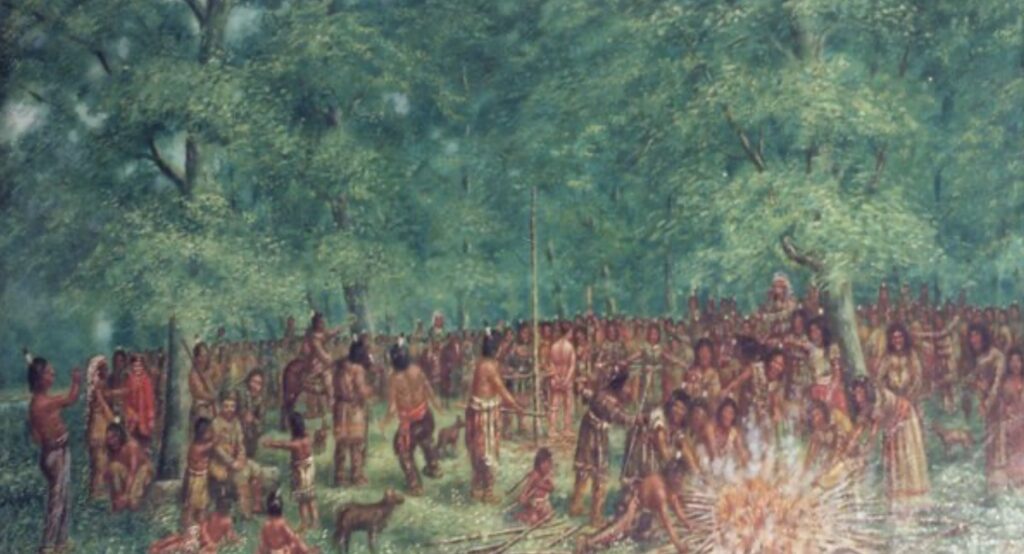
Upon reaching Wakatomica, the prisoners were forced to run the gauntlet, a traumatic event where the men were forced to navigate past assailants armed with clubs and other weapons. The results varied from gauntlet to gauntlet, dependent on tribes and contemporary events, but the severest beatings were reserved for adult men such as Robinson and Hellen. Afterwards, Robinson, severely beaten but alive, was left tied to a stake while the community debated his fate. Many in the community were in mourning and wanted him burned, but Logan urged adoption.
James Logan, often referred to by Anglo-American sources as ‘Logan the Orator’
was one of those individuals whose powerful, persuasive arguments usually impelled others to give way. Finally, as Robertson awaited his fate, Logan arrived to tie a wampum belt around him as a symbol of adoption. Robinson was then led to an elderly woman, whom he was led to understand was now his adoptive aunt. Instead of death, he was to fill the place of one of the Yellow Creek Massacre’s victims.
The Witness
Robinson’s now aunt did not speak English, but he understood her to have communicated that she had been one of the individuals across the Ohio at the time of the Yellow Creek Massacre. She had watched in horror as the Greathouse/Tomlinson party murdered John Petty, his son Molnay, Koonay, and others. Robinson understood that the murderers invited the Ohio Haudenosaunee across the river under the guise of shared alcohol and then, once the guests who partook were in a sedated state, attacked them with tomahawks while murdering the rest with firearms.
“Whenever she entered on this subject, she was thrown into the most violent agitations, and that he afterwards understood that, amongst the Indians killed at Yellow Creek, was a sister of Logan, very big with child, whom they ripped open, and stuck on a pole.”[3]
Robinson’s testimony is the only surviving account of the Yellow Creek Massacre not delivered by the perpetrators. It is, however, not a primary eyewitness account. Rather, it is a mediated narrative, conveyed to Robinson by witnesses whose language he did not speak and preserved through his own interpretation. Robinson’s interpretation provides one of the most horrific images in frontier lore. Through repetition, it has become the defining image of the massacre: Logan’s sister, murdered while huge with child, her body and child mutilated in a way meant to signify total annihilation. That image has endured not because it is well documented, but because it is repeatedly told.
Yet the claim becomes difficult to sustain under scrutiny. Koonay had given birth not long before her death; even if she had conceived again, she would not have been visibly pregnant, let alone “very big with child.” Other accounts describe the only other women present as both beyond childbearing age. What Robinson preserved was not an anatomical fact, but an image of irreversible loss, one that transformed murder into legend and ensured that Logan’s grief would be remembered in the most absolute terms.
John Logan
Three days after the community gathered at Wakatomica had accepted the adoption of the two white men, Logan returned with paper and a form of ink derived from gunpowder. Robinson was instructed to transcribe in a letter what Logan was about to dictate. Logan’s words, as dictated by Robinson,
“ Captain Cresap, what did you kill my people on Yellow Creek for? The white people killed my kin, at Conestoga, a great while ago; and I thought nothing of that. But you killed my kin again, on Yellow Creek, and took my Cousin prisoner. Then I thought I must kill too, and I have been three times to war since, but the Indians are not angry, only myself. Captain John Logan.” [4]
Koonay’s daughter had been taken, by William Crawford’s intervention, from the attackers after the murder of her mother. The infant was being cared for by members of Crawford’s household until her white father, John Gibson, a well-known trader, returned from his downriver trading mission. Logan had no way of knowing that the child was being cared for to be given to kin. Yet, the circumstance of removing Native children from their tribal communities to be raised in the white society of their biological fathers was never, barring extreme circumstances, the best-case scenario. Tribal customs assigned tribal identity maternally. In Native eyes, the child belonged with her Ohio Haudenosaunee kin. Additionally, regardless of John Gibson’s acceptance of his responsibility for the child, white society rarely offered full acceptance to mixed-heritage children, leaving many permanently suspended between cultural worlds. Aside from the fact that Gibson did accept responsibility, nothing is known of Polly’s life; Koonay’s daughter fades from the record almost immediately.
A Child’s Tragic Regret
Modern highways often reveal ancient paths. The route later traced by Interstate 81 is one such route that follows an older geography. Long before asphalt, the valley served as a corridor of movement—first for Native peoples, later for settlers. The Roberts family lived near that corridor. It was hundreds of miles from Wheeling to the Virginia–Kentucky frontier near the landmark known as King’s Mill, where the Roberts family lived. Reedy Creek, a tributary of the Holston watershed, is often described in early accounts as part of the North Fork and joins the Holston River at what is now Kingsport, Tennessee.
When word first went out of an attack on the area, the first assumption was that the Cherokee were the attackers. The distance from earlier Shawnee/Ohio Haudenosaunee violence was assumed to be sufficient defense. That assumption proved fatal. Logan’s attacks reveal that he did not distinguish between those who wielded tomahawks at Yellow Creek and those who benefited from the world that made such violence possible. His war was not aimed at the nearest settlement, but at the structure that enabled it. The very structure that many believe he had once counseled other Native peoples not to go to war with.
John Roberts, his wife Sara, and their five children lived together in their cabin until the night of September 24, 1774. The night before, two enslaved African Americans were taken from a neighboring homestead. On the following night, gunshots cracked across the hills and through the trees. When daylight came, the bodies of John, Sara, and three of their children were found. All had been scalped. An uncle called out the names of the two missing children. One boy answered. He recognized the voice and came toward it. He spoke clearly, but the injury told the rest of the story—a tomahawk blow to the back of the head, the cut driven deep into the skull.
The fifth child, a ten-year-old boy named James, had been taken by the attackers. Major Campbell sent for “an old man that had some skill” to tend the wounded child. The wound did not heal. After a week of suffering, the injured Roberts child died. In his final days, he spoke with a child’s clarity and regret, lamenting that “he was not able to fight enough for to save his mammy.”[5]
Conclusion
William Robinson remained among the Ohio Haudenosaunee and Shawnee until November 1774. By his own account, he was treated well by the community, especially his adoptive family. Robinson carried with him the memory of a community that had murdered Coleman Brown before debating whether his own fate would be death or incorporation. Others were neither taken nor returned. Many were left mutilated to be buried by their own communities. Logan’s reprisals spared neither age nor gender, and few in his path were left untouched by the violence.
By dictating the message, Logan announced both his losses and the violence he believed they demanded. Years later, the post-conflict speech attributed to him, remembered as his “Lament”, would present a more reflective voice to American readers. It was that speech that Thomas Jefferson later reproduced in Notes on the State of Virginia, presenting it as evidence of Native intellectual and rhetorical capacity. Yet whatever power readers found in Logan’s words existed alongside a cycle of violence that had that reached within settler households, including their children.

Notes & Citations
[1] “Statement of William Robinson, 28 February 1800,” Founders Online, National Archives, https://founders.archives.gov/documents/Jefferson/01-31-02-0341. [Source: The Papers of Thomas Jefferson, vol. 31, 1 February 1799 – 31 May 1800, ed. Barbara B. Oberg. Princeton: Princeton University Press, 2004, pp. 397–400.]
[2] Rogers, John. Burning of Colonel Crawford. Engraving from A History of the Indian Wars with the First Settlers of the United States. Hartford, 1851. Public domain. Wikimedia Commons.
[3] “Statement of William Robinson, 28 February 1800,” Founders Online.
[4] Jiobmson’s declaration https://archive.org/stream/americanpioneerm01will_0/americanpioneerm01will_0_djvu.txt
[5] https://archive.org/details/documentaryhist00thwarich/page/218/mode/2up
For readers who wish to follow ongoing research, subscription is available in the footer.
Leave a Reply