Modern Dresden, Ohio, now known for the world’s largest basket, has, at a glance, the quiet charm of a historic small town. Storefronts line its main street, and little in the landscape suggests that this ground once bore witness to one of the frontier’s most perilous dramas. [1] In the summer of 1774, near this very location, William Robinson stood bound to a stake while his Shawnee and Ohio Haudenosaunee captors debated whether he would live or die.
Colonial observers often referred to members of Ohio-based Haudenosaunee communities as “Mingo,” a colonial umbrella term that obscures the complex, multi-origin character of the western Haudenosaunee people. In May of 1774, following the murder of members of Cayuga leader James Logan’s family, it was here along the Muskingum that he launched his campaign of reprisal. Logan occupies an uneasy place in the story of the American frontier. Known in earlier years for his willingness to engage positively with colonial neighbors, the murder of his family in 1774 altered the trajectory of his life and, in many respects, the conflict itself.
That summer, Wakatomika became the place where Colonial Virginia demonstrated its willingness to project an organized military force deep into the Ohio Country. More than a village, it was a strategic nexus. Its destruction signaled that the frontier conflict had entered a phase from which neither side could easily retreat.
Between Refuge and War
In the eighteenth century, expanding colonial settlement pushed displaced Native communities westward. Leaders such as Lenape diplomat Paxinosa helped establish the diplomatic relationships and migratory pathways that made the Ohio Country a gathering ground for people fleeing the pressures of empire.
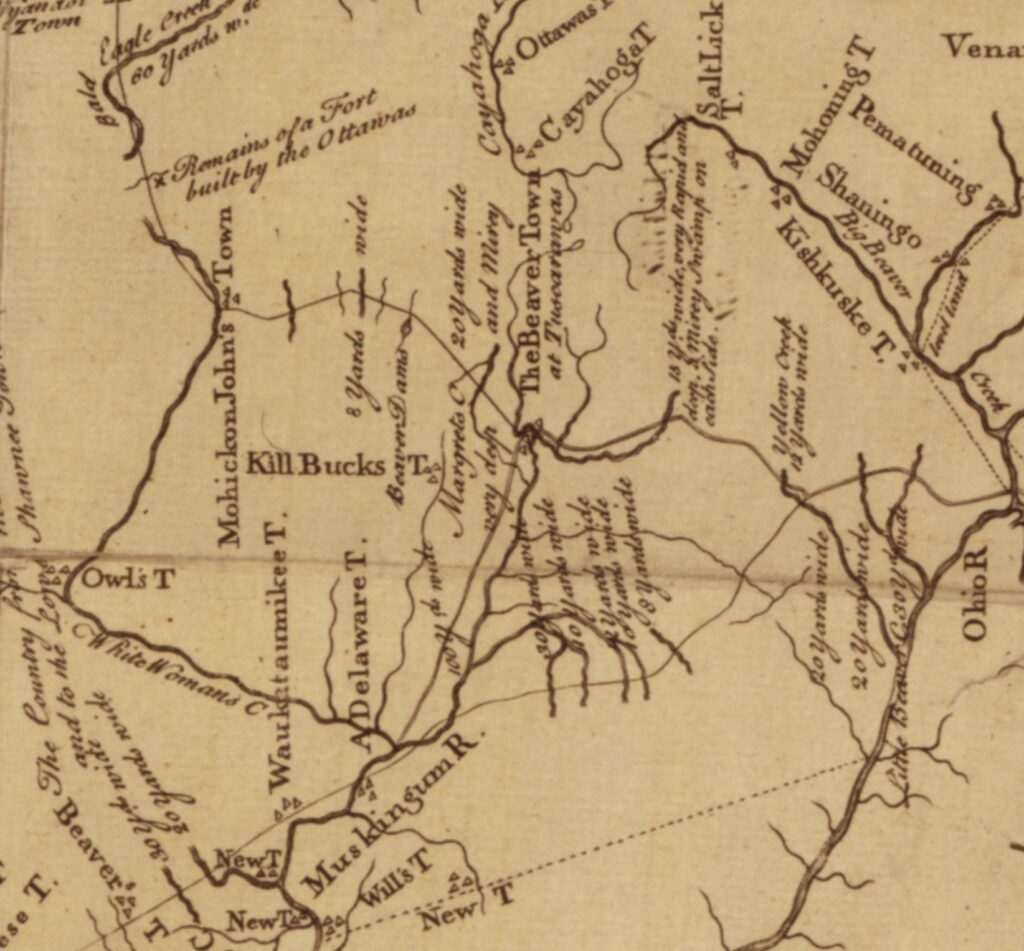
Along the Muskingum and Scioto rivers, migrating families founded new communities that rebuilt kinship and political networks disrupted farther east. The middle valley of the Muskingum River was known for its fertile bottoms and dense forests. Early travelers remarked upon elk paths and buffalo traces drawn to the region’s abundant salt licks. David Zeisberger recorded the name Muskingum as meaning “Elk’s Eye,” a translation that reflected the valley’s long association with abundance.
Colonial observers frequently described Wakatomika as a Shawnee town. When colonials labeled a physical settlement as Lenape, Haudenosaunee, Shawnee, etc., they were often identifying its political center rather than its actual residents. In reality, Wakatomika is called a “Shawnee village” not because it was ethnically homogeneous, but because colonial observers categorized Native towns by the dominant political nation they believed controlled them. Most Ohio Country settlements were multiethnic, confederated communities shaped by migration and displacement. In effect, villages such as Wakatomika functioned as refugee communities where segments of various former eastern settlements retreated, while also acting as trade and diplomatic centers. Such sites could also serve as military staging grounds when conflict demanded it.
By 1774, Wakatomika was already decades old. The settlement occupied a strategic position along routes associated with the Warrior Trail system discussed earlier in this series, part of a wider network of Indigenous travel corridors linking the Muskingum settlements with Shawnee towns in the Scioto Valley.[3] Moravian missionary David Zeisberger recalled receiving a friendly and welcoming reception during his visit to the settlement in 1772. Altogether, Wakatomika functioned as an important economic and diplomatic center within the Muskingum Valley, facilitating trade and relations with neighboring and foreign communities.
Wakatomika was known by Native peoples for its medical practitioners. Reverend John Heckewelder recorded an encounter with a Shawnee man gravely injured while escorting white traders to Pittsburgh. A settler had shot him; possibly one connected to the militia violence committed under John Connolly’s authority, as reported earlier in the series. Believed by Heckewelder and others present to be beyond medical saving, the man insisted he could be healed at Wakatomika. A decade later, Heckewelder encountered the man alive in Detroit.[4] As a further demonstration of the medical practices for which the settlement became known, later regional traditions recorded by local historians described eighteenth-century traders referring to Wakatomika as “Vomit Town.” The nickname is said to derive from ritual emetic purification observed among its inhabitants, often described in later accounts as involving a herbal drink that induced vomiting.
Part of the confusion surrounding the attack on Wakatomika stems from conflicting descriptions of the settlements destroyed during the campaign. Contemporary and later accounts frequently refer simultaneously to the destruction of “several villages,” while emphasizing that nearby Lenape communities were spared. Meanwhile, other sources, including Historical Collections of Ohio, describe Wakatomika as the only predominantly Shawnee settlement in the immediate vicinity, with surrounding towns largely Lenape in character. This apparent contradiction may be explained by the fact that, rather than a single centralized town in the European sense, Wakatomika appears to have consisted of a dispersed cluster of related settlements spread along the river valley.
The retaliation that followed the murder of Logan’s kin at Yellow Creek did not constitute a Shawnee, Hadenosaunee, or even an Ohio Haudenosaunee offensive. Wakatomika appears closely connected to Logan and members of his extended kinship network.
One of the men killed during the cycle of vengeance that followed Yellow Creek had received warnings from Native people he encountered to make for the safety of Lenape-affiliated Gekelemukpechünk. A member of a trading party under John Jones, he was murdered and dismembered after he became separated from the group near Wakatomika, his remains scattered along the trail. David Zeisberger later learned that the killers were relations of those slain at Yellow Creek. Chief White Eyes (Koquethagechto), a member of the Lenape Turkey Clan (Pële), personally gathered the man’s remains and buried them, but the attackers returned and exhumed the body. White Eyes located the remains a second time and ensured that they remained undisturbed.[5]
The Long Feared Advance:Virginia Marches West
“A large body of Virginians are certainly in motion. Colonel Henry Lewis is ordered to the mouth of Kenhawa to build a fort there, and Major McDonald, with about five hundred men, is to march up Braddock’s Road, and down to Wheeling, to build another there, and Cresap, with three others, are appointed to raise ranging companies.”[6] Arthur St. Claire to Governor Penn, 4 July 1774.
Having supervised the construction of Fort Fincastle at Wheeling, by the end of July, Major Angus McDonald and eight companies, comprising roughly four hundred militia, mustered at the mouth of Fish Creek, a tributary north of Wheeling. Captain Michael Cresap, promoted by Lord Dunmore the previous month, was among the force. If the elder Cresap’s nephew, Michael Cresap Jr., and those militiamen under him were also within the expedition, then Sgt. Daniel Greathouse, often named among the perpetrators of the violence at Yellow Creek, may also have marched west as part of the same command network.[7]
The Upper Shawnee towns on the Muskingum, particularly Wakatomika, their primary target, lay eighty to ninety miles to the west. McDonald fled his Scottish homeland after 1745 following the British defeat at Culloden. A veteran lieutenant of that campaign, he later received a Virginia militia captaincy and served during the Seven Years’ War. The previous February, Governor John Murray, 4th Earl of Dunmore, rewarded him with two thousand acres of western land.[8] Among those accompanying the expedition was Jonathan Zane, one of Wheeling’s founding Zane brothers, who served as one of its three interpreters.
The first Native community encountered by Major McDonald’s expedition was Lenape. John Gibson, returning from a trading mission and already aware of the murder of his daughter’s mother at Yellow Creek, had recently been sent from Pittsburgh to warn Lenape leaders of impending hostilities from Virginia’s militia forces. For months, Lenape diplomats, including White Eyes, had pursued exhaustive peacekeeping efforts even as rumors spread among their own people that Virginia intended attacks against Lenape communities such as Gnadenhütten and Gekelemukpechünk.[9] McDonald, however, had already received instructions not to engage tribes considered friendly to Virginia, particularly the Lenape.
War Without Assembly
A June payment authorized by the Frederick County Committee at Winchester, Virginia, to Wheeling-area trader Isaac Zane, another of the Zane brothers, for the care of Native prisoners indicates that colonial authorities were already preparing for the custody of captives.[10] That these preparations originated in Winchester rather than Williamsburg reflected the realities of frontier governance. From the Shenandoah Valley east of the Allegheny Mountain barrier, Winchester functioned as the principal administrative hub directing frontier policy westward. To contemporary observers such as Nicholas Cresswell, it appeared less a frontier town than the effective capital of Virginia’s western affairs.
What was Virginia’s Williamsburg-based government’s intention? Normally, historians might consult the Executive Journals of the Council of Colonial Virginia, yet those volumes offer little guidance for this period; a silence consistent with the colony’s political instability at the time. From May 1774 onward, tension stretched from Appalachia to the Atlantic. That month, Lord Dunmore dissolved the Virginia House of Burgesses in response to the Burgesses’ public support for Boston following Parliament’s passage of the Coercive Acts.
The House of Burgesses had attempted to declare June 1 a day of “Fasting, Humiliation, and Prayer” in solidarity with the town following the severe punishment meted out upon it as a result of the Boston Tea Party. By the first week of August, even as Major Angus McDonald led his forces against towns in the Ohio Country, former burgesses were reconvening independently as the First Virginia Convention; an extra-legal assembly royal officials could scarcely have viewed as anything short of seditious.
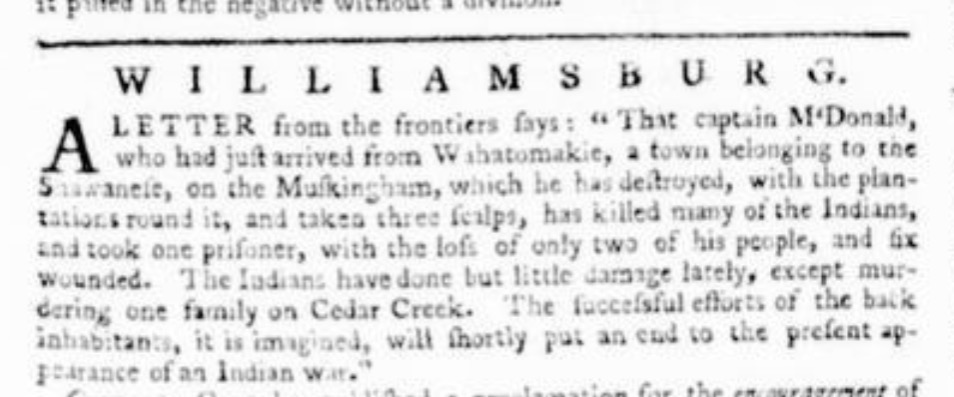
Like the frontier it had long struggled to control, British political authority along the colonial coastline was now migrating beyond imperial reach. While a July edition of the Virginia Gazette defended Boston’s actions as an expression of the “fifth principle of human nature,” preservation, the western frontier confronted a far more immediate struggle for survival.[11]
Across the Muskingum
Roughly six miles from Wakatomika, McDonald’s force encountered an ambush that resulted in the death of two militiamen. Upon reaching the Muskingum on August 2nd, diplomacy was initiated while the river still separated the Virginian force from the main body of the Shawnee-affiliated settlement. After the Shawnee rebuffed demands to surrender Ohio Haudenosaunee to be taken as hostages, McDonald ordered the attack. By the end of the day, Wakotomika was occupied by Virginia forces after fighting “for a good while with the Shawnee and Mingo who were there.” [13]
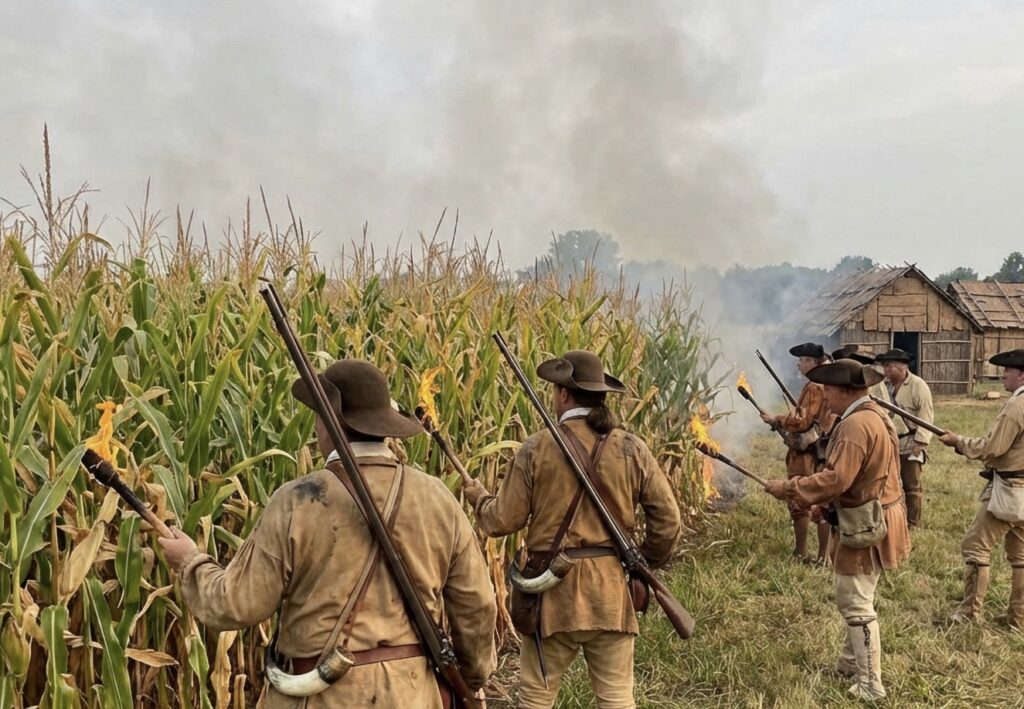
In truth, most residents of the surrounding settlements had fled in the days and weeks before the attack, or during the strategic pause created by the negotiations. McDonald’s militia encamped within Wakatomika overnight. The following day, four of the five settlements recognized by the invaders were burned, and “everything of value” was confiscated or destroyed, including roughly seventy acres of corn.[14] Although this particular episode does not appear in Susan Sleeper-Smith’s work, her research provides numerous examples of frontier settlers exploiting moments of instability to plunder Native towns and appropriate valuable goods, underscoring how the prosperity generated through Native participation in the fur trade could itself become a target of opportunistic violence and material profit in the backcountry.
Their objectives accomplished, McDonald and his force turned eastward to await Lord Dunmore’s advance. With them walked their only prisoner, the Ohio Haudenosaunee man who had conducted negotiations across the river.
Conclusion
Wakatomika was destroyed in 1774 as a town Virginia authorities regarded as hostile. For the time being, Newcomer’s Town — known in the eighteenth century as Gekelemukpechünk — and other nearby communities deemed friendly were spared. Lenape leaders such as White Eyes saw their determined pursuit of peacekeeping diplomacy prevail, if only briefly. Within eight years, however, those same Muskingum villages would suffer catastrophe of their own. In 1782 militia violence culminated in the killing of Moravian Lenape at the Gnadenhütten massacre, a tragedy that revealed how little protection neutrality ultimately offered on the Ohio frontier.
In the summer of 1774, the Muskingum Valley stood at a crossroads between refuge and war. Some communities resisted and were burned. Others sought accommodation and survived, for a time. The march against Wakatomika demonstrated that Virginia was willing to carry organized violence deep into the Ohio Country in a western theater increasingly defined by reprisal. The rivers that had briefly separated negotiation from battle could no longer contain the conflicts that followed.

Notes & Citations:
[1] The original village site was near present-day Dresden in Muskingum County, while the modern community of Wakatomika in Coshocton County was established later and named in remembrance of the original settlement.
[2] Thomas Hutchins, A General Map of the Country on the Ohio and Muskingham Showing the Situation of the Indian-Towns with Respect to the Army under the Command of Colonel Bouquet, March of His Majesty’s Troops from Fort Pitt to the Forts of Muskingham in 1764 (Philadelphia, 1765), Library of Congress, Rare Book and Special Collections Division, https://www.loc.gov/item/2001695748/
[3] “The Delaware Tribe Had Moved from the East into the Muskingum Valley,” The Times Recorder (Zanesville, Ohio), December 3, 1967, 17.
[4] Heckewelder, John Gottlieb Ernestus. History, Manners, and Customs of the Indian Nations Who Once Inhabited Pennsylvania and the Neighbouring States. New and revised ed. Introduction and notes by William C. Reichel. Philadelphia: Historical Society of Pennsylvania, 1881. 230.
[5] Heckewelder, John Gottlieb Ernestus. Narrative of the Mission of the United Brethren among the Delaware and Mohegan Indians, from Its Commencement in the Year 1740 to the Close of the Year 1808. Philadelphia: McCarty & Davis, 1820. 132.
[6] Peter Force, ed. American Archives: Consisting of a Collection of Authentick Records, State Papers, Debates, and Letters and Other Notices of Publick Affairs, 4th ser., vol. 1 (Washington, DC: M. St. Clair Clarke and Peter Force, 1837), 527.
[7] Furlong, Patrick J., and William H. McDonald. Virginia’s Colonial Soldiers. Westminster, MD: Heritage Books, 1988, 142.
[8] ‘Letter from Colonel William Christian to William Preston, July 12th, 1774’ Draper Manuscripts 3QQ6.
[9] “Diary of Schoenbrunn on the Muskingum from May 22–September 12, 1774,” in The Moravian Mission Diaries of David Zeisberger, (University Park: Penn State University Press, 2023), 217, accessed via JSTOR, https://www.jstor.org/stable/10.5325/jj.27939655.14
[10] William P. Palmer, ed., Calendar of Virginia State Papers and Other Manuscripts, Preserved in the Capitol at Richmond, vol. 8, 1773–1778 (Richmond: James E. Goode, 1875), 226, accessed via HathiTrust.
[11] Virginia Gazette (Williamsburg, VA), no. 426, July 7, 1774, microfilm copy, Rockefeller Library, Colonial Williamsburg Foundation Digital Collections, Williamsburg, Virginia, accessed February 20, 2026, https://digitalcollections.colonialwilliamsburg.org/asset-management/2RERYDTDXLT7
[12] Virginia Gazette (Williamsburg, VA), no. 432, August 18, 1774, microfilm copy, Rockefeller Library, Colonial Williamsburg Foundation Digital Collections, Williamsburg, Virginia, accessed February 20, 2026, https://digitalcollections.colonialwilliamsburg.org/asset-management/2RERYDTD66BB.
[13] Force, American Archives, 723-724. “Diary of Schoenbrunn,” 221.
[14] Ibid
For readers who wish to follow ongoing research, subscription is available in the footer.
Leave a Reply